I’ve seen most of Rainer Werner Fassbinder’s big film hits (and his early stuff), but he’s also well known for 2 television miniseries: Eight Hours Don’t Make a Day (5 parts, 1972-73) and Berlin Alexanderplatz (14 episodes, released in 1980). Clocking in at 8 hours and a massive 15 hours, respectively, I went in with patience, knowing, from his previous films, that I’d be rewarded.
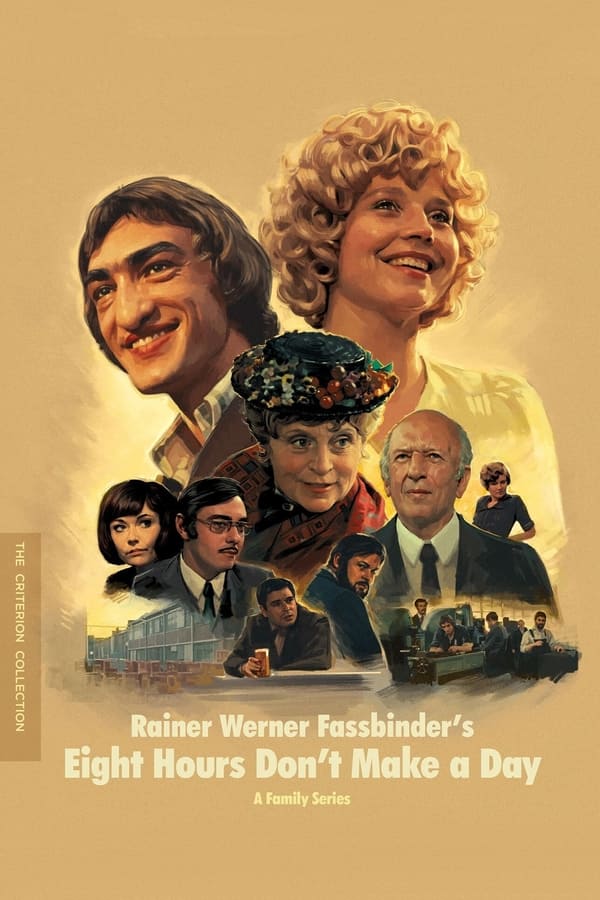
Eight Hours Don’t Make a Day is basically 5 feature length movies, as each episode runs between 1h30m and 1h45m. In the first episode, we meet our characters. There’s a dinner party going on, with Jochen, his parents, his sister and her family, and Grandma, “Oma.” Jochen runs to get some more champaign and meets Marion; it is love at first sight and he brings her to the party, which Oma loves but everyone else thinks is weird. Jochen is a bright guy who works in a metal-making factory, and in fact, he invents a better way to make the latest order. The episode ends with the strong-willed Oma “bullying” a man to be her boyfriend, and then deciding that they need to get a place together.
Episode two focuses on Oma and her new boyfriend Gregor. They are shopping for a dirt cheap apartment they can afford, and this presents the opportunity for a lot of humor. They also start an illegal kindergarten to give the kids somewhere to go, rather than play in the street. After some fights with the authorities, they do finally get approval on their kindergarten, which gives them a small salary, enough to finally get a place together. The third episode goes back to Jochen, this time looking more at his workplace. His friend Franz wants to become the new foreman, but he doesn’t have the math skills to calculate the parts correctly. Jochen, feeling powerful after the success at resolving the work issue in the first episode, gets his coworkers to put pressure on the foreman who was hired from outside the company, hoping Franz can still get that job. There’s a funny side story involving Oma again, who thinks her son-in-law (Jochen’s father) is too despondent since she moved out and he lost his “arguing partner.” She takes out an ad for a quarrelsome grandmother who can live with her son-in-law, to take her place.
The fourth episode features the start of a new marriage, and the collapse of another. Marion’s long-roaming mother comes home, and while she initially doesn’t like Jochen, he grows on her. Though everyone initially thinks it is a mistake, Jochen and Marion get married. At the same time, Jochen’s sister Monika has decided to divorce her abusive husband Harald. He resists, not because he still cares for her, but because he’s spiteful. The episode ends with a large party to celebrate Jochen’s and Marion’s marriage, where all of their family, friends, and coworkers all come together for the first time in the series. At the party, Aunt Kathe and Oma are able to convince Harald to agree to the divorce. A lot goes on in the final episode. Jochen’s bosses want to move their plant across town, and all the workers fight it. Marian’s coworker and one of Jochen’s coworkers, who met at their wedding party, get serious. Jochen’s best friend falls for Monika, but she seems taken with someone else. Can everything get wrapped up in the final 90 minutes?
I thoroughly enjoyed every minute of this series. So very funny, endearing, and maybe best of all, the feeling of a human connection is palpable. After so many hours with our characters, I felt like a member of the family. By the end, I was invested in their outcomes, and wanted the best for all of them. Even the ones who weren’t necessarily good people (Monika’s husband Harald) were shown as flawed humans, but not irredeemable. It’s a wonderful miniseries: no “action,” no outlandish plot elements, just real people living their lives, seeking happiness at home and at work. ★★★★
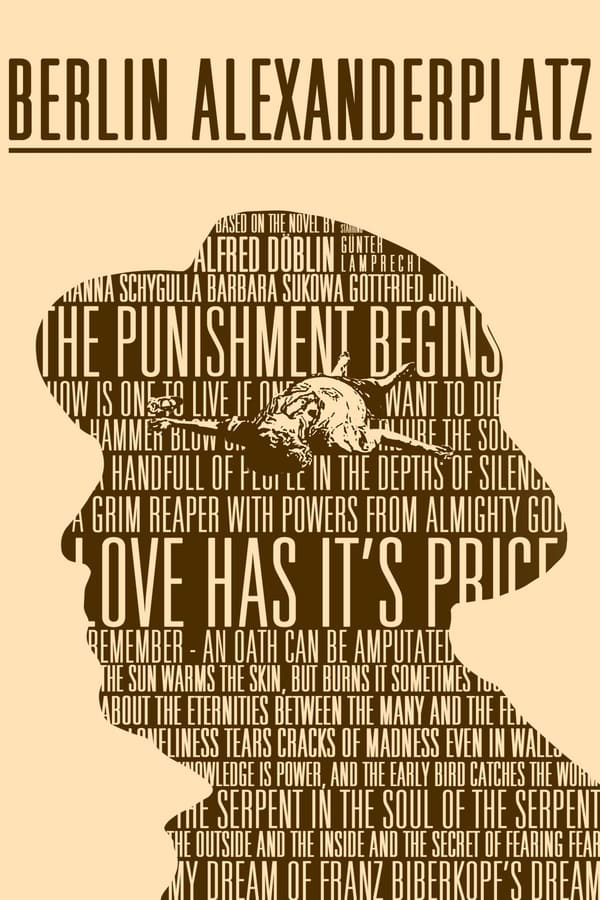
The previous series was released in 1972-73. Fassbinder had had a minor local hit in with The Merchant of Four Seasons, but he was still building a fandom. By the time Berlin Alexanderplatz aired in 1980, he was a star, with a couple internationally acclaimed films under his belt. Starting in 1928, this series follows Franz Biberkopf, a man newly released after serving 4 years in prison for killing his girlfriend. This series is longer, but easier to watch in short spurts; except for the first and last (epilogue) episodes, each of the rest was only an hour long.
The first couple episodes show him getting his bearings in a world that has changed quickly. Franz initially struggles for a secure foundation, trying to go clean after vowing to himself that he will not risk going to jail again. He has a quick affair with his dead girlfriend’s sister, something that seemed to be going on from before his arrest, but eventually settles for a Polish girl named Lina. After a couple jobs don’t pan out, he lands a job through Lina’s uncle Otto, selling shoelaces door-to-door. This leads to his downfall though: the first door he knocks on belongs to a widow who thinks Franz looks just like her departed husband. She lets herself be seduced, and when Otto hears of it, he goes after her too, expecting the same treatment. When he doesn’t get it, Otto roughs her up and robs her. This setback spirals Franz into depression. He leaves Lina, and goes and rents a single room in a flat. Franz drinks all day and night, is delirious half the time, and only slowly is brought back to life through the help of a kindly man who refuses to give up on Franz.
Those first couple episodes were a bit tough to get through for me. I couldn’t connect with Franz at first, but in the fourth episode, with his crash and resurrection, the show started to hit its stride. At the beginning of the fifth episode, Franz has returned to his friends and is ready to find life again.
The fifth episode introduces Reinhold; Franz and he hit it off and become fast friends. Reinhold can only stay in a relationship for a couple months and then is ready to cast off the girl for a new one. Franz is willing to take Reinhold’s leftovers. This provides a humorous (if sexist) diversion for an episode, before the drama returns. A man named Pums is running some kind of illegal operation in the area, employing many of Franz’s friends, including his long-time best friend, Meck, and Reinhold. Franz resists joining, keeping to his vow made to himself in the beginning. He inadvertently ends up on an illicit mission one night, and Reinhold (literally) casts him aside, pushing Franz out of a moving vehicle. Franz is hit by another car, and ends up having his arm amputated. Franz recupes with a woman who once carried a flame for him named Eva, even as Pums, Reinhold, and that crew decide what to do about him, since he knows a bit about their business now.
At the start of the eighth episode, Franz has decided that going straight has not worked out for him, and despite warnings from his friendly bartender Max, Franz starts working with Willy, a local crook. Franz does seem to finally find love though, when Eva introduces him to Mieze, and the two fall for each other quickly. However, it turns out Meize is just like Eva and Ida, and is a prostitute. Franz becomes her defacto pimp, just as he was for Ida before he killed her, and it seems his life has come full circle. Will things turn out the same as they did for Franz and Ida? It looks like they may, as Franz becomes jealous of a rich man Meize starts seeing at the end of the tenth episode.
The eleventh episode heralds that the end is nigh. Franz wants back in Pums’ gang, but Reinhold thinks that Franz has ulterior motives, namely, retaliation against himself. Franz is nothing but friendly with Reinhold though, inviting him over to his apartment. While there, Franz has a blowout fight with Meize, when she tells him she’s fallen in love with another man. Franz savagely beats her, and would have killed her just as he did Ida if Reinhold weren’t there to stop it. Like most abused women, Meize takes Franz back, and the episode ends with them frolicking in the woods.
The final 2 episodes and epilogue, I’ll leave to you to watch if you are interested. Reinhold will obviously play a bit part before the end, as well as Meck and Eva, the girl that has known Franz the longest. The final film-length epilogue has Franz wandering in a Fellini-esque dreamlike state through heaven and his own mind, even as his physical body recoups in a hospital. It’s a great series, about man’s struggle against the forces of fate, friendship, human’s fallacies, and even himself. The cinematography and “feel” of the series is better than Eight Hours; you can definitely see how Fassbinder has developed in those intervening years. I think Eight Hours is maybe more enjoyable from a pure story standpoint, but Berlin Alexanderplatz is the better overall project, with so many intertwining threads and characters that weave in and out over the course of its 15 hours. In Berlin, the story is secondary to the life and soul of Franz Biberkopf. It’s a true masterpiece. ★★★★★
- TV series currently watching: The Boys (season 1)
- Book currently reading: The Sword of Shannara by Terry Brooks

 Jons Movie Takes
2 thoughts on “Quick takes on 2 Fassbinder series”