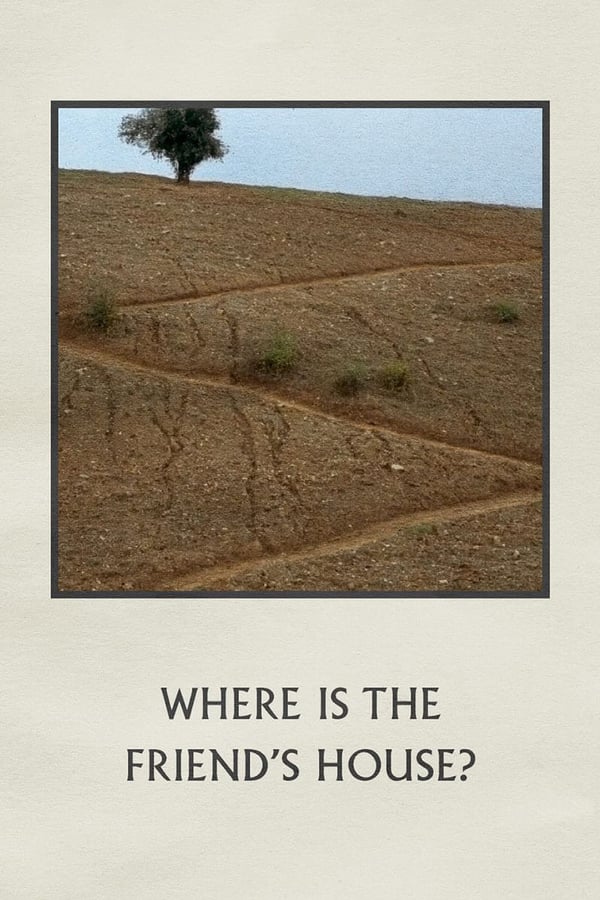
I’ve heard a lot about Iranian film director Abbas Kiarostami, but have never seen anything from him before. Time to rectify that, starting with Where Is the Friend’s Home?, released in 1987. It’s a very quiet picture, one of those films where the journey is more important than the destination. The plot is simple: Nematzadeh keeps getting in trouble at school for leaving his workbook at home, and finally the teacher threatens expulsion if it happens again. That night, his deskmate, Ahmed, realizes he’s taken Nematzedeh’s workbook home with his stuff. Wanting to save his friend from trouble, he goes to find him, but unfortunately, he only knows that he lives in the next village over. Taking place in the rural Iran countryside, where life is simple and the year could be anything from 1887 to 1987, Ahmed must deal with adults who don’t listen to his voice, to other kids who may or may not be the most willing to help, to his own parents who try to keep him busy with what they think is best. This is one of those films which is best viewed with a quiet mind, and just let it wash over you. Though Kiarostami has been around a lot longer, it reminded me a lot of Nuri Bilge Ceylan’s films. There’s nothing that grabs you and shakes you to pay attention to, but nevertheless it sticks with you long after it’s over. ★★★★½
Three years after Where is the Friend’s Home?, northern Iran was hit by an awful earthquake. In And Life Goes On (also called Life, and Nothing More), a man is traveling, with his young son, through this area. At first, we aren’t aware of his destination, but we learn after awhile that the man is a fictionalized version of director Abbas Kiarostami, and he’s trying to get to Koker to see if the young actors from the first film have survived the devastating earthquake. Having the son present adds some of the same “through the eyes of a child” aspect as the first film, but as the title suggests, it is overall more about the perseverance of the people of this region, dealing with the loss of loved ones, and in some cases, their homes and all of their worldly goods. The movie plays out as a quasi-fictional documentary, with “the director” stopping to chat with survivors on his way to Koker, asking about the boys he’s searching for, but also just getting an idea as to what the people have been through. The people he’s talking to are actors of course, but they are also legitimately from this area (as were the characters in the first film), and have recently survived the earthquake themselves, so the film hits hard in multiple ways. Another beautifully soft and touching film, showing people coming together to face tribulations as one. ★★★★
Ok, stay with me on this one, because for Through the Olive Trees, the final film in this “trilogy” of sorts, Kiarostami pulls back multiple layers for the viewer. A new actor introduces himself to us in the opening monologue, and states he will be playing the part of the director this time. He is outside Koker to film a movie, and we learn later that the film he is making is in fact And Life Goes On. Besides the (new) director, one of the main characters this time is a man, Hossein, who was interviewed by the (first) director in the previous picture. In the film, Hossein plays a man newly married to a woman named Tahereh, though outside of the film, Hossein’s advances have been rebuffed by Tahereh and her grandmother, who doesn’t condone the relationship because Hossein is just a laborer and not educated. Between film takes, Hossein tries to coax Tahereh to give him a chance, but of course, as a viewer, we know all of this is a “picture within a picture” anyway, since the (new) director told us as much in the opening sentences. It might sound confusing, but it is no less heartful of a picture, and the final scene is one of the most (joyous? heartbreaking? depends on how you decide to take it) wonderful moments I have viewed recently. Absolutely pure cinematic perfection. ★★★★★

In 1989, Abbas Kiarostami read in the paper about a man who was arrested for impersonating another Iranian film director, Mohsen Makhmalbaf. The accused, Hossain Sabzian, had tricked a family into giving him some money and said he was going to cast them in his next picture, but to the reporter he claimed to not do it for the money, but only because he loved film, idolized Makhmalbaf, and liked the attention. Kiarostami reached out to everyone involved in the case, and made a movie about it, but in a very non-traditional way. Everyone in Close-Up plays themselves, from the perpetrator, to the family he tricked, to the police, to the reporter, and even the judge in the case. They all reenacted scenes before and after the arrest, but in a wild twist, the judge gave Kiarostami access to the court trial, allowing him to ask questions to the defendant and accusers during the trial. All is shown in the movie. It’s a fascinating way to make a film, and it received critical acclaim around the world, but I found the film much more dry than the previous trio. I can appreciate the art, but the final product was left wanting in my opinion. It definitely blurs the lines between fact and fiction, so it was interesting to watch for that reason. ★★½
The director made another (in my view) masterpiece with 1997’s Taste of Cherry. Like the Koker trilogy, it is a very simple film about the interactions between people (I’ve realized this is an important tenet to Kiarostami’s films). A mostly-unnamed middle aged man has decided to commit suicide. He’s already dug the grave in the hills outside Tehran, and spends the day driving around looking for someone who will bury him after he does the deed, because in his faith, he must be buried in the ground. However, Islam forbids suicide too, so he’s having a hard time finding someone to agree to the job, even when offered a large sum of money. Throughout the film he picks up three walkers to try to get them to help in his quest: a young, shy soldier; a religious student currently attending seminary; and an older man who, coincidentally, also contemplated suicide once upon a time. The film is slow, but for those with patience who will let the film experience happen naturally, it is a profound and poignant look at the psyche of man. Though we never learn why our main character has chosen this path, we learn from him and those he talks to about the differing views of the world around us. ★★★★½

 Jons Movie Takes