Sacha Guitry was a playwright and director in the early 20th Century in France. He wrote and produced several successful plays in Paris, but avoided making movies during the silent era (after watching a couple of his pictures, I see that he loves quick and counterpointed dialogue, which would be impossible to pull off in intertitles) but embraced talkies once they became standard. Today I’ll look at 8 of his films from the 1930’s, culled from the nice sets put out by Arrow Films and the Criterion Collection.

The New Testament is based on a play of his and is pretty much a filmed play, mostly on one set. It follows Jean, a successful doctor, his wife Lucie, and their circle of friends and servants. One day Jean doesn’t come home to a dinner party, but a stranger appears at the door with his jacket. Lucie worriedly goes through its pockets, and they find his last will and testament. Frantic for a clue to his whereabouts, they open it, and find a shock. Jean confesses to having an affair with a woman who (coincidentally?) shares the name with his new secretary, and more than that, admits he knows of his wife’s adultery too, with a (very young) friend present for the dinner party. When Jean swoops through the door, those present hide the will and pretend nothing is amiss. The film is a bit dated, but a lot of the quick dialogue is still funny today. But in an old-timey way, the “play” is entirely spoken, with no real action to break it up. As such, as a non-native language viewer, you are stuck reading constantly. I like foreign films, but it’s hard when you don’t get to actually watch much of what the actors or doing because you are tied to the text at the bottom of the screen. ★★
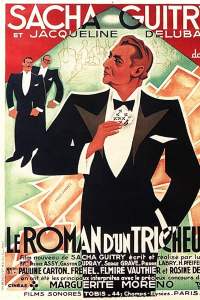
The Story of a Cheat (aka Confessions of a Cheat) is leagues better, and also, I think, way ahead of its time. It starts with Guitry, in voice-over fashion, introducing the actors and film crew who are involved in making the picture, including the composer of the music, the film editors, the producer, etc., a technique that Orson Welles would later famously do as well, and an outside-the-box idea that you can envision inspiring a young Truffaut or Resnais during the French New Wave 20 years later. When it gets going, the film is also very uniquely done. It is entirely narrated by “the cheat,” who is writing his memoir in a café, even going so far as to speak for his actors when they have a line to deliver. He begins as a young man, when he is grounded from eating the mushroom delicacy which was prepared for dinner (grounded because he was caught stealing from the till at his parent’s store), only to become the sole survivor after said mushrooms killed the other 11 members of the family. From then on, our narrator tries to go the straight and narrow path of honesty, but always seems to be pulled into schemes by less scrupulous people around him, from coworkers to beautiful femme fatales. Though we only hear one voice, his, through all of the film, it never gets stale. For one, it is truly funny, not dated at all, and is beautifully written. For two, the story has some fabulous twists and turns that keeps the viewer on his toes as we go through the peaks and valleys of our antihero’s life. I loved every minute of it. ★★★★
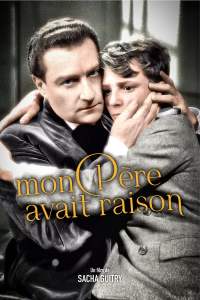
Like The New Testament, My Father Was Right is also based on a play of Guitry’s, and unfortunately the other thing they have in common is being a total bore. There’s even less going on in this film than there was in the first. The overall gist is about learning to live life to be happy and not to worry about what may or may not happen to destroy that happiness. A wealthy man raises his son on his own, after the mother flew the coup 20 years previously, and as a young man, the son has a distrust of women for fear of betrayal. It is up the father to assuage his fears. That’s really it, and it takes nearly 2 hours to get through it. There are some moments of brevity but the whole thing is pretty monotonous. The Story of a Cheat was based on a book Guitry had written, but so far, the two film adaptations of his plays have been a struggle to get through. ★
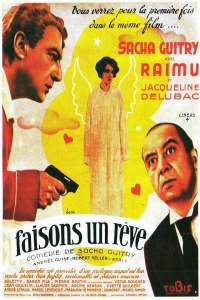
And uh-oh: another play-based film. Let’s Make a Dream comes from a play of Guitry’s from 1916. I settled in with little hope for a pleasant film. Maybe it was the low expectations, but I enjoyed this one! It’s another simple story: a husband is most clearly planning to run around on his wife one night, so she goes off to sleep with a new man of her own. What should have been a quick evening tryst goes awry when they end up sleeping through the night. The next morning, she is distraught about how to go home to her waiting husband, so her new lover plans how to get them off scott free. The big twist is yet to come though! The best part of the film is the long monologues delivered by the lover, both alone to the viewers and to his new girl later. Witty and engaging, it’s a clever and funny picture. I’m not entirely sure today’s average moviegoer would dig it, but the banter is top notch. ★★★
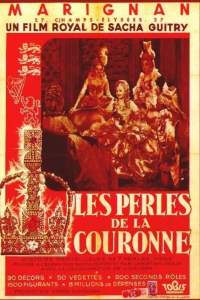
Pearls of the Crown is another original work of Guitry’s, not based on a previous play of his, and it was his most ambitious film to that point. It is the (fictitious) story of 7 pearls, four of which would go on to adorn the crown of England, and the other 3 which seem to be lost to time. Told in flashback over the course of 400 years, the tale jumps countries constantly with a revolving multitude of cast members, and involves kings, queens, mistresses, and popes. Guitry, always playing the leading man in his films, plays 3 or 4 of them here, including King François of France and Napolean III. He brings his trademark irreverent dialogue to this film, but that’s the only highlight. There was so much going on, I felt a bit lost at times. And frankly it’s all a bit boring for too-long stretches. The film has good moments, and some chuckles, but it felt really long, and wasn’t even 2 hours. ★½
Man oh man, I’m up and down with this director. I really liked Désiré, the story of a butler (with the title’s name) who takes a job with a well-to-do society woman named Odette. Odette is dating a politician and runs her household in the strict, time-honored fashion of delineated boundaries between servants and master. Though she is kind to Désiré and the maid, Madeleine, she makes sure to keep them separate from herself and her boyfriend Felix. Désiré comes from a family of valets and knows his place, and he is very good at it, but for some reason, he and Odette share some kind of subliminal attraction to each other: each night, they dream about each other and even call out their names in their sleep, much to Felix’s chagrin. Désiré is aghast at this breach of protocol, as is Odette for much the same reason. The movie is comedy, but also strays towards satire in poking fun at the differences in class. The best scene is the second-to-last act, a dinner party involving Felix, Odette, and a deaf friend, with Désiré waiting on them. It is pure laughs throughout. The ending drops the comedy though, and becomes quite poignant as Guitry screams for equal treatment for the “lesser” class. ★★★
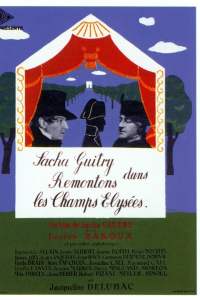
Let’s Go Up the Champs-Élysées is alright I guess. It is very similar to Pearls of the Crown, in that it is a “historical” story, in this case, about the famous venue in Paris and how it came to be, but that is just the backstory. Mostly the film focuses on a few key players, kings of France and whatnot, because the person telling the story happens to be distantly related. The storyteller in this case is a teacher, who is 64 years old today, a significant age in the history of his family. It seems his ancestors always fell in love at 54, and died at 64, so on this special day, he tells the tale of his lineage to his class. It is a long and winding story, made by head spin a bit at times. While not a complete dud, it wasn’t as engaging as the better Guitry pictures, and distinctly lacked the comedic wit of the films I’d enjoyed to this point. I have one more to go to finish this set, I’m hoping to finish with a good one. ★★
Did indeed end on a good note. Quadrille came out in 1938 (can you believe Guitry made all 8 of these films in a 3 year window, 1936-’38?!) and is about a long quadrangle. Philippe is a decent enough guy; he’s always stayed faithful to the woman in his life, though his first marriage ended after she cheated. He’s been with a successful actress, Paulette, for a number of years now, and they are discussing marriage, when her eye strays to a popular (and young) American actor named Carl. She goes and has a one-night fling with him, and the next morning, is torn between returning to Philippe or latching on to Carl for good. When Carl goes off to do his own thing, Paulette begs Philippe to take her back, but for how long? It seems she can’t control herself whenever Carl is around! Tired of her antics, Philippe starts eyeing his own young plaything, Claudine, whom he’s known since she was young but who is now a dashing young woman. As verbose as any of Guitry’s pictures, it was just clever enough to keep my attention. After seeing all these films, I’ve definitely come to know his style. While dated, some of these pictures can still be entertaining if you sit back and enjoy the wordplay, because ultimately, that’s really the focus of all of these films. ★★★

 Jons Movie Takes