 Going to look at some of the most popular films of Ernst Lubitsch. He was extremely popular (and bankable) in his day, but you don’t hear much about these movies anymore. The Shop Around the Corner stars Jimmy Stewart (a few years before It’s a Wonderful Life) and Margaret Sullavan as coworkers in a small goods shop. They can’t stand each other, but unbeknownst to them, they’ve been writing anonymous letters to each other through a post office box and falling in love with that ideal person. The banter between them and the other workers in the store is fantastic, and there’s a whole plot involving the owner of the store (Frank Morgan, more popular known as the Wizard himself in The Wizard of Oz), and the owner’s wife having an affair with one of the other employees. But the developing love story between our two leads is the real draw. A very popular film, it was remade a couple times, into In the Good Old Summertime (starring Judy Garland) and, most recently, You’ve Got Mail with Meg Ryan and Tom Hanks. Though Mail credits the original play as its inspiration, it obviously draws heavily from this film (and if you remember, the bookstore that Meg Ryan’s character owns is named “Shop Around the Corner”). ★★★
 The above film is from 1940, but a lot changed between it and 1933’s Design for Living, specifically, 1933 is pre-Hollywood Code. As such, more than just innuendo about sex, we get straight up talk about sex and straight up (off camera) sex. And it’s funny too! This film is about a girl, Gilda (Miriam Hopkins), who ends up on a train to Paris with a couple of men, roommates named Thomas (Fredric March) and George (Gary Cooper). Gilda is a successful corporate artist in advertising but the two men are struggling in their artistic endeavors, Thomas as a playwright and George as an artist. Each of the men instantly fall head over heels for the beautiful and vivacious Gilda, and in wonderful pre-code fashion, she’s not timid or shy about her own needs: she wants them both! The two men try to put bros before hoes and shake on not pursuing the girl, but neither can keep up his end of the bargain. When Thomas goes away to London to open a play, Gilda starts sleeping with George, but romps with Thomas when he comes back to visit. The film is delightfully funny, and though I haven’t seen a lot of pre-code films, I think they are so far ahead of their time in depicting strong women who stand up for themselves and what they want, physically and otherwise. It’s a fantastically fun film, based on a play by Noël Coward (loved the stuff David Lean did based on his plays). Unsurprisingly, when the Hollywood Code hammer came down the next year, Design for Living was banned by the Catholic League of Decency. ★★★★
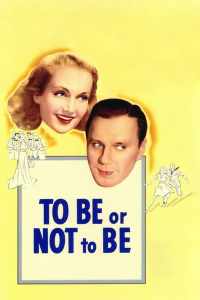 Imagine the deftness of writing and direction it takes to combine nail biting suspense with laugh-out-loud comedy. That’s what is found in To Be or Not to Be. The film follows the actors of a small theater in Warsaw, Poland, in the days leading up to and just after the Nazi invasion. Josef Tura (Jack Benny) is the leading man, supported by his wife Maria (Carole Lombard). Maria meets with a young Polish airman in her dressing room each night during the performances, and once the invasion begins, the young man goes to England where he can fight the Germans. There, he meets a Polish resistance leader, Professor Siletsky, and gives him a message to give Maria. However, Siletsky is actually a spy for Germany, and has been gathering intel on those Polish citizens who have gone over to fight against the invaders. Back in Poland, Josef and Maria have been doing what they can to support the resistance, and now take it upon themselves to kill Siletsky before he can pass on his intel to the gestapo. Sounds dire, and it is, but this black comedy is also incredibly funny. The comedic lines are delivered perfectly, at unforeseen moments, so that even when you are leaning forward during a tense exchange, when the actors are in very real fear of death, something will be said that will ease the tension and produce a laugh. Done poorly, and either the drama or the comedy suffers, but nothing is done incorrectly in this film. It all goes together so wonderfully. If the writing isn’t perfect, or if the direction isn’t spot on, or if the lines aren’t delivered just so, a movie like this could be a mess. Instead, it all comes together to brilliance. The film was not well received when it was released in 1942, it was after all satirizing the Nazi party when they were doing some very terrible things. But seen today, it is a whole other story. On a side note, Lubitsch (a German-born Jew who was a successful director in Germany before the war, and in Hollywood during it) was particularly despised by Hitler, who used Lubitsch’s face in propaganda pictures. ★★★★★
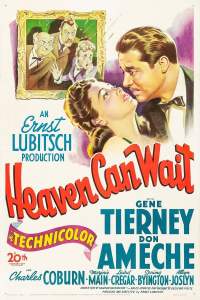 Heaven Can Wait is the first clunker from this director that I’ve seen. It still has some of the witty dialogue, but wasn’t all that intriguing for me. An old man has just died and rather than arrive at the pearly gates, he gets to the one place where everyone in his life has told him to go. At hell’s vestibule, Henry is greeted by a suave and welcoming Satan, who admits he isn’t familiar with Henry’s credentials to get him into hell. Henry begins to recount what he believes is a bad life, starting with being a naughty child, and then into adulthood, where he ran away with his cousin’s betrothed, only to continue his dalliances (off-camera of course). Henry always had a way with words, which kept him out of serious trouble throughout his life, and he uses them to save his marriage. Henry is portrayed by a young Don Ameche, who I recognized immediately from films of my childhood (Cocoon and Trading Places – one of my favorites as a kid). But nothing is memorable about this film unfortunately. ★★
 Cluny Brown is a young woman, niece to a plumber, who isn’t afraid to do things for herself (and in fact, loves crawling under a sink and fixing a leak herself). When she responds to a service call in place of her uncle and does just this, she meets a foreigner named Mr Belinski, who is in London in hiding from Hitler’s Nazis. Mr Belinski is smitten with the modern Cluny, and fate brings them together again when they meet in the country, after Cluny is there to become a maid and Belinski is again in hiding. Cluny tries to do what she thinks is proper and has a date with the local pharmacist, but Belinski tries to convince her that the man is not for her, with his staid and unadventurous lifestyle. It’s a very nice romantic comedy, with Lubitsch’s trademark risqué interchanges. And holy cow, how did some of this dialogue get past 1940’s censors?! There’s a delightful scene where Cluny is thanking Mr Belinski for meeting him in the city and rolling down her stockings and banging it out (meaning the plumbing) within earshot of the housekeepers, who are obviously flabbergasted. The dialogue is the best part of the film, as the story is a little too expected. Nuts to the squirrels! ★★★½

 Jons Movie Takes
One thought on “Quick takes on 5 Lubitsch films”