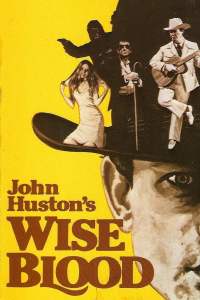
 I thought it’d be nice to watch some film adaptations of some of these books I’ve been reading. Wise Blood, directed by famed actor and director John Huston and released in 1979, is based on a book by the great American writer Flannery O’Connor. I didn’t read this book, but I did read her famous book of short stories, A Good Man is Hard to Find. This film is about a man recently released from military service, Haze, who has lost all faith in faith, if you catch my meaning. We see in flashbacks that his dad was a charlatan preacher, and after witnessing another man pretending to be a blind preacher as well (basically panhandling), Haze decides to start a new kind of church. He starts the “Church of Christ Without Christ” and tells people they don’t need Jesus, and to only look out for themselves. Along the way, he continues to cross paths with the blind man and his daughter, who is obsessed with getting Haze in the sack, as well as a local boy who finds his own personal Jesus in the form of a mummified corpse at the local museum. Its zany adventures and characters remind me of a Coen Brothers film, so fans of theirs should check this out. I definitely see some inspiration there. Good cast too, starring Brad Dourif as Haze (most well known as stuttering Billy from One Flew Over the Cuckoo’s Nest), as well as Harry Dean Stanton and a small part for Ned Beatty. ★★★½
 I did read The Grapes of Wrath, and this film version came out just a year after the book, in 1940. It stars Henry Fonda in a younger role as Tom Joad, and is directed by the great John Ford. The film is a pretty faithful adaptation of the book, so you can just read my blurb there. Obviously it is a shortened version, and my only gripe is the film feels rushed. And they did move some stuff around, to give the movie a more uplifting ending. In the film, the family finds itself at the government camp near the end instead of shortly after arriving in California. This lets them end on a good note, feeling some hope for the future. The only hope in the book is the hope that man will continue to help each other through even the worst of times. The film completely eliminates the final chapters of the book, when the Joad family hits rock bottom and is starving, as well as Rose of Sharon delivering a dead baby, and the famous, iconic final scene. Still, the movie is very well done for what it is, and is well deserving of being heralded as one of the great classic American films of all time. ★★★½
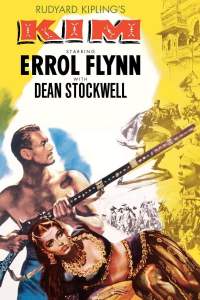 It’s been awhile, over 5 years and about 100 books ago, since I read Kipling’s Kim. I remember the gist of it, and recall really enjoying it. The film adaptation from 1950, starring Errol Flynn and a young Dean Stockwell, has the look but missing some of the magic of that great novel. The basic premise is the same: a young Irish-born orphan is living on the streets in India, and has absorbed local cultures and customs so much that people think he is an Indian. He falls in with a holy man, a Buddhist lama, who is seeking a river of enlightenment. At the same time, Kim is aiding a horse trader/British spy known as the Red Beard, who is covertly battling against Russian invaders for land in the Afghanistan region. It isn’t long before Kim is recruited by British spies for “the Great Game” in the the battle for control over the area. The film has the basics of the book down, and because much of it was filmed in India (no small feat in 1950), it has brilliance and vibrancy that sucks you in from the opening scenes, but it seems to lose something halfway through. It comes off as a typical Hollywood flick, and doesn’t give its characters space to breathe. And though my memory may be a little fuzzy, the latter half seems greatly different from the book. Whereas the book left the reader thinking about the larger picture, the film is more cut and dry. Certainly not a bad flick, but it doesn’t live up to the source material. ★★★
 1984 sticks to George Orwell’s novel pretty closely. In a dystopian time, Winston Smith feels rebellious towards the ever-watching Big Brother, and he knows that much of what he is told is not real at all. He finds a like-minded woman in Julia, and despite relationships like this being outlawed, they begin a covert love affair, meeting above an old shop in the “prole” district, where cameras and microphones aren’t around to capture everything. Just when Winston starts to dig more into a supposed rebellion movement, he and Julia learn that they’ve been under surveillance all along, and Winston now faces torture and, worse, mind controlling changes to force him into party lines. The film is great, led perfectly by John Hurt as Winston, and if it had been an original picture and not based on an amazing book, I’d probably rate it higher. But as good as it is, it isn’t quite as good as the source material. Winston does narrate some of his thoughts to us viewers, but you just can’t get into his head as you can in a book. Still, a very enjoyable picture, that speaks more today than it did when the novel first came out. When today’s politicians say one thing, and then later deny ever saying it, sprouting “fake news” when confronted with proof, it isn’t all that different from the terrible and scary future depicted by Orwell in 1949. ★★★★
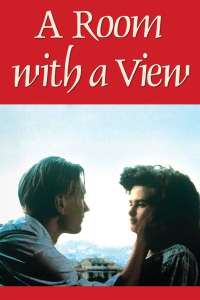 A Room With a View is based on the book by EM Forster, and stars a 19-year-old Helena Bonham Carter in her first film role. Lucy Honeychurch is a young woman from a well-to-do family, traveling in Italy with her cousin Charlotte as chaperon. In Italy, the two women meet Mr Emerson and his son George (Julian Sands). Mr Emerson sees George has an instant attraction to Lucy, and implores her to get George to come out of his sullen ways. Out on a picnic one day, George steals a kiss, seen by Charlotte, so she rushes Lucy away. They return to England and Lucy does the proper thing, getting engaged to Cecil (Daniel Day-Lewis), a suit with nothing to offer the world except his money and position. It is to be a marriage for society and not for love, in fact, their first kiss is awkward and lacking the passion Lucy shared with George. Lucy’s mother isn’t fond of Cecil either, thinking him standoff-ish towards the “new money” Honychurchs. Lucy’s little world is thrown in disarray when, seemingly by fate, the Emersons rent a nearby villa, and Lucy must confront George again. The film Howards End was done by the same director (James Ivory) and lead (Bonham Carter), and in that case I liked the book more. Here, while I did enjoy the book very much, the film is absolutely perfect. It is charming, funny (with a lot more humor than I remember from the book), emotional, and richly detailed in both scenes and dialogue. A wonderful film, with a top-notch cast including the above before-they-were famous trio and supporting roles by established stars Maggie Smith, Judi Dench, Denholm Elliott, Simon Callow, and other recognizable faces. ★★★★★
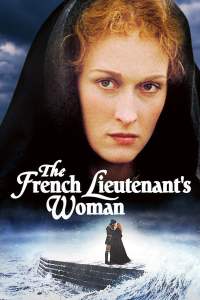 Followed up with another period drama, The French Lieutenant’s Woman, based on a book I was lukewarm to when I read it. Unlike the two previous films above, this one is not a strict adaptation. This is a film-within-a-film with two timelines. In one, we see the story from the novel, featuring the love affair of Charles Smithson and Sarah Woodruff. The other shows the actors playing these characters, Mike and Anna, and their own clandestine tryst. Inside the movie, Charles ultimately ends his engagement to a high society woman to pursue Sarah, a so-called town whore, of whom it is whispered she once slept with a ne’er-do-well Frenchman passing through the village. Outside the movie, Mike is head-over-heels for Anna, but she is married and does not look to be leaving her French husband anytime soon. The correlations between the two narratives are pretty obvious. Though not exactly faithful to the book, the two stories were done on purpose; since the book had 3 endings, they can simulate a similar feel by having 2 distinct stories going on in the movie. I found the book overly wordy and the author prone to long philosophical discussions, and enjoyed the film much more. The converging separate plots come together cleanly in the end, and Meryl Streep and Jeremy Irons are splendid in the two leads. Release in 1981, it is early in their long and storied careers. ★★★½

 Jons Movie Takes
One thought on “Quick takes on 6 films based on books”