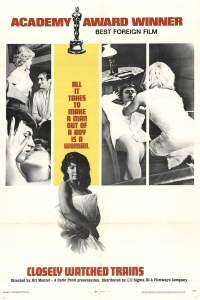
Closely Watched Trains may be one of the finest films to come out of the “Czech New Wave” film movement. Released in 1966 and directed by Jiri Menzel, it follows a young man/late teenager named Milos Hrma who’s gotten his first job as a train porter. It takes place in a tiny town during World War II, while his country is under Nazi occupation. He’s only occupied with the things kids his age are always are, namely, getting laid. He wants to sleep with a pretty young local girl, but is scared to make a move and doesn’t know how to do so, it being his first time and all. After their first awkward attempt, he even attempts suicide but is saved by an onlooker. The doctor tells him he is just suffering from premature ejaculation, and to find an older woman for his first experience, who can “show him the ways.” Through all this, it turns out the other workers at the train station are involved in the resistance movement against the Nazis, all completely oblivious to the sex-crazed Milos. It’s a funny film and typical of the New Wave movement, but also very heartfelt and, in the end, very sad and endearing. A lovely film (it won the Oscar for Best Foreign Language film) from a country I’ve had next-to-zero experience from before. ★★★★
 Before Milos Forman won a couple Oscars for One Flew Over the Cuckoo’s Nest and Amadeus, he made a name for himself in the Czech New Wave in his native Czechoslovakia. On the surface, The Firemen’s Ball is a screwball comedy. A group of local firefighters is throwing a big retirement party for their outgoing chairman, and the whole troop is a bunch of bumbling idiots. The main sources of laughs come from people stealing prizes from the lottery table all night, and the lecherous old men ogling over very young women for the beauty contest to be held. But the comedy is only so light-hearted, once you realize Forman was making fun of the Communist party in control of Czechoslovakia. In fact, the film was banned in his home country for a long time. The Fireman’s Ball was his last film made there before coming to the USA. While away scanning locations for his next film in 1968, Prague was invaded by the Warsaw Pact of countries, including the USSR. He obviously did very well in America, but this was a great film and a lasting piece of that era. ★★★½
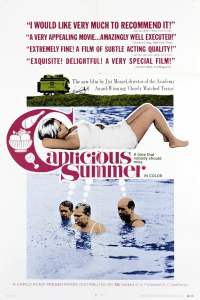 I liked Jiri Menzel’s above film so much that I hunted down another. Unfortunately Capricious Summer doesn’t come close. Released two years after Closely Watched Trains, this film is about three middle-aged men, life-long friends, as they relax on a summer retreat. They debate life and poke fun at each other as all friends do, but their relaxing days are thrown into disarray when a traveling circus performer comes to town. The one married man of the trio sees his wife fall for the performer, while the three men all vie for the attention of his lovely young assistant. I chuckled a few times, but found myself bored for way too large of a portion of this picture. ★
 Just as I loved and hated two films of Jiri Menzel’s, I loved and hated films by director Jaromil Jires. A few months ago I saw Valerie and Her Week of Wonders and it did nothing for me. I gave him another chance for The Joke, and this one was great. It is about a man who writes a questionable joke to his girlfriend deriding the Communist party, and when it becomes public, he is sentenced to 6 years in a “rehabilitation” army, which is basically prison and manual labor. The movie shows the events of then, and also ten years later when he returns to his hometown to enact a revenge, though on who and for exactly what we are not quite aware yet. The movie is narrated by our main character, and in a cool new wave-y style, we see “current” Ludvik watching events from the past that merge with his modern setting. It sounds weird but makes sense when you see it. The film is very obviously anti-Communist party, and since it was completed just before the Soviet invasion, it was banned and shelved for 20 years. Whereas many directors from the country would flee to continue making the movies they wanted, Jires stuck around and made less controversial films until the party fell apart in the late 80s. ★★★½
 Pearls of the Deep is an anthology film, made up of 5 short skits based on a book of short stories by Czech author Bohumil Hrabal. Each part of the film has a different director. Like most anthology movies, it is a bit uneven, but overall it is a nice picture. The Death of Mr Baltazar, directed by Jiri Menzel, shows a group at a motorcycle race, each person one-upping another with wild tales they’ve witnessed, before the eponymous Baltazar crashes in the race. The Imposters (director Jan Nemec) is about a pair of dying old men in a hospital, telling each other of their exploits in life, before we find out later from the coroner that the stories were all made up. The House of Joy (director Evald Schorm) follows a couple insurance salesman who get more than they bargained for when they try to sell man who sees himself as an important artist more than a goat pelt producer. The Restaurant of the World (director Vera Chytilova) takes place in a restaurant one night when a woman is found having committed suicide, while a wedding party celebrates outside. Finally, Jaromil Jires’s Romance is a fun romp, about a beautiful young gypsy girl who offers her body to a passing young man in exchange for some new clothes from the department store, but he gets more than anticipated when they quickly fall in love with each other. Parts of the film were good (some very good, particularly Jires’s finale), and as a whole there is a sense of railing against the establishment. Unfortunately for these directors in 1965, they would lose the ability to openly do that very soon. ★★★

 Jons Movie Takes
One thought on “Quick takes on 5 Czech films”