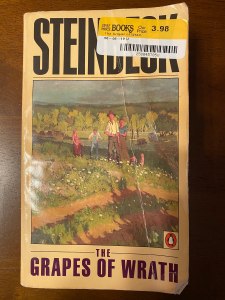
During the journey through these 100 books, I’ve read a lot I’d never been through before. I did however, once upon a time way back in high school, read John Steinbeck’s The Grapes of Wrath. It was so long ago that I only really remembered that it was a tragedy of epic proportions, and that nothing good happened to the family it centered on. Reading it now over 20 years later, it was fresh for me, but reaffirmed those memories.
The book focuses on the Joad family out of Oklahoma. The family consists of Ma and Pa, Pa’s brother Uncle John, the Joad adult children Al, Tom, Noah, and Rose, and the smaller children Ruthie and Winfield. Rounding out the clan is Pa’s parents, Granma and Grampa, Rose’s husband Connie, and family friend (and former preacher) Casy. The family has lost their farm due to years of declining crops as a result of the dust bowl, and are now being kicked off the land. Latching on to handbills that have been circulating promising work in California, they use a bit of saved money to buy an old jalopy of a truck, pour all their worldly possessions on it, and start the cross country drive, with less than $200 to their name.
Of course, everyone in the book has their issues, which I won’t get into here, but suffice to say, each member of the family has something they are dealing with, which they will each have to face (or choose to ignore) before the end. But don’t expect any good, happy endings here. Steinbeck wrote the novel to shine a light on the calamities faced by a good portion of our country during the great depression. The only good you see is the goodness that exists between people facing hardship together, both within the family, and from others facing the same problems. Even when they having nothing, they share what they can with others in need. But the hardships do pile up for the Joads.
On the journey west, Grampa (on the first day) and Granma (later on) both die. Noah gets fed up with the problems they are facing together and heads out on his own, with nary a goodbye to his family. Connie abandons his pregnant wife, Ruth, shortly after arriving in California. Once the Joads are there, they find, of course, life isn’t any better than what they left. The fliers promising work brought hundreds of thousands of people in situations like theirs, which has allowed the farmowners in California, mostly large corporations, to drive down workers’ pay to as little as a dollar a day in some places. People fight for even those jobs, because the only other option is watching your family starve. Most cannot find work at all.
The Joads do find a bit of luck at first, and are able to stay at a government assistance camp on their second day in California. It has running warm water, toilets, and a nice communal environment where people look out for each. But there is no work close, so 6 weeks in, they are completely broke. They use their last dollar to put some gas back in the truck, and leave to find work, and what little luck they found runs out. Casy is killed in an altercation with some local militia/hoodlums, and Tom kills the attacker, forcing Tom to go into hiding, later leaving the family to keep them safe. A huge rainstorm floods the area the family has been staying, destroying the truck and all their goods. Al leaves to marry his own girl, and Rose gives birth to a dead baby, probably from lack of proper nutrition. With nothing but the clothes on their back, Ma, Pa, Rose, Uncle John, and the little kids walk up the road and take shelter from the continuing rain in a barn. In these final pages, the most iconic image of the book takes place. They find a young man and his ill father, dying of starvation. Ma and Ruth share a knowing look, and Ma ushers everyone out while Ruth offers her milk to the man.
What can I say, it’s Steinbeck, so of course the novel is extremely well written. You get into the heads of everyone, and though the book mostly follows Tom, we see what makes each of them tick. Maybe my only gripe is Steinbeck doesn’t leave much to interpretation, he lays it all out and in some spots, drives home his point by reiterating ideas repeatedly. It’s probably what makes this point so popular in the school setting; it’s a well written book but doesn’t require deep introspective deciphering. Still, if that’s my only gripe, it’s a small one. I really enjoyed the book (again), and its eye-opening look at one of the terrible periods in our country’s history.

 Jons Movie Takes
2 thoughts on “Misery abounds in Steinbeck’s epic Wrath”