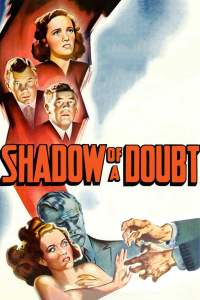
 I’ve reviewed many of Hitch’s earlier films, and now I’m getting into some of his more famous pictures, but still ones I’ve never seen. Hitchcock is on record for saying 1943’s Shadow of a Doubt is his personal favorite. It features a pair of big stars of the 1940’s, Teresa Wright and Joseph Cotten. Charles Oakley is a bachelor from the east who returns to California to visit his sister and her family, including his niece Charlie, who is named for him. Charles seems a charming man, showering the family with presents, but Charlie almost immediately begins to suspect something is up. Things don’t get any better when a pair of investigators show up, under the guise of reporters doing a story about the “all-American family,” and Charles refuses to have his picture taken. When Charlie unearths the real reason the investigators are digging into her uncle Charles, that he is a suspect in murders of wealthy widows back east, she is shaken, but keeps the secret to herself, not wanting to stress her mother in particular. I liked this one quite a bit. It has a lot of heart, a strong plot, and doesn’t have as sudden an ending as many of Hitchcock’s other films; he wraps it all up nicely. ★★★½
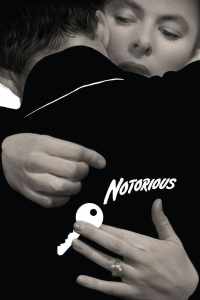 I seem to constantly forget how great Ingrid Bergman was, until I watch a movie like Notorious. Paired with Hitchcock (and America’s) fave, Cary Grant, Bergman plays Alicia, the daughter of a Nazi German spy who’s just been convicted and sentenced for his crimes. Alicia is recruited by Grant’s Devlin, a government agent, to do a mission for the good ol’ USA in Brazil, but even he doesn’t know the details. The pair arrive in Brazil and just as they start to fall for each other, they learn about the job: Alicia is to use her family’s history to get close to Nazis who have fled to Brazil to avoid prosecution, and to seduce one of them who used to have the hots for her, in order to dig up dirt and see what the remaining Nazis have planned. What a tremendous film. Besides the spying and suspense, Devlin is obviously sending out a girl he cares for into a dangerous situation, knowing she’s with another man. He doesn’t want to love her, because he knows about her former partying days, but he can’t help himself. Grant is great as the conflicted lover, it’s hard not to like anything he’s in, and Bergman is eye-arresting in every scene she’s in. Hitchcock often toyed with the Hollywood censors with his sexual innuendo, but he is downright brazen in this film, especially for 1946. It’s a brilliant high-stakes spy thriller, called by some to be Hitchcock’s best. ★★★★★
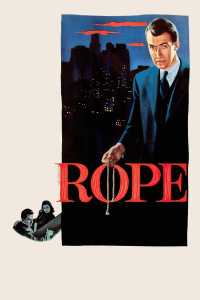 Rope followed in 1948, and was Hitchcock’s first color picture. The picture’s name is used in the opening scene of the film, as a murder weapon. A pair of men have just killed a man, just for the thrill of it, and because of a warped sense of superiority over the victim. They’ve stuffed his body into a large trunk in their living room. To add to their sense of power, they’ve planned a get-together that evening, in the very room where their now-dead friend is lying in his temporary resting place. The film has a lot of comedic wordplay, including lots of morbid humor related to the body a few feet from the unknowing visitors. John Dall and Farley Granger portray the perpetrators, with legendary James Stewart playing a former teacher and intellectual who picks up on the subtle hints that something is amiss. It is a quietly gripping film, with slow-building suspense especially in the latter third. There’s a scene after dinner where the maid is clearing the food off the trunk, in preparation to put some books back into it, all while the guests are chatting about the missing friend, that is pure Hitchcock thrills. The film is a technical masterpiece too. It is shown in real-time and has the illusion of being several long takes, though the length of film did necessitate cuts. It was later edited in such a way to make it appear to be just a couple shots. ★★★★½
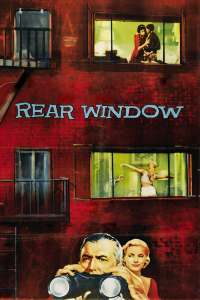 Rear Window is one of the director’s most famous pictures, and one I’m ashamed I’d never seen before. Many people know the gist of the story. James Stewart plays Jefferies, a successful photographer who’s been holed up in his tiny apartment for 6 weeks due to a broken leg. The only thing he can do is look out the window at his neighbors, and he’s followed their routines for these last few weeks. One particular couple, an older man with his nagging wife, becomes the central plot of the film. One night during a particularly bad storm, Jefferies hears a scream, and then watches the husband leave and return to the apartment several times over the course of the night, always with large suitcase in hand. Jefferies thinks the wife’s been killed, and the body taken out in pieces. The next morning, Jefferies tells his physical therapist his little hunch, which she laughs off, but then Jefferies sees the suspected murderer putting away a very large saw and knife, and later, Jefferies’ girlfriend thinks there may be something to it. This fuels his suspicions, and ratchets up the suspense. The final 15 or so minutes is some of the most psychologically scary moments on film that you’ll ever see. ★★★★★
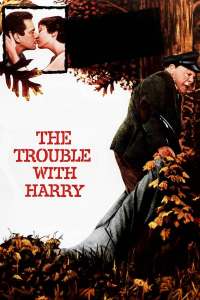 Finishing up with one of Hitchcock’s lesser known films, The Trouble with Harry, from 1955, though it is noted as Shirley MacLaine’s film debut. It is also very different from the above films, and most other Hitchcock movies, as it is a comedy, albeit a dark comedy, and even has a romantic element to it. The trouble with Harry is that he is dead, his body found in the woods, and no one who stumbles across the body (and hilariously, many people do) seems to care too much. No only that, but there is more than one person who thinks they are responsible for the murder. It seems the whole town gets involved in Harry’s business, or lack thereof, before the end. I really enjoyed the first half of this film, but the weirdness of it wore off after awhile. Many (most?) Hitchcock films have some funny dialogue here and there, but this film is the result when you write a movie full of it, and it doesn’t work as well as you’d think. I’ll give it an average rating for the good moments. ★★½

 Jons Movie Takes
One thought on “Quick takes on 5 Hitchcock films”