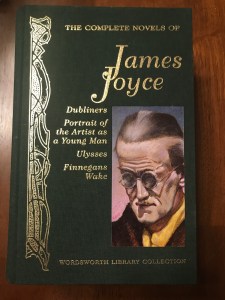
Ulysses. The name itself can send shivers down the spine of any reader, prepared or not. I thought myself in the former group, having already completed other novels of James Joyce (Finnegans Wake and A Portrait of the Artist as a Young Man). Both were challenging (Finnegans Wake is often called the hardest book to read in the English language), but Ulysses is on another level. The book follows a similar structure and shared character profiles of Homer’s epic poem The Odyssey. This is a true masterpiece, written by perhaps the greatest writer of all time. Though hard to read, and even harder to decipher, it is rewarding for those brave enough, and patient enough, to tackle it.
The book takes place over one long day and chiefly follows two men, Leopold Bloom and Stephen Dedalus (returned again from Joyce’s previous novel). It begins with a couple short chapters following Stephen, mostly serving (as far as I can tell) as an introduction to him for people unfamiliar with Portrait. Stephen interacts with some friends and coworkers, and thinks about his mother’s death. It then switches to Bloom, who will be the chief character for much of the book. Bloom is at home in the beginning of a busy day for him. He sorts the newly delivered mail and says goodbye to his wife, Molly, and daughter before heading out for some errands. While walking through town, he reflects on his wife’s affair with her manager, a man named Boylan. He then heads to a friend’s funeral, along with Simon Dedalus (Stephen’s father) and other acquaintances, though being Jewish, Bloom isn’t “one of the boys.”
Bloom has lunch at a local pub, then heads to the library, where he crosses paths with Stephen, who is expounding his theory of Hamlet to his friends. Afterwards, Bloom has dinner at another bar, and sees Boylan head out for his tryst with Bloom’s wife. Bloom goes for a stroll along the beach, masterbating to a pretty young girl he sees with her friends, before visiting a maternity hospital where a young woman is giving birth. Again, Stephen is there too, but while Bloom, as an older man, is worried about the girl and her long and painful labor, the younger and less mature Stephen tells ribald jokes with his buddies. Afterwards, Stephen and Bloom find themselves at a local whorehouse, where each daydream about their past lives, sins, hopes, and dreams. After helping a drunk Stephen home in a very fatherly-like way, Bloom returns home to Molly. Now very late in the day, he crawls into bed with her, while she ruminates about her time with Boylan earlier and her previous loves as a younger girl, before reaffirming to herself and the reader than she does indeed still choose Bloom.
That’s it, in a nutshell. Nearly 800 pages summed up in 2 paragraphs. Reading that, you may think, what’s the point? The proof is in the pudding, or as I like to say, the journey is more important than the destination. Nearly each “chapter” or section of this book, and there 17 or 18 of them by my count, is written in an entirely different manner. One, when the two men are in the whorehouse, is written as a play, complete with stage directions. Another, when Bloom visits the local paper in his wanderings in the morning of the day, is written with headlines and news stories. When they are at the maternity ward, Joyce shows off his mastery of the language by giving us a history of language itself, meaning, the narration changes throughout the chapter in styles of other writers, and even a section that is very Bible-esque in structure. There’s a chapter that is entirely made up of questions and answers, which for me, solved the most riddles contained in the rest of the novel. And in true modernist fashion, the final chapter is nearly completely stream-of-conciousness writing.
Only a few times throughout this expansive book is there traditional, flowing narrative, i.e. Bloom crossed the street, said, “Hello.” to a passerby, etc. Most times we are in his or someone else’s head, as they dream, reflect, consider, pontificate, and otherwise explore the world around them. A sentence grounded in the real world may end, and the next will begin a paragraph of thoughts or imaginations, with nothing to warn the reader that something has changed. I’m not sure I had the same sense of wonder upon completing Ulysses as I did on Finnegans Wake, but there’s no denying that this is a true work of art, perhaps the greatest novel ever written, and worthy of all the praise you’ve ever heard about it. Like Finnegans, I’ll revisit this one again one day, perhaps with an annotated helper to assist me in deciphering its deeper explorations.

 Jons Movie Takes
One thought on “Ulysses is Joyce’s masterful odyssey”