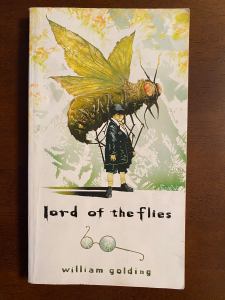
Here’s another book that I somehow got through grade school without reading, but it caught up to me now. William Golding’s Lord of the Flies was one that, frankly, I didn’t enjoy much through a good portion of the book, but it really picked up in the second half, and once I got there, I couldn’t put it down.
The book starts with a group of boys, some “littluns” and some “bigguns,” who have been stranded on a remote, tiny island after their plane went down. There are no adult survivors, so the eldest of the boys set themselves up as leaders. Piggy, called so because of his weight, has the brains but not the charisma, so he sets up his early friend Ralph to lead the group, and everyone elects Ralph as chief. This is to the chagrin of Jack, a brash boy who would like to lead. As consolation, Jack is named head hunter.
Early on, Ralph tries to get the boys to do the important things to survive. He wants to get shelters built, and keep a fire going at all times in hopes that a passing ship will spot the smoke. But he is thwarted early and often. Jack and his followers go on increasingly long hunts, ignoring the fire-building and the work around the camp, and the littluns just want to play, wandering off into the forest so much that no one knows how many of them there are. The smaller boys also start spreading rumors of a beast in the woods, to which Ralph and the older boys scoff. However, one night a fighter pilot parachutes onto the island and dies coming through the trees, and when seen from a distance, the boys all believe that it is the beast. Jack uses this to play off their fears, to get more to join his cause, even going so far as to leave the main camp and build a new one for his followers further up the beach.
By now, Jack has set himself up as a king, and turned his followers into savages, painted faces and all. When a curious boy named Simon goes up the mountain to investigate the beast, and finds it is just a dead man, he comes down to Jack’s camp in the middle of a celebration after a successful hunt. Jack’s followers turn on Simon, thinking in their frenzy that he is the beast, and kill him. Ralph and Piggy now know there is no turning back, and they must confront Jack. When they go to his new stronghold, Piggy is thrown off the rocks and killed, and Ralph runs for his life. He is hunted throughout the day, in a very tense section of the book. Just as his pursuers catch him on the beach, Ralph looks up and sees a ship has found them. The captain walks down the gangplank and see the painted boys who have been chasing Ralph, and guesses that they have been playing, quipping that boys will be boys. Only at the end does Jack realize what they have become, and starts to cry.
As I said, I struggled in the beginning of this one. The narration is stilted and doesn’t flow easily, written in a child-like manner to purposefully imitate the mindset of the boys as they get used to their new surroundings. The style grew on me though, to the point that when the finale hit with Simon getting murdered, and then Ralph’s climactic flee through the forest, I was engrossed. It’s a short book at just 200 pages, and to put it in perspective, it took me a couple days to read the first half and an afternoon to read the second. I saw the movie first on this (the original, from 1963) and didn’t care for it much at the time, but I definitely need to go back and re-watch it now.

 Jons Movie Takes
2 thoughts on “Society devolves to barbarism in Lord of the Flies”