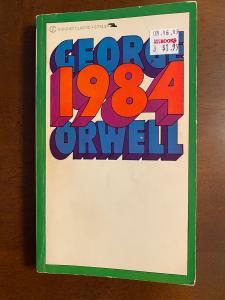
I’ve read George Orwell’s 1984 once before. Though it’s been nearly 20 years, I still remembered most of it, so this re-read was very familiar. This book is a classic dystopian which has influenced a trove of books and films since its release in 1949, and introduced words and phrases into our vernacular that are still in use today.
Winston Smith lives in London, in the nation of Oceania. He thinks it is the year 1984, though as he admits, one can no longer be sure of that. Oceania is a totalitarian state ruled by Big Brother, a shadowy figurehead. All residents are under constant supervision, by the “thought police” who dress as normal people but are constantly surveying for people who stand out from the norm, by hidden microphones that could be anywhere, and even from their own telescreens, which are 2-way televisions in every room (including your home) which constantly display propaganda while also watching what you are doing. Winston works at the Ministry of Truth, which is anything but what it sounds like. The government actively engages in changing history so as to make themselves seem infallible, so if a high-ranking person is arrested as a spy and assassinated, the Ministry of Truth changes all records of that person so that the history books would always say they were a criminal, or if it is a lesser known person, that person just gets erased from existence all together. Books, magazines, and newspapers are completely re-written and movies are re-shot with technology to make everything seem like nothing is wrong, and that Big Brother is always right. The other wings of the government are the Ministry of Peace (which is the military and deals with war), the Ministry of Plenty (which rations out the substandard and too-little food and good to its residents), and the Ministry of Love (which is where the tortures take place).
While Winston goes about his day, on the surface he acts like everyone else, but inside, he knows this is not the way things always were. He remembers a time as a child, before the revolution, when people didn’t eek out a living on low rations, were free to marry who they wanted, and didn’t have to worry about disappearing when the government deemed it so. Though Big Brother says Oceania is at war with Eurasia and has always been at war with Eurasia, he remembers just a couple years ago when Oceania was allied with Eurasia against Eastasia. (In fact, during the big Hate Week annual celebration, when the country comes together in their hatred of their heated rival Eurasia, the target is swapped in mid-speech to Eastasia again, and henceforth, they are allied with Eurasia again. Everyone seems fine with this except Winston). Winston remembers a time when he received at work a picture of well-known party members when they were been awarded esteem, though history now calls them all traitors and enemies of the state. Due to not knowing who he can trust and who is a member of the thought police, Winston keeps all of these feelings to himself, writing only a few things in a diary he keeps hidden in a tiny corner of his apartment that his telescreen cannot see.
Winston’s life changes when he meets Julia. Julia has feelings like Winston, and the two begin a love affair, despite knowing that if they were ever caught, they’d end up tortured and eventually killed. They begin to regularly meet in a poor section of the city, where the “proles” (proletariats, or laborers, who are not part of society) live. This section doesn’t have the security or surveillance that the others parts do, so the couple has at least a semblance of freedom. Their tiny place is a room leased above a vintage shop, the shopowner being just an average prole looking to make a couple dollars. Winston and Julia eventually even manage to make contact with the resistance, and their inside contact is a man named O’Brien who is high up in the party. Just when it seems they might make some headway, they are discovered at the rented room and arrested. The shopowner was a member of the thought police the whole time, and O’Brien was leading them on along.
In the coming days, weeks, and months, Winston is continually beaten, starved, and tortured relentlessly, to the point that when he finally sees himself in a mirror, he thinks he is looking at a dead body. O’Brien tells him that Big Brother doesn’t just kill dissenters, because it has learned from past governments that martyrs will lead to its downfall. It wants people to love Big Brother, so they break people until they do so. They don’t leave Winston alone until O’Brien can hold up 4 fingers, ask how many there are, and Winston not only says 5, but believes it whole heartedly. Not only that, but when faced with the one fear of his life, Winston screams to be spared and to have Julia put in his place. After this, they let him go free. Months later, having regained weight and out in society again, Winston runs into Julia. She has scars from her similar torture and treatment, but they no longer look at each other with love, only with disgust. When Winston sees news that Oceania has won a major victory against Eurasia (because they have always been at war with Eurasia), Winston tears up over his love of Big Brother.
Orwell’s book paints a stark picture of a society where government has thought of every measure to keep people under control. As it details in the book, the three major states of Oceania, Eastasia, and Eurasia aren’t really at war anymore, because each has everything they need and no longer need trade with others to survive. It has been that way for decades, but each keeps “the war” going to keep their citizens in check, to use up supplies to keep production going, etc. The bombs dropped on their cities are most likely dropped by their own government to keep population numbers correct too. The governments have decided that fear and hatred work better than love and respect, and keep pushing the boundaries of acceptable human civilization to control everything. They aren’t content with controlling behavior, they want to control thought. During Winston’s torture, O’Brien boasts that while they’ve already successfully gotten rid of love between couples and have schooled a generation of children to spy on their parents, one day they will get rid of relationships completely, growing children in tubes and outlawing sexual relations. It sounds ridiculous, but the book doesn’t make it seem that far fetched.
Some of this stuff goes on now, so reading the book can seem downright scary. With our cell phones telling people where we are, what we browse, what we buy, and who we communicate with, people can find out just about everything they want about us. News media (and both political parties) do create fear by blowing up stories on a daily basis of invading armies and/or elected representatives who want to destroy your way of life and/or take away your rights. People who live in fear are easy to control. Though the book does get a bit bogged down when Orwell is doing his damnedest to rant against big government, socialism, etc., it is still a great novel. Everyone should read it to know what to look out for.

 Jons Movie Takes
I would say people who don’t live in fear are the ones who are easily swayed and controlled, because they haven’t looked and seen anything bad coming beforehand.
LikeLike