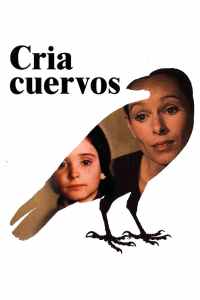
 Up today is 5 Spanish language films (but not necessarily from Spain). I really enjoyed Cria Cuervos, from the great director Carlos Saura (I can’t think of a movie of his I have not enjoyed!). This one is a beautiful blend of realism and a daydream-like fantasy, from the eyes of a young girl dealing with the recent loss of her mom. It begins with Ana (played by Ana Torrent, famous as the young lead actress in Spirit of the Beehive) seeing her father die, but rather than be upset, she is pleased, and believes she is the one who killed him. As Ana’s aunt moves into the house to take care of her and her sisters, what follows is Ana going about her life in the present, but at times she has visions of her mom, or housekeeper, or dad, either memories or, at other times, events that she probably didn’t witness but can imagine how they went down. She sees her mother unhappy in her marriage to a strict military man, and Ana believes ultimately this unhappiness led to her mother’s death, for which Ana blames the father. These serious moments are interposed with moments of play when Ana and her sisters are just the children they should be, playing at dress-up. I cannot stress how much I loved his film, on its own merits, but even more so when you take into context of when it was made. Released in 1975 amid a time of extreme uncertainty in Spain (dictator Francisco Franco’s regime was crumbling, his named successor had already been assassinated, and the country was heading for its first change in leadership in nearly 40 years), this movie too has a sense of wonder, of anticipation, and of hope for a new beginning. Lots of not-too-deep metaphors, such as the death of military/dictator (the dad), the love/hate relationship with that figure (the mom), and the uncertainty of what comes next (Ana). Brilliant stuff. ★★★★★
 For the Luis Buñuel films I’ve seen, they’ve been hit and miss for me. I’ve really enjoyed the more linear plot-driven films, his more traditional stuff, but really hated his more esoteric stuff (I’m looking at you The Milky Way). Viridiana is thankfully of the former group, though not without its controversy at the time. Viridiana is a young nun initiate, ready to take her vows, when she goes to visit her aging uncle. He confesses that he has always been attracted to her because she resembles her aunt, his deceased wife, and begs her to marry him. She refuses, but he drugs her and begins to molest her in her sleep. Even though he can’t go through with it, he tells her he did the next day in an attempt to force her to renounce her faith and live with him. Viridiana doesn’t take the bait though. She gets to the bus station to return to the convent before she is called back to her uncle’s property by the police: they have just discovered he hung himself. His will has split the property between Viridiana and his estranged son, an illegitimate son he never claimed in life. Viridiana clashes with the son over differing opinions about what should happen to the old manor, even as she begins bringing homeless and poor into the home to help their situations. They repay her by trashing the place. The film is completely irreverent from the very beginning, so much so that the Vatican denounced it as blasphemous. It was also banned by the Franco government in its native Spain. It’s a good film though despite that controversy. Really beautiful camerawork and fantastic work by the great Silvia Pinal as Viridiana. ★★★½
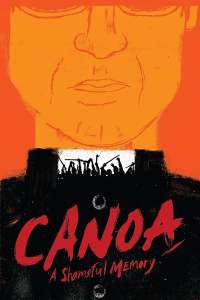 Canoa: A Shameful Memory is a Mexican film recounting the true story of a lynching of 5 young men in the tiny town of San Miguel Canoa in 1976. Parts of the film play out as a quasi-documentary, with actors relating directly to the camera the political environment at this time in Mexico, and others are acted out. Across the country, the state was wary of the rising political power of the younger generation, and spreading fear that they were communists and socialists (sound familiar?). In San Miguel Canoa in particular, a corrupt Catholic priest had stirred people to a frenzy. After the opening narration, the fateful day is acted out. 5 young employees at the university in Puebla come to visit to climb a local dormant volcano, but are stuck in the town overnight. due to heavy rains. While they find refuge in a local farmer’s house, a man who knows the priest for what he is, the priest stirs up the local population with news that the communists have finally come to their peaceful town. The whole town turns out and attacks the 5 young men, ultimately killing two as well as the owner of the house where they were staying. It is a stark, raw, emotional portrayal of what fear can do to a population. ★★★½
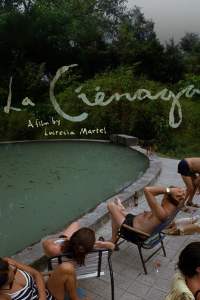 La Ciénaga is not a film I should like, but I did. It is a neo-realist picture heavy on plot elements but light on actual plot, not the type of film I like since I’m so into “stories.” But it is a fascinating picture. An Argentine film from director Lucrecia Martel and translated as “the swamp,” this film follows an extended family during one sweltering hot summer. Mecha is the matriarch; she’s an alcoholic living with her husband Gregorio in a crumbling manor in the countryside. Though the family probably once had money, it looks like it is evaporating. They still have a couple servants, but the house is falling apart around them, seen most clearly in the filthy pool the woman hang around all day. In the first scene of the movie, a drunken Mecha falls by the pool and cuts herself on a broken glass. This brings everybody over to visit: her sister with all of her kids, as well as her adult son. There’s too much going on to get it all in a short synopsis, but a lot is touched on, including some quasi-flirtatious actions between a brother and sister, extreme racism by Mecha and her family towards the American Indian servants, and the tight grip of a bourgeois past which the family can obviously no longer claim. The movie feels as real as the family next door and is mesmerizing in a voyeur-like way. We see a family in a way that is usually only kept behind closed doors. ★★★½
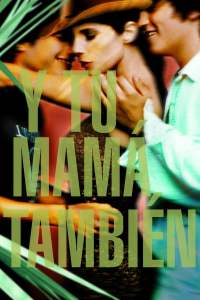 Y Tu Mamá También is an early film from director Alfonso Cuarón, who would go on to be a megastar with Gravity and, most recently, Roma. It is a coming-of-age tale in Mexico, following two horny teenagers. Tenoch comes from a well-to-do family and Julio from a working class one, but they are best friends. They share an attraction with Luisa, who is married to Tenoch’s cousin Jano, and is also at least 10 years older than them. When Jano cheats on Luisa though, she calls Tenoch and Jano to go on a road trip with them. She teaches them about life and love, and they in return allow her to live life to the fullest, something she had forgotten in her staid everyday life. The movie is a little too crude for my tastes (ok, a lot too crude) in its sex depictions between the three of them, but damn if it isn’t a tremendous film anyway. Besides the overt message of living life, it is also a commentary on social issues and the disparity between the upper class and the middle. If you can look past the graphic scenes, this is an enjoyable and touching art film. As a side note, the voiceover narration in the film reminded me a lot of Canoa, and it did not surprise me to read afterwards that Cuarón saw that film as a teenager and admitted it made a lasting impression on him. ★★★★

 Jons Movie Takes