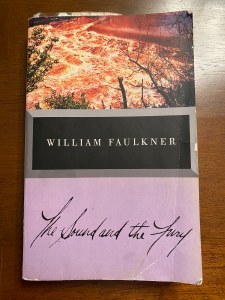
Yet another challenging read but a good one, a common thread I’m finding here as I get near the top of this list. William Faulkner’s The Sound and the Fury is a book of four parts, and looks at a once-prominent family as it fades away within a single generation. Three of the four sections are written in first person narrative, each by a different member of the family, and thus each section is very different from the others. The final section is in third person and follows a fourth character, looking from the outside-in.
The first section is about Benjamin, nicknamed Benjy, who is an adult male with a severe learning disability. As such, it is the most challenging section of the book to read. It jumps around a lot, with at least three different time periods that I became aware of (not at first of course, it took a bit to catch on), and maybe more. It will jump in mid-paragraph at times, and because of Benjy’s simple, uncomprehending mind, the reader is as lost as he is. Benjy is non vocal, and only knows what he likes and what he doesn’t like, with no deeper clarification or understanding of what is going on around him. So the reader is as in-the-dark as he is. We get introduced to the various members of the family, but this section of the book is mostly stream-of-consciousness, so finding hard facts is really difficult. All I really picked up on is Benjy’s sister, Caddy, one of the few people who treats Benjy well, was banished from the family at some point for getting pregnant, leaving Benjy without any real friends. He likes to watch golfers on a course near their home, and we learn that he name was initially named Maury at birth (named after an uncle), but it was changed to Benjamin when the extent of his disability became more clear, because the family didn’t want to tarnish Maury’s name. At some point as a teenager or young man, Benjy also chased after a girl and scared her. Though he probably had no devious intent, the result was the family decided to have Benjy castrated. We learn that their mother Caroline is always sick and often bed-ridden.
The second section is easier to read, but just barely. It follows the oldest son in the family, Quentin. Quentin feels a ton of pressure to protect his family and they all have high hopes for him continuing the legacy of the family name, so much so that they sold a lot of the family land (which became the golf course mentioned above) to pay for Quentin’s Harvard education. But Quentin is also mentally and/or emotionally unstable, and much of this section is a deteriorating, jumbled mess as Quentin loses his grip on sanity. Some things are still easier to grasp than what was in Benjy’s section. We learn that Quentin was really angry when Caddy got pregnant and tried to fight the father of her baby, but was soundly whooped. He even tried to convince their father that he, Quentin, impregnated Caddy, thinking that if society thought they were guilty of incest, they’d go to hell together and he could protect her there, as he wasn’t able to in this world. Ultimately Quentin does lose his grip and commits suicide after his first year at Harvard.
Finally the third section brings a lot of these pictures into focus. Here, we get Jason’s side of the story. Jason is the youngest son and, as it turns out, their mother Caroline’s favorite. From here on out, the book is linear and much easier to follow. The family’s father is dead and Jason is the head of the house. We earlier thought that Caroline was sickly, but it turns out she is just a severe hypochondriac (but also very manipulative), which Jason uses to his needs. Jason wants to have Benjy committed to an asylum but Caroline and the family’s black maid, Dilsey, who has been with the family for decades raising the kids, will not allow it. Jason is also looking after young Quentin, the 17-year-old daughter of Caddy. Caddy never returned to the family, but did end up marrying a wealthier man, and she’s been sending money for years to help the younger Quentin. Jason however has been pocketing the money, and Dilsey knows this; it is this knowledge that keeps Jason from committing Benjy. This section paints a clear picture of Caroline’s low opinion of her dead husband, thinking that it was his weak blood that has ruined their once-proud family, and she thinks Jason is the only one who can restore it.
The last section follows Dilsey, a reverent and church-going lady woman who has stuck with this family, even after Jason stopped paying her. She stays to protect Benjy and to keep Jason in check. One day though, Miss Quentin breaks into Jason’s room, steals all the money that is rightfully hers, as well as all of Jason’s own savings, and flees town with a man from a traveling circus. With Dilsey’s threat no longer holding water, Jason has Benjy committed. We learn in the appendix (first published 15 years after the book, but now included in most printings) that Dilsey moved away after that, and Jason was able to rebuild some wealth, but that he sold off the family home after Caroline died, and died himself a bachelor, taking the family name with him.
Pure and simple, this is one of the best books I’ve ever read. It paints an entire portrait of a family as it dies, and while it is easy to point the finger at the despicable people like Jason, we see that everyone played their part in it. It is also (fortunately? unfortunately?) one of those books that just screams to be read more than once. Now knowing how it all turns out, I’m sure going back and reading the first two sections would glean a whole lot more that I most likely missed. Not only that, but in writing this up, I realized that Quentin is one-and-the-same the narrator of Faulkner’s book Absalom! Absalom! during his time in Harvard. I’ll return to this one again one day and probably the other as well, looking for further clues. If you want a challenging but rewarding book, it doesn’t get any better than this. It is difficult without being impossible, and Faulkner’s style is one of the best.

 Jons Movie Takes
One thought on “Faulkner narrates the death of a family in The Sound and the Fury”