 Thieves’ Highway was one of the last films made by Jules Dassin before being blacklisted during the McCarthy era, and moving to France to work overseas. It is a tremendous movie about a veteran returning home from the war, only to find that his dad has been robbed of money from a previous job , losing his legs in the process. Nico vows to get even, and takes a job moving produce from Fresno to San Francisco to confront the buyer who swindled his pop. In supreme film noir fashion, the movie is oozing with cynicism, and even has a woman paid to divert Nico in San Fran and provide the classic femme fatale role. Death, greed, sex, and high tensity suspense all combine for a mesmerizing, satisfying dark tale. Doesn’t get any better for this genre.
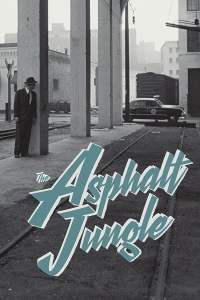 John Huston’s The Asphalt Jungle is a classic heist film, but it was the first of its kind in 1950. Many elements that were introduced in the film would become standard, such as showing the gathering of the crooks for the job (Ocean’s 11-style long before there was an Ocean’s 11), and the planning of the job and actually showing it getting carried out, to exacting detail. The film has an ensemble cast of crooks and cops, but focuses on the man hired as the muscle of the robbers, Dix Handley (Sterling Hayden). Doc, a long-time thief just released from jail, knows of a job where the payday will approach 1 million bucks, a ton of money in 1950, and he hires Dix and a couple others to help him pull it off. Their payroll is financed by a man named Emmerich (who once was rich, but is living off reputation right now, and plans on double-crossing Doc and his team once the job is done). The film plays up the whole “crime doesn’t pay” line a little too hard, but as a film it is fantastic. Nearly every character in the movie is as hard boiled as they come. There’s also a nice little part for film newcomer Marilyn Monroe, as Emmerich’s side-piece.
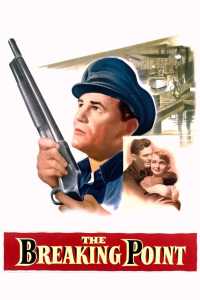 The Breaking Point, directed by Michael Curtiz (famous for Casablanca) in 1950, is based on Hemingway’s To Have and Have Not (as a side, for all those that say Hollywood just regurgitates ideas these days, that’s nothing new. The first film based on this book had just been released 6 years previously, starring Humphrey Bogart and Lauren Bacall). It follows a fisher and boater named Harry (John Garfield), who’s been down on his luck and struggling to provide money for his wife and two kids. He takes a rich business and his young, blond girlfriend Leona (Patricia Neal) down to Mexico for some gambling, but once there, the rich man dumps them, leaving Harry on the hook for the bills. To scrape some money together to get home, Harry agrees to smuggle some Chinese people across the border, but the deal goes south and Harry ends up killing his contact. Things get worse when he gets back the USA. Still broke, Harry decides to try to smuggle again, but this time it is a gang of crooks who fight back. Curtiz does a good job of creating an anti-hero that is tough not to root for, even when he takes questionable jobs and flirts with Leona behind his wife’s back. Not as tense as some other film noirs, but still a solid movie. I enjoyed the personal aspects of the film, the tender moments between Harry and his wife.
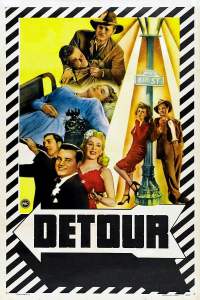 Often today, the term “B movie” brings to mind a low budget film of questionable quality, but one such vintage film that definitely exceeded its grasp is Detour. Directed on a shoe string budget by B movie auteur Edgar G Ulmer in 1945, Detour proves that you can make a movie on the cheap, without making a cheap movie. It follows and is narrated by a man named Al Roberts, who is broke but trying to thumb his way from New York to Los Angeles to meet up with his girl, with aspirations to marry her. He is picked up by Charles Haskel, driving a fancy car and carrying a wad of cash. When Charles falls asleep and is later found to be dead, Al freaks out, knowing the cops will think he killed him for the bread in his pocket. Al stashes Charles’ body in the desert, takes his ID and car to pose as him, and finishes the drive towards LA. What Al does not account for is the dame he picks up on the side of the road, who is carrying a secret of her own: she was earlier picked up by Charles, and knows that this driver is not him. A captivating film where the real star is the dialogue and narration; it is chuck full of every cynical, hard balled shred of dialect from the film noir era, spun together in a quick-flowing stream of suspense and turmoil. It’s my first Ulmer film, and I hope more that I see in the future are even half as good as this one.
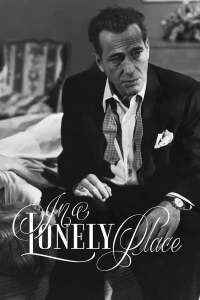 I saved Nicholas Ray’s In a Lonely Place for last because of its main actor, film noir legend Humphrey Bogart. As a film, it is much different than the previous four; it is more heartfelt, with a relationship as the central plot element. Dix is a nearly-washed up screenwriter who hasn’t written a good film in a long time. He is approached by his agent to do treatment on a trashy popular novel which Dix hasn’t read, so he asks a local hotel worker to come to his house late one night to give him the gist of it. She leaves late in the night, and early the next morning, the cops are at Dix’s door with news that she was murdered. Dix is suspect number one, but he is rescued by his aloof neighbor Laurel Gray, who provides an alibi, since she saw the girl leave, alone, the previous night. Dix and Laurel begin to fall in love, but she is disturbed by Dix’s often violent behavior. She even begins to wonder if Dix didn’t kill that girl after all. Bogart shows a very personal side in this film, a person who has spent years shutting people out and who now has a hard time letting anyone in. The look of vulnerability on Bogart’s face as he realizes how his life is going is a view I’m not sure I’ve seen from him before. And the ending is as tense as it gets.

 Jons Movie Takes
One thought on “Quick takes on 5 classic film noirs”