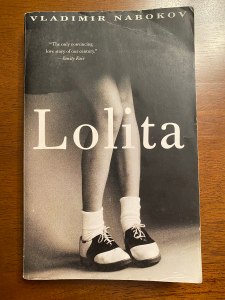
Vladimir Nabokov’s Lolita is a creepy book to read, for obvious reasons. Even the nickname “Lolita” has become synonymous with sexually precocious children. Most people know at least the premise of the story, but it is much more than just a creepy older man grooming a young girl.
Humbert Humbert (pseudonym for the first-person narrator of the book, as all names have been “changed”) is an admitted pedophile. Early in the book he openly discusses his attraction to what he calls nymphets, or girls between the ages of 9 and 14, who are in that class between young child and developing woman. More than just a specific age group though, Humbert is attracted to girls who are becoming aware of their sexuality, and flaunt it, even if in a subconscious manner. He knows this is not a normal attraction, but he doesn’t provide excuses. For Humbert it simply is what it is, and he doesn’t want to change it. Somewhere it his late 30s, he has spent his entire life hiding his desires, even marrying once before, and recalls fondly his one sexual encounter with a 14 year old (when he was the same age).
Humbert’s life changes when he becomes a boarder at Charlotte Haze’s house. Charlotte is a widower and is raising her 12 year old daughter Dolores on her own. In Dolores, whom Humbert nicknames Lolita, he sees the perfect specimen for what he has always been seeking. Lolita is a typical hard-headed, rebellious girl, clashing with her mom on many topics, and in Humbert, she instantly recognizes someone she can manipulate. When Charlotte threatens to send Lolita away to a boarding school, Humbert even goes so far as to marry Charlotte and begin to plot her murder, so as to gain custody of Lolita. The decision is taken from him though. One morning Charlotte finds Humbert’s diary and notes, explaining in detail his unrequited love of Lolita, and in her rage and anguish, she walks in front of a car and is killed. Humbert picks Lolita up from her summer camp, and so starts their love affair.
For the next two years, Humbert and Lolita are lovers. For a year they travel the country under the guise of father and daughter, never staying in one place long enough for anyone to grow suspicious. Eventually they return to school, but by then, Lolita is becoming more brazen. She has Humbert wrapped around her finger, and withholds sexual favors for anything she wants, and of course, he always gives in. She’s become spoiled and unruly, and Humbert has become jealous of anything or anyone who might take her away from him. He researches her friends and forbids many social engagements. When he pulls her from the school play to which she’s been very excited to be in, she runs away for a short time. When Humbert finds her, she asks if they can go on the road again, and he agrees.
They aren’t out long before the jealous and paranoid Humbert begins to think they are being followed. He starts watching Lolita even more, looking for her to make calls or meet strangers at gas stations, and his worry seems to be well founded when one day, she just vanishes. Humbert spends two years looking for her, to no avail, and finally settles down with a young alcoholic named Rita, another person he can manipulate. When he gets a mysterious letter from Dolores one day, he drops Rita cold though and heads to his beloved Lolita. He finds her, now 17 years old and pregnant, but not by the man she fled with those years ago. Turns out that mysterious pursuer was another older man, Quilty, not much different than Humbert himself, and the playwright of the school play she was to perform in. After pleading one last time for Lolita to return to him (to which Dolores smiles sadly and says “no”), Humbert hunts down Quilty and kills him. At the end of his memoir, in jail for Quilty’s murder, Humbert asks that this book not be published until Lolita’s death. Little did he know that she would die in childbirth, and Humbert would follow shortly after due to heart failure.
OK, so lets set the creepiness factor aside, as much as we can. Yes, it gave me the shivers reading Humbert’s regaling of how lovely he thought the creamy, unblemished skin of 12 year olds is. But this book is so much more than its surface. For one, Humbert is a well educated and socially conscious man, and the book is chuck full of literary and cultural references. I hear there is an annotated version out there, that is probably well worth picking up, just to catch all the little subtle clues and ticks that point to other pieces. “Humbert” is an extremely funny writer too, so reading his narrative is seamless and engaging. That makes the perverted nature of some of his ramblings a bit easier to take. On a larger perspective, many have praised the way the book is told. We only hear Humbert’s side of the story as the aggressor. We know nothing of how Lolita thinks or feels about the situation, and that is done intentionally. Her voice as the victim in all this is completely silenced. I read somewhere that the book can even be taken as a criticism of the tyranny of soviet Russia, from which Nabokov and his family fled. I’m just a humble reader, so I won’t get into all that, but it is definitely worth thinking about. On the whole, it is a fascinating read and worthy of all the praise it has received over the years. If you can set aside your morals and just get into it, you should enjoy it.

 Jons Movie Takes
One thought on “Repulsion and genius alike found in Nabokov’s Lolita”