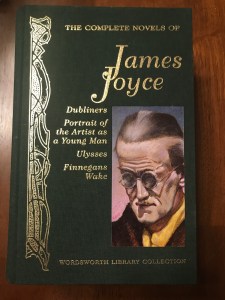
Ok James Joyce, you got me. Finnegans Wake was a super hard read, and deserving of its reputation as one of the hardest challenges of the English language. But after finishing A Portrait of the Artist as a Young Man (Joyce’s first novel, published in 1916), I realize that he’s just a tough author in general. Granted, Portrait is no Finnegans Wake, but you still can’t speed read it.
Portrait is largely autobiographical and follows a man named Stephen Dedalus from his time as a young boy up into adulthood. Each chapter depicts a major moment in his life, moments that would shape his views on life and the world around him. Though it isn’t written in first person, the style of the writing changes too as Stephen grows older. It begins in a wondrous mood, since kids’ eyes are open to the wide world around them, but as Stephen ages, he (and the writing style) loses some of that luster and, while still called “the artist” or “the poet” by his friends because of what he enjoys doing, he becomes more pragmatic.
Stephen is a boy raised in Ireland at a time when nationalism is at an all-time peak, and at times, there is a conflict between the government and the church, which is often seen as being a bit corrupt. Of course to the young Stephen, he is blissfully unaware of all of this, and only sees glimpses of it at home in arguments between his devout mother, his one-of-the-guys father, and their surrounding family, who like all families, fall across all lines of the political and religious landscape. There are moments that seem to push Stephen away from the church (such as when he is physically punished by a priest for having lost his glasses at school) and other times when he feels the call of God personally. Through much of it, Stephen often just goes with the flow and doesn’t seem to speak up for himself until he is much older. You get the impression of a young man who takes in all, but doesn’t show his cards.
At 16, Stephen commits his first big sins, and begins sleeping with prostitutes. He does this for awhile before, overcome with shame, he goes to a priest to confess. This leads to a renewed sense of Stephen feeling the presence of God, and he devotes himself again to leading a better life. He wants to feel something, and in so wanting, he dives in headfirst. This only lasts so long though. In college, Stephen finally realizes that he is unsure if there even is a God (but he is equally unsure if there isn’t too). He’s lost faith in man, and feels constricted by the ropes everyone wants to put on him, whether those ties come from his family, the church, or his community. He decides to leave it all behind and go into a self exile, where he can finally become the artist that he has always dreamed to be.
In some of my other reviews, I’ve praised the beautifully crafted language of some authors (William Faulkner comes to mind). James Joyce’s works are equally brilliantly built, and while it most definitely has a lyrical quality, it is much more challenging. You have to devote all of your attention to your reading, because if you get distracted for even a breath, you seem to lose the cadence and flow of words that Joyce is carrying you along through. A Portrait of the Artist as a Young Man is a difficult read, but it is rewarding for those with patience and care to read (slowly) and enjoy the journey along with Stephen.

 Jons Movie Takes
2 thoughts on “A poet finds his place in the world in Joyce’s Portrait”