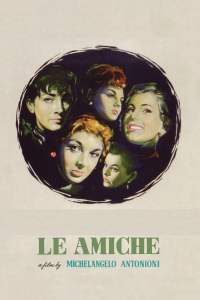
 Michelangelo Antonioni was an Italian filmmaker whose films became very influential in the art house circuit. I’ve never seen any of his stuff before, so will look at some today, including 3 of his arguably most famous pictures. Le Amiche (The Girlfriends), released in 1955, is about a group of five girlfriends as they deal with relationships in a changing society. Two of the five, Rosetta (coming off a recent suicide attempt because of an as-yet unknown reason) and Nene are in love with the same man: Lorenzo, Nene’s husband. This love triangle is the focus of much of the film, but the dynamics with the group of girls is heavily explored too. Momina seems to care for not much more than herself, Clelia is a woman who puts career before love (still a bit taboo in 1955), and all of them tiptoe around Rosetta because of her attempt to end her life. It’s a very lovely picture and acts as a snapshot of the time; it feels very real in a certain sense, but some of the characters feel like caricatures and too one-dimensional. Not a very deep film, but I can see how it heralds the more well regarded films that were to follow.
 Some art films are often guilty of placing characters before plot (not necessarily a bad thing, but you have to be in the right mindset to watch a film like this). L’Avventura fits the bill, because it has hardly any plot, but I was still riveted. The film follows a spoiled rich girl named Anna who seems to hold the world on a string. She craves everyone’s attention but returns no feelings, either to her father, her boyfriend, or her best friend. After yachting with some friends, she disappears suddenly on a secluded island, and no one can find her. In searching for her for the rest of the film, her best friend Claudia and her boyfriend Sandro begin a relationship with each other. The film is all about these two and their circle of friends, and what makes them tic. But also, the film is a showcase of Antonioni’s style. He has a way with the camera, creating stark and empty landscapes where it seems our actors are the only people in the world. The scenes where the party is searching on the rocks of an empty, desolate island for Anna are almost surreal-feeling in a very real environment. You’ve heard of a slow burn, well this one isn’t even that, it’s more of a slow simmer. But I was enthralled. Light on plot but heavy on character development, L’Avventura is movie magic.
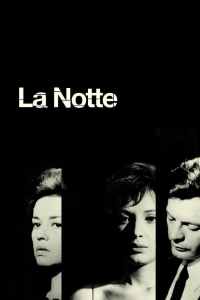 La Notte (The Night) is the story of a couple on the rocks, told over the course of a long day and night. Actually “on the rocks” may not be the best description, because that would imply that one or both of them would like to save their marriage, and it becomes increasingly apparent throughout the film that these two hardly have anger for each other. In fact, it is almost extreme apathy. Lidia walks around looking completely uninterested in her life and is almost certainly depressed, while Giovanni flirts with any woman that catches his eye. He is a popular writer among the intellectual (and pretentious) crowd, and enjoys all the attention, but isn’t wealthy himself, having gotten “into money” when he married Lidia. However, he internally fears that he is a fraud and isn’t nearly as talented as everyone thinks he is. The lack of talent does seem to bother him though, it is the threat of loss of status that he may care more about. Our vapid couple fit right in with the societal circles they hang in. It’s a very beautiful (if slightly depressing) film with wonderful, subdued acting by its two leads (Jeanne Moreau and Marcello Mastroianni). Like L’Avventura, not much a real “plot” to follow along, and it does move slow, but it is a very rewarding film.
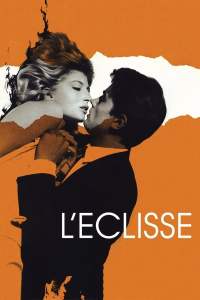 L’eclisse (The Eclipse) was heralded upon its release in 1962, as a film showing the disconnect between people in a modern “connected” society. Once again starring Antonioni’s muse, Monica Vitti, it is about a woman who can’t find love. Vittoria is a beautiful young woman, too beautiful for her own good, because men just want to sleep with her, but she seems to be looking for something more. The film begins with her breaking up with her previous boyfriend, who becomes a bit stalker-ish by showing up at her place the following night and hanging out outside her window (when she calls the ex-boyfriend’s friend to let him know to look out for his bud because he might need a helping hand at the moment, the friend hits on her as well). The next day, Vittoria meets Piero (a young Alain Delon, just two years after his break-out role in Purple Noon), a stockbroker whose lifestyle is as frenetic as his work. Vittoria likes him immediately, but like all men around her, he is singularly focused on one thing. She rebuffs him for awhile, but does eventually give in and the two sleep together. They agree to meet the next day at “the usual spot,” but as Antonioni shows with his brilliant camera pacing again, neither show up. I thought this movie had a very good-to-great beginning, and a transcendent ending, but the middle was a bit boring honestly. The ending makes up for it, but bring your patience. A brilliant film overall, showing the alienation of individuals from each other in world that was growing increasingly connected, and looking back on it from eyes in 2019, it has only gotten worse. As a side, I finally put my finger on how the director gets these films to feel so expansive. For one, he obviously picks locales where, often, there are few if any bystanders walking the streets, creating a feeling of emptiness. But more importantly, he uses the widescreen format to perfection. Whereas a lot of those old black and white films are 4:3, Antonioni’s films fill a widescreen television, and he often places the camera just a hair lower than you typically see done. It isn’t so much that you get a feeling of “looking up” at the actors, in fact it is easy to miss, but you do see the expansive sky above and around them while the walk around. Outstanding filmmaking, and I feel like a buffoon for missing it on the first couple films.
 The last film is, unfortunately, the one I couldn’t get through, and I was probably most looking forward to this one initially. Red Desert is about a lonely, self-isolated woman (again, Monica Vitti) who feels disconnected from everyone around her, even her husband and son. She shares a bit of kinship with a coworker of her husband’s, who has similar feelings but has learned to live with them, and the two start an emotional affair. The affair maybe got physical by the end, but I didn’t make it that far. After about 80 minutes into the 2 hour film, I gave up. I wanted to like this one, because to add to the feeling of isolationism the main character feels, the film has an almost post-apocalyptic feel, and I typically dig those kinds of films. The industrial workers live in cold, concrete buildings, and there is pollution and dreary, foggy, miserable conditions all around them. But honestly the film is a slog. It lacked the trepidatious feeling of the previous 3 films, and watching our leading lady struggle through life seemed more challenging for the viewer than for her. I might attempt this one on another day in the future, but lacked the patience for it today.

 Jons Movie Takes
3 thoughts on “Quick takes on 5 Antonioni films”