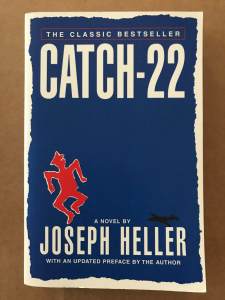
For myself, Joseph Heller’s Catch-22 was one of those books that, while reading, I knew it was good stuff, but for whatever reason, it never really grabbed me and held my attention. Some books just get a hold of you and you can’t put them down, turning page after page for hours. Catch-22 was good, almost unarguably great, but I never got that sense of urgency to find out what happened next.
The book is almost entirely a piece of satire, focusing on many subjects but primarily the asininity of the US military chain of command and the bureaucracy that goes with it. It follows a unit of air force bombers stationed in Italy during World War II, and almost all of them are nearly certifiably crazy (as the book points out, you’d have to be to fly repeatedly over enemy territories in slow planes while getting shot at, wouldn’t you?). The main character is Yossarian, who seems to be the least insane of them all, because he realizes that everyone there is trying to kill him, from the enemy combatants to his own commanders, for continually sending them on suicide missions, and he wants out. However, every time the unit gets close to meeting their quota of bombing runs, Colonel Cathcart, who is obsessed with impressing his superiors so as to become a general, keeps raising said quota. The big “catch 22” referenced in the title is Yossarian’s conundrum for getting sent home. A person would have to be crazy to do what he’s doing in his bombing missions, but to apply for reassignment he’d have to be of sound mind, thus not crazy, and still capable of flying more missions.
If Yossarian is sane for wanting to get out of his situation, everyone around him is most certainly not sane. His cohorts are all nutty, and include: Milo, the mess officer, who runs a “syndicate” trading in black market goods, even to the enemy; Orr, a pilot who gets shot down on every single mission, but always survives along with all of his crew; Major Major (rank and name), a recluse who hates meeting with people, so he makes sure his aid only lets visitors in to “see” him when he isn’t in the office; McWatt, Yossarian’s pilot, who Yossarian considers completely insane because of how sane he appears during the war; Nately, who is in love with a prostitute who will sleep with anyone but Nately; and a host of others. The doctors don’t know anything about medicine and the commanders don’t know anything about combat, leading to some very funny exchanges throughout the novel.
Through a multitude of seemingly unrelated events but which ultimately all tie together in the end, the book does have a nice plot, but there’s far too much of it to get into here. I’ll suffice to say that, like stated above, it is a good (great?) book, but just not engaging for me personally. Some of the humor had me chuckling, other parts rolling my eyes, and a few spots genuinely offended, such as the pilots’ treatment of the female nurses in the medical tents. Of course, it was written in a different time, published when “men were men” in 1961. I can’t argue that it is wonderfully written. Starting on it, it seems like it is jumping around a bit too much, but you realize after awhile that it is logically following certain ideas down paths to their conclusions, and then exploring something new, which may have started earlier but may finish later, if that makes sense. I’m not sure I’d place it as a top 15 “greatest of all time” novel, but it is a very nice book and I’m glad to have finally read it to see what all the hype is about.

 Jons Movie Takes
One thought on “Lack of choices abound in Catch-22”