 Juliet of the Spirits was Fellini’s first film in color, and he uses it to beautifully showcase the dream world that he so often puts in his films. This one follows Juliet (Giulietta Masina), a woman devoted to her husband, but otherwise lonely and maybe even depressed. After a seance with her friends, she begins to be visited by spirits, in particular, Iris and Olaf. They both seem to be trying to tell her something, though the masculine Olaf is more forceful. Shortly after, Juliet begins to suspect her husband of cheating, and hires an investigator to follow him. As the investigator is working, Juliet becomes friendly with the neighborhood wild girl, Suzy, who admits she sleeps with anyone and lives life to the fullest. Hanging out with Suzy seems to awaken more spirits for Juliet. Juliet, who married the first man to come along and never lived a life on her own, is starting to feel independent for the first time in her life. When the investigator comes back with news that, yes, her husband is having an affair, Juliet is saddened, but no longer demure, and goes to confront the woman. By the end, Juliet seems to have found peace for herself, and does not need a man’s happiness to give her joy. It’s a good film, a little out there with the blending of dreams and real life, but it was hard not to root for Juliet to finally break free of the upbringing that chained her to be a timid little housewife (even if film does suggest that if she would just a bit of a floozy, she’d be a lot happier).
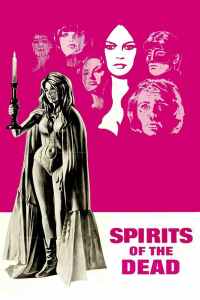 Fellini is one of three directors in the anthology piece Spirits of the Dead, from 1968. All are based on stories of Edgar Allen Poe. The first stars a young Jane Fonda, and is directed by her then-husband, Roger Vadim. In medieval times, the young and beautiful Frederica has inherited a large estate. She only lives for physical pleasure, and treats people poorly. However, she genuinely falls in love with her cousin, Baron Wilhelm, who lives a simple life on land nearby. When he rebuffs her, she has his stable burned down, and in the ensuing blaze, Wilhelm dies trying to save his horses. That same day, a black horse comes to Frederica’s castle, and she believes it to be Wilhelm’s spirit returned to her. She leaves her old life behind and finds joy with the black horse, and decides to die in flames with him when lightning sets her fields afire. The second tale, directed by Louis Malle, stars Alain Delon as William Wilson, an all-around terrible person who is haunted by a man of the same name. Every time Wilson does anything bad, the other Wilson is there to turn him in, landing him in trouble his whole life from childhood to an adult. Finally the two spar after a masquerade party, and the evil Wilson kills his doppleganger with a knife. When the mask is removed, Wilson sees his own visage. Faced with the knowledge that he is crazy and has “killed himself,” Wilson jumps from the tower to finish the deed. Onlookers rush to to the body, to find him dead from the fall with a knife in the stomach as well. The final vignette comes from Fellini, and of course, it is the most dream-like. A declining, alcoholic actor arrives in Rome to shoot a new film. Immediately upon his arrival in Rome, he begins having visions of a little girl, playing with a ball, that he names as the devil. At an awards ceremony later, his hallucinations grow worse. After the ceremony, extremely drunk, he gets into his new ferrari and speeds off, driving around all night. Eventually he comes to a downed bridge, and sees the girl and her ball on the other side. He speeds towards it, but crashes, becoming decapitated. The segment ends with the girl forgoing her ball and picking up the head. Honestly I enjoyed the first two pieces a lot more than the third, which just seemed like the ravings of a madman. Overall, a decent, if ultimately forgettable, film.
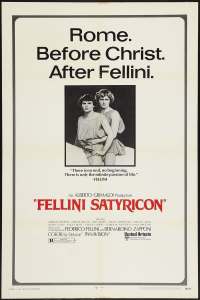 Fellini Satyricon, from 1969, is both more and less cohesive (a tighter story and better characters, but crazy, insane images of a culture on the decline) than the director’s short in Spirts of the Dead, and it is one wild, fun ride. It is based on Satyricon by Petronius, a Latin piece written in the first century. To try to give it even a short synopsis here would not do it justice. Based around two brothers, Ecolpius and Ascyltus, a whole lot happens in the movie’s 2 hour length. There are wild adventures, death, curses, bizarre weddings, stories-within-stories, and the death of Caesar. Fellini uses the debauchery and setting of ancient Rome to make a film as gaudy and dream-like as any he had ever done. It is easy to see the inspiration in this film for some of Pasolini’s films that would shortly follow in the early 1970’s, but while I didn’t care for those films as much (Decameron, Canterbury Tales, and especially Salo), I did like Satyricon. It is a bizarre, colorful trip from beginning to end.
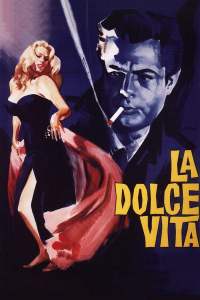 La Dolce Vita was Fellini’s biggest hit. Released in 1960, it won the Palme d’Or at Cannes that year, and was a huge box office smash. (When it came to the states in 1961, it was still the 6th highest grossing film of the year, subtitles and all.) It follows Marcello (Marcello Mastroianni), a celebrity news journalist, and his wayward life among the stars. Marcello spends his days aimless, and his nights partying among the elite, sleeping with its various women from rich Italian heiresses to American movie stars. His girlfriend wants him to give up the lifestyle and choose to stay with her alone; she dreams of having a house and family away from the noise of Rome, but Marcello doesn’t seem to want anything else. If you are expecting Marcello to find redemption by the end, don’t hold your breath, this is not a film with a sweet ending. But it is a fantastic movie, loaded with poignant moments that leave you pondering its meaning long after it is over. From Marcello’s memories of an absent father, to his best friend’s murder-suicide of his family after talking about the constraints his home life in contrast to the “glamorous” lifestyle of their other friends, to a seemingly chance encounter with a girl at a restaurant which may be more fate than chance. The film paints a stark picture of a society that glamorizes celebrities who are undeserving of the fascination the public gives them. This may sound ho-hum today, but consider this movie was made 60 years ago. When watching the film, I thought many times of the idiocy of these rich and famous people, getting drunk at parties and carrying on like college kids without a care for tomorrow.
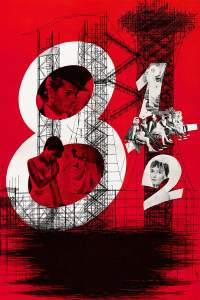 If La Dolce Vita was Fellini’s biggest commercial hit, 8 ½ is arguably his the most critically acclaimed one. Released in 1963, it is widely regarded as one of the best films ever made, and still finds itself on top 50 lists to this day. It has often been called the greatest film about making a film. The film follows a famous director, Guido Anselmi (Marcello Mastroianni, in perhaps my favorite role I’ve seen so far, next to A Special Day), as he prepares to make a new movie. However, for someone who wants to make a picture, he doesn’t seem like he wants it very much. He is dragged around here, there, and everywhere, pulled in a million directions, by the producer, potential actresses, his wife, his lover, set designers, etc. Most have questions that he keeps putting off; in fact, it seems he is completely unready to make this movie. While a very expensive set is being built out in the country, Guido is vague about all details, even to the producer. He privately admits to himself and us viewers that he thinks he is a fake, an impostor, who maybe isn’t as talented as everyone thinks he is. Yet, at the same time, he is extremely narcissistic, daydreaming that all women want to be with him, and thinking he is fooling his wife about his extramarital affairs. Near the end of the film, during screen tests for actresses (all of whom are dressed like his friends and family, a clue that the picture is becoming autobiographical), one of the actresses sees Guido immediately for the man he is: a person who doesn’t know how to love, and only takes from people, never giving. This movie is tremendous, fantastical as you’d expect from Fellini, but also, very real and grounded in the emotion and turbulence of a famous director surrounded by sycophants, with he himself perhaps being the worst of them. It won Fellini his third Oscar for Best Foreign Language Film; he would win a fourth 11 years later, the most ever won by a director in this category.

 Jons Movie Takes
2 thoughts on “Quick takes on 5 Fellini films”