 Chantal Akerman was a Belgium filmmaker who made films from the 1970s until her death in 2015. I’d never seen anything from her before, so up today is some her earlier pieces from the 70s. First is a silent, experimental film called Hotel Monterey. For those that can bring your patience with you, this is a beautiful, sometimes haunting picture. The whole of the film (about an hour long) is long, sometimes panning shots around the hotel in New York. The building is old and dated, and the camera examines everything from long, dark hallways; to rooms (with or without inhabitants); to its dingy basement. An early 12 minutes are devoted to a continuous shot of the elevator going up and down, stopping at various floors, to see the doors open to people or empty halls alike. It’s an avant-garde film for sure and not for everyone. I usually steer away from these kinds of pictures (I can not get into Stan Brakhage despite several attempts) but I was enthralled by this piece. Some of the slow, creeping walks down tight hallways give a Kubrink Shining kind of vibe, several years before that film was made. Beautiful shots throughout, and it’s amazing how a quiet, unmoving camera can either elicit tension or peace, depending on the view and/or the mindset of the viewer.
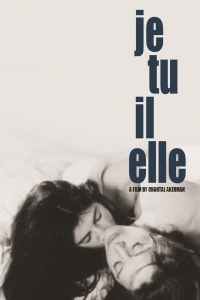 Je tu il elle (I You He She) was Akerman’s first feature film, released in 1974, and stars herself in the lead role. Julie is a young and depressed woman, living in a small apartment. After trying to change the things she has control over (painting the room twice, moving all the furniture around, then removing it all except the bed, and finally just lying naked on the floor), she writes letters to herself, then edits and revises them. She hints through narration that she’s waiting for something, but what, we do not know, and most likely. When she finally runs out of sugar, her only sustenance, she gets dressed and leaves, with the feel of a finality that she is not coming back. She hitches a ride out of town with a trucker, who provides food in exchange for sexual favors. Ultimately, Julie ends up at a woman’s house, obviously her former lover, with their breakup being the reason for Julie’s depression. The two have sex, during which Julie holds her partner so tight, it looks like she will never let go. Julie gets up in the morning, grabs her clothes, and walks out. Throughout the film, we never hear Julie speak to anyone with whom she comes in contact, her voice is saved only for narration to us as the viewers. It’s a slow burn of a film, doesn’t move much faster than the silent documentary described above, but it is rewarding for those with the endurance to sit through it (even if the sex is a bit too gratuitous for my tastes).
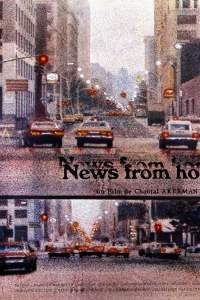 News from Home is just what it sounds like. This documentary is a series of shots by Akerman around New York, where she lived for awhile. In the busy city, Akerman focuses on visions of solitude and loneliness within the greater hustle-and-bustle of the metropolis. In voice-over throughout, she reads letters sent from her family back in Belgium. The letters are exactly what you’d expect from a mother who misses her child in a time before the internet. She begs for her daughter to write more often, tells her how Dad is doing, warns her to be careful in dangerous New York, etc. I see and talk to my parents regularly, but even I felt homesick with the letters oozing love and warmth, in stark contrast to the lonely video of the cold, uninviting city. The mom’s a bit passive aggressive, sometimes more than a bit, but you can tell she loves her daughter. An achingly beautiful film, and a fantastic time capsule of 1976 New York.
 By now, I’ve realized Akerman has a thing for telling stories about single women living in a man’s world. That’s the nuts and bolts of Les rendez-vous d’Anna (The Meetings of Anna) too. Anna is a filmmaker who travels around Europe for work, and she must have the kind of face where people just want to tell her their problems, but no one seems to care much what she wants. Everyone seems to tell Anna all their woes, while she listens silently. First a man in Germany with whom she has a one-night stand, lamenting the state of his divided country after World War II, then her friend Ida, who talks about her terrible marriage, and then a stranger she meets on a train. It’s not all doom and gloom though, there are surprisingly funny moments too, like when Ida takes a break from bashing her husband to tell Anna she should marry her son, because women should marry. I enjoyed the first half, but the film really got good in the second, when it became clear that people aren’t just unburdening their souls to Anna, but are in fact just using her. She’s been going through life letting people say and do whatever they want to her. Even though she’s successful in her career, as a woman of the 70s, she has little power in relationships and no voice for her own desires. I’m dense, so it too me awhile to realize this (very late in the movie), but the film took on a whole new light upon this revelation. It moves at a slow pace, so it will test you, but a really great picture.
 Up last is Akerman’s most critically acclaimed movie, and the one that got me interested in watching these films of hers. Jeanne Dielman, 23, Quai de Commerce, 1080 Bruxelles (yes, that is a long title) has been lauded as a masterpiece since its release in 1975 on the art house circuit. It clocks in at over 3 hours long, and having seen 4 previous Akerman films, I came ready for lots of long, slow shots sans dialogue, and when there is conversation, for it to be deliberate and, perhaps, a bit meandering. Our main character is Jeanne. Extremely methodical, from the way she dresses (with hair perfectly coiffed) to how she cleans herself to the way she eats, you get the impression her routine is exactly the same every day. After a very staid dinner with her son (husband is 6 years deceased), she gets out her knitting, and I thought, “Of course she knits!” The movie begins in the middle of her routine, preparing said dinner for that evening, but then something unexpected happens. A man arrives, they retreat to the bedroom, come out an undetermined amount of time later, he pays her, and he leaves, saying, “See you next week.” Our little homemaker is turning tricks! The evening plays out, then the next day, when the doorbell rings again, to a new man. Same story. And that’s the first 90 minutes of this film, so we aren’t even half way through yet. Here, I did have a single doubt creep in. To this point, I was invested in the film, it sounds boring watching someone just going about their day, but I was fascinated. However, after her john left, I wondered if we were going to see the whole ritual again. But no, the camera thankfully skips ahead through the mundane events we already saw, and, in a change, we start to see cracks in Jeanne’s veneer. Even the camera lets us know this, by showing her kitchen from a different angle than we’ve seen before. Jeanne picks up a pot of food, and wanders around the house listlessly, like she can’t quite place where to go with it. She begins to repeat actions in an increasingly frantic manner. Her normally perfect hair is messy. Day 3 starts worse, with Jeanne forgetting to fully button her house coat when she puts it on, and then forgetting to turn off lights when leaving rooms, having to stop mid thought to return to do so. The viewer definitely gets a sense of foreboding, of impending catastrophe. Whether something does or not, you’ll just have to sit through 3 ½ hours yourself to see. I can see what the hype is about, this is a compelling film, but like all of Akerman’s stuff, be patient and let it come to you.

 Jons Movie Takes
2 thoughts on “Quick takes on 5 Akerman films”