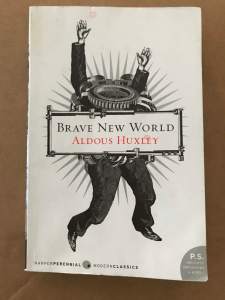
Aldous Huxley’s Brave New World was groundbreaking when released in 1932. Preceding World War II, the science envisioned in the book would seem far-fetched at the time, but isn’t too far off from things that we are capable of today. It is a dystopian novel, dealing with one man’s personal fight against the society that exists a couple hundred years in the future.
The book starts by introducing characters Bernard and Lenina, and through them, we learn about the world they live in. They live in a place where no one is born anymore: all are raised from test tubes, which are fed the exact amount of chemicals and proteins to make them become exactly the person society needs. Those destined to be leaders and teachers are fed the best stuff, and called Alphas, and they live (figuratively and literally) above the Betas, Gammas, Deltas and Epsilons, who are each progressively “grown” with less social drive, less goals, less smarts, etc., so that everyone is happy with the live they live. And when a person becomes unhappy, they can take a pill (called soma) to get high and forget their misgivings.
Bernard and Lenina are Alphas. Lenina, being a woman, is encouraged to sleep around (but carefully, and always using contraception, so as to avoid pregnancy), and as a high Alpha, she has no lack of partners. She is intrigued by Bernard because he is different, and the reason he is different is because (it is whispered) his tube was given a bit too much alcohol, leaving him shorter than all the other Alphas. This has given Bernard a big chip on his shoulder, and he finds solace in hanging out with a professor named Helmholtz, who secretly wishes to teach his students from banned books (which is basically anything pre-Ford, who is their deity for ushering in the assembly line). Lenina agrees to go on a weekend trip with Bernard to a Savage Reservation in New Mexico, where uncivilized people are allowed to live as they always have.
On the reservation, Bernard meets a man named John, who was raised among Native Americans, but was born to a woman named Linda. Linda is from the World State but became lost years before, and has lived here ever since. She has grown old and ugly (which people do not do in the World State anymore thanks to anti-aging chemicals, and a swift death before they can lose their mental capabilities), and is ashamed that she actually gave birth to someone. John has been raised on stories of where Linda came from, and as a white man, has never been accepted by the local population. John agrees to return to the World State with Bernard and Lenina, on the condition that Linda come too.
Back home in London, Bernard is a superstar for the first time in his life, for bringing The Savage. John becomes a curiosity and all the rave at Bernard’s parties. But it isn’t long before John realizes the awfullness of this civilization. Linda dies from taking too much soma, and in this place where people are taught from birth that death isn’t a bad thing, no one gets why John is so upset. When Lenina attempts to have sex with John, he fights her off. Raised on a single book of Shakespeare and ideals removed from the World State, he wants courtship and romance, but Lenina just wants casual sex. John and Helmholtz end up attacking a hospital to “free” the children (who don’t want to be freed), and they, along with Bernard, end up arrested and meeting the leader of Western Europe.
This leader, Mustapha Mond, admits to John that he too has read Shakespeare, as well as the Bible and many other banned books. In fact, he was once a scientist whose research nearly got him expelled. Instead, Mustapha embraced the World State. John (and the reader) now realizes the absolutely chilling existence that is the world now. The government has created a world where there is no sadness, but also no real happiness. There are no attachments to people or things, no fear of death or disease or war, no individualism of any kind. By creating people to only care about the group rather than the self, to take away pain with a pill of soma, they have created a perfect society where nothing bad (but also nothing really good) ever happens. Afterwards, Bernard and Helmholtz are banished to islands where they can live with other people that are “slightly different than the norm,” and John the Savage is sent to live in a lighthouse in northern England.
John thinks that here, he will finally find peace and happiness. He starts a garden and enjoys the quiet, but he cannot get Lenina out of his head. He inflicts pain on himself to purify his soul, which is caught on camera by a hidden reporter. The next day, swarms of people arrive in helicopters to see the curiosity again, including Lenina. John attacks her and the others flee, but this makes even bigger headlines, and more people come the following day. They approach the lighthouse, only to find John has hung himself.
The book starts really slow. It begins with a tour being given in the birthing center, with artificial wombs, chem labs, childhood indoctrination centers, and “sleep-learning” beds (where tapes are played while the child sleeps, subconsciously telling them how to live and how to think). It’s a bit heavy for quite awhile until the real plot gets going, but once it does, it is a wild ride. Scary to think that something like this could happen, but at the same time, it isn’t all that far fetched anymore. We aren’t too far away from being able to put whatever genes we want into our offspring, and many of the methods discussed in the book have been used by some of the less scrupulous, totalitarian governments in our world. Great read.

 Jons Movie Takes
One thought on “A scary look at the future in Huxley’s Brave New World”