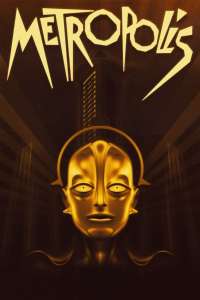
 Metropolis was one of renowned German director Fritz Lang’s last silent films, and was groundbreaking for being a very early feature length science fiction film. It is set in a dystopian future where a privileged upper class frolics in high rises while the working class slave away a mile below the surface of the planet, keeping the machines running that power the city above. One day, Maria, a woman from the underworld who preaches a future peace and understanding between the classes, sneaks upstairs and runs into Freder, the son of the master of the city. Freder has been oblivious to the hardships below him, and he goes down to see it with his own eyes. Meanwhile, a scientist, Rotwang, who wants to take over Metropolis, has created a robot who can take on the likeness of any human, and he uses it to make a copy of Maria. While the fake Maria sows rebellion underneath, Freder searches for the real Maria to attempt to soothe the mob. There are a lot of elements of the film that have been copied copiously down the years, but I thought by itself the movie was just all right. Plenty of good moments, but it does drag, and at over 2 ½ hours, it feels very long for a silent film.
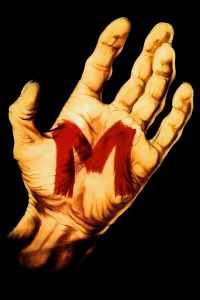 M is quite possibly one of the most influential psychological thrillers of all time, and widely regarded as one of the best. Lang’s first sound film in 1930, it is about a serial killer who has been preying on the most innocent of people, as his targets have all been young girls. The city is on lockdown, but the cops have been unable to find any clues, so they are leaning heavily on the criminal underground, performing nightly raids on gambling establishments and “houses of ill repute” in hopes of turning up something. These raids are cutting into the profits of the crime lords, so they also set out to find the killer, employing the town’s beggars to be on the lookout, just so that things can return to status quo. It’s not much of a mystery, because the viewer sees early on who the killer is (Peter Lorre in perhaps his most famous role, which is saying something since he shows up in The Maltese Falcon and Casablanca 10 years later), but knowing the killer does not lighten the suspense in any way. Watching the cops and the robbers tighten their noose around the murderer is thrilling, but when he lures another girl to his side, we hope that noose would tighten just a little faster. Amazing film, Lang himself considered it the best movie he ever made.
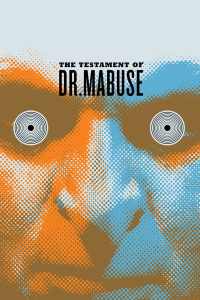 The Testament of Dr Mabuse is a sequel to a silent film Lang did in 1922 (which I have not seen). Dr Mabuse is a brilliant but insane man locked up in a sanitarium. The only thing he does is write, all day, every day. The notes he writes are fool-proof plans on how to pull off crimes, and someone is using those notes to do just that. There is a secret organization being led by an invisible “man behind the curtain,” a shadowy figure who issues orders and kills those who don’t obey. A police chief, Lohmann, is at a loss for solving the perfect crimes and murders going on his city. He does find that clues seem to be circling Dr Baum, who runs the asylum, and pulls at those threads until the exciting conclusion. This is a tremendous film, with exciting action sequences and a superb mystery that keeps the viewer guessing as much as Chief Lohmann.
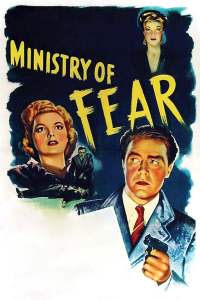 Ministry of Fear came out in 1944, after Lang fled Nazi Germany, and was now making movies in Hollywood. A film noir, it is about a man, recently let out of an asylum for an as-yet unknown reason, who becomes the mistaken target of a nefarious group of spies from Germany. As he unravels the mystery surrounding himself, various people come into his sphere, most of whom he can’t trust. It’s one of those movies where a lot happens, but at the same time, I felt like it wasn’t getting anywhere fast. Honestly I was bit bored for a good stretch of the film, but it ended well. It has a few too many tropes of 40’s Hollywood, and overall just an OK movie experience.
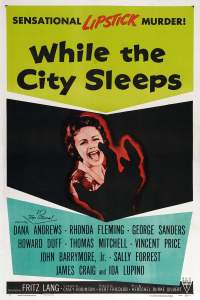 By 1956, Lang’s monstrous ego had burned a lot of bridges in Hollywood, so While the City Sleeps comes near the end of his career. It is a star studded affair, with names like Dana Andrews, Thomas Mitchell, Rhonda Fleming, Vincent Price, John Barrymore, Ida Lupino, and George Sanders. It follows a news organization owned by the Kyne family as a serial killer is terrorizing the city. Rather than focus on the murders, the movie mostly follows the head of the various news outlets (tv, wire, and paper) run out of Kyne. As the old man Kyne dies and his unprepared son takes over, the son promises to give a big promotion to whoever can break the story and identify the killer. The heads of the three above departments race each other to hunt down the bad guy. Part film noir, part drama, and even with some comedy thrown in, the film is entertaining, even if the plot is a bit thin. Dana Andrews as TV anchorman Ed Mobley is fun to watch as a man without a hat in the ring, but who cares about helping his friend reach his goals. And any movie with Thomas Mitchell (most famous to my mom as Uncle Billy in It’s a Wonderful Life) is a plus for me. The movie feels very different from Lang’s earlier work, but it’s a good one.

 Jons Movie Takes