 Pandora’s Box is a late silent era film from 1929, directed by G.W. Pabst in Germany. It is about a girl, Lulu, who always seems to find trouble. Extremely good looking and flirtatious, she has the attention of an old man (who ends up dead), the man’s son (who ends up broke and on the run from the cops), and a con artist (also dead). The title hints of the Greek mythology of Pandora unleashing evil into the world, and while murder and crime does follow Lulu wherever she goes, it seems often the real culprit is an older man who seems to be a father, or at least, fatherly figure, to Lulu. This old crook is the one who hints to her boyfriend to cheat the casino, gets Lulu to go prostitute when he wants a Christmas dinner, etc. The film was a bit slow to get going, but I ended up really enjoying it. The soundtrack isn’t great in my opinion (on the version I watched) and that’s a bummer for a silent film, but still a good picture. Pabst wanted American actress Louise Brooks in the main role, and she only came on after quitting at Paramount when they hesitated to give her a raise, thinking she might not be as good in sound films as she was in her previous silent hits. She proved to be fantastic in the lead role.
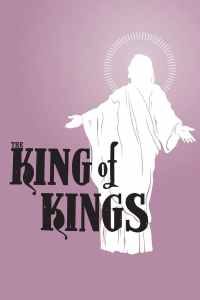 The King of Kings is arguably Cecil B DeMille’s most famous silent film. A director most known today for the Golden Globe lifetime achievement award given in his name, and for his final film (the Charlton Heston-starring The Ten Commandments), DeMille made 70 silent and sound films in his career. The King of Kings is just what it sounds like, the story of Jesus, and specifically his final days, crucification, and resurrection. Like just about every biblical film, there are a lot of liberties taken to “flesh out” Jesus, showing everyday events that were not in the Bible, but as a whole, the film tries to keep as close as possible. Even much of the “dialogue” (intertitles) is direct quotes from the Bible, with book and verse number in the bottom right. It’s a good film, though it definitely feels dated, and not just because it came out in 1927. I’ve seen a lot of those old films by now that are just as entertaining today, and while this one is well acted, well shot (for its day), and uplifting in all the right spots, it still “feels” old.
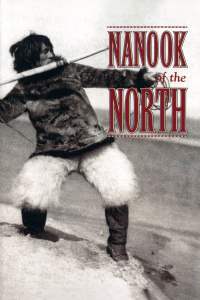 Nanook of the North is one of the oldest films I’ve ever seen, released in 1922. Ostensibly a documentary, but with its fair share of “directorial liberties,” it follows a far northern Eskimo called Nanook and his family. The film receives a lot of criticism today for having some scenes staged, but it was ground breaking at the time, for both the effort that went into its filming (with very large gear in 1922!) and for giving the documentary genre (a name that wouldn’t be coined for a few more years) some direction and story, giving it an almost romantic-like feel. Obviously pre-code, there are a lot of scenes that would never fly just a decade later, such as showing the hunting and gutting of animals, Nanook’s multiple wives (and their nakedness when they prepare for bed), etc. But it is a startling film depicting the harsh life in the far north, so long ago.
 People on Sunday is a German silent film which, I’m convinced, has only stood the test of time because of the people involved in it. The quasi-documentary has a loose story about people enjoying their day off. A duo of men spend the time trying to pick up women, who both end up interested in the same man, creating jealousies. The film is interesting because it depicts Weimer Germany in 1930 before the rise of the Nazi party, and it is funny, because the clothing, hair styles, antics, and style of life could just as easily be USA at the time. Oh what the course of history can do! Honestly the film is a bore until they get to the beach, then it opens up in the second half. But as I said, this film is most notable for the pre-famous people behind the camera. It is directed by Robert Siodmak (Hollywood noirs) and Edgar G Ulmer (noirs and Hollywood B movies), with a screenplay by Billy Wilder (big name obviously, with movies like The Apartment and Some Like It Hot), and cinematography by Fred Zinneman (who would later win 4 Oscars). All four men fled Germany during Hitler’s reign and found themselves in Hollywood to launch their stardoms.
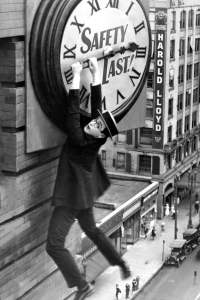 Ending today on a high note with one of the best comedic actors of the silent era, Harold Lloyd, in Safety Last! This is a romantic-comedy about a man who comes to the big city to get rich so he can marry his girlfriend, but finds himself working as a salesman in a department store. He regularly sends letters home pretending that he has made it big and will send for his girl soon, but in reality he is just barely scraping by. When she decides to go to the city and surprise him though, he needs to find a way to make money quick so as to marry her. He approaches the president of the company about a scheme to climb to the top of the skyscraper as a publicity stunt, to which the owner agrees and offers to pay $1000. Of course it doesn’t go so well, but does generate the famous scenes of Lloyd hanging from the roof. A fantastic film that is truly laugh-out-loud funny, it showcases Lloyd as the perfect everyman comedic actor of the silent film era.

 Jons Movie Takes
2 thoughts on “Quick takes on 5 Silent Era films”