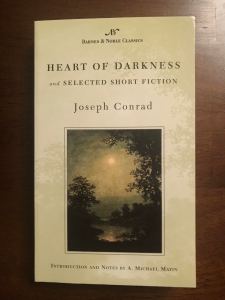
Joseph Conrad’s Heart of Darkness is a fascinating short book, or novella, even more so because it is light on plot, and even lighter on substance, but it is inarguably engrossing. Released in 1899 and the loose inspiration for the film Apocalypse Now, it reads as a story told by Conrad’s favorite explorer and adventurer, Marlow. Marlow is telling his listeners about a time he traveled up the Congo River deep into Africa, following a legend of a man named Kurtz.
Marlow begins with how he was sent there in the first place, but the book really gets going when he arrives at the “Outer Station.” He begins hearing rumors of a man who has a voice that can sway all people into doing what he wants, even the local “savages” and cannibals. There are tales that this man is sending in more ivory (the extremely valuable reason the British are in the area at all) than all of the others combined. Marlow is intrigued but doesn’t put much faith into legends. But as his trek carries him to the Central Station, and then finally to the Inner Station, Marlow begins to believe everything he has heard. When Marlow finally meets Kurtz, who is near death from some unknown disease, he finds that the natives not only respect him, but downright revere him. It is only some of the other English that are jealous and despising towards Kurtz, especially the Manager who wants a cut of the money Kurtz has been bringing in, or at least the knowledge of where Kurtz is finding his ivory.
Kurtz dies shortly after being found by Marlow, and his final, anguish-ridden words are simply, “The horror! The horror!” Marlow returns with the news back to England. There, the company also just wants info, hoping that Kurtz passed along something before his death. But Marlow either has no information, or is unwilling to enlighten them. When Marlow visits Kurtz’s fiancee, she asks what his final words were, and Marlow tells her it was her name.
This book lives up to its name. From the opening sentences, and progressively through each page, it gets darker and more foreboding. Conrad does an amazing job of describing the murky fog, the agitated steamboat workers, and the sense of dread as the boat works its way slowly up the river. And it is extremely ambiguous, which in this instance, is not a bad thing. At the conclusion, we don’t know how Kurtz did what he did (other than his power of persuasion). Other evils that are hinted at being attributed to Kurtz, like heads on a stake at the Inner Station, and whispers that Kurtz’s methods are “unsound,” are never explored, but definitely add to the sense of trepidation. Really enjoyed the 2 books of Conrad’s that I’ve read on this trip (the other being Lord Jim).

 Jons Movie Takes
One thought on “Suspenseful, bleak thrills in Conrad’s Heart of Darkness”