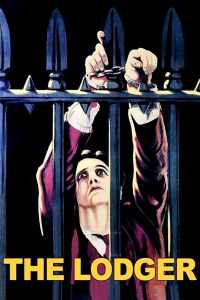
 Going to look at some of Hitchcock’s perhaps lesser known films today, including two from the silent era (yes, Hitchcock made several silent films). First up is The Lodger: A Story of the London Fog, from 1927. This was Hitch’s third film, and his first psychological thriller, obviously the genre he is most famous for. Daisy is a cute young blonde at a time when that is not such a good thing. A serial killer known as “the Avenger” is Jack Ripper-ing it up around London, targeting fair haired women. When a witness finally spots him and describes him as a tall young man hiding his face in a long scarf, just such a man shows up at Daisy’s house, requesting to stay in the advertised open room. The new lodger moves in, and in Hitchcock-ian humor, begins to ominously tell Daisy how beautiful her blonde hair is, and promising to “get her real soon” when they play chess, while carefully reaching for the fireplace stoker (only to move the coals around of course). When he quietly stalks out the night of the next murder, and Daisy’s mom notices, he becomes suspect number one. If you know Hitchcock at all, you know all ready if he is really the murderer or not. A little slow to get going, and a little slow in the latter third as well, but ultimately a fun, early slice of Hitchcock thrills.
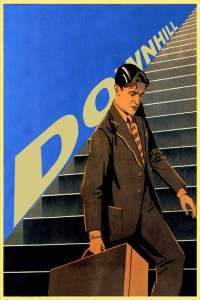 His next movie was Downhill, released the same year, and starring the same lead actor (Ivor Novello). In this dramedy, Roddy Berwick is a man with the worst luck in women. It begins at an exclusive all-boys school, where he takes the fall, protecting his best friend, and says it was he that got a local shop worker pregnant. Roddy gets expelled from school and cut out of his affluent parents’ inheritance. A little while later, he is scraping by as an actor and falls in love with the lead, but he only gets her attention once he has inherited 30 thousand pounds from his deceased godmother. They marry, but aren’t together long before she wipes out his money on lavish purchases and leaves him for another man. It doesn’t get any better any time soon for old Roddy, as he becomes a cheap gigolo in Paris. The film has funny moments, but ultimately there’s nothing to write home about. If any other director had done it, this is the kind of film that would have been lost to time, and maybe it should have been. Not terrible, but not memorable either.
 Sabotage came out in 1936, adapted from a work of renowned writer Joseph Conrad. The film opens with a deliberate blackout in London; an act of sabotage has cut power everywhere for a few minutes. Mrs Verloc and her husband Karl run the local cinema, and while Mrs Verloc holds of the perturbed crowd wanting their money back, Karl sneaks in the back, it being implied that he was behind the power outage. We soon learn that he is being paid by a group of shady men, to what purpose we don’t know yet, but what’s more, is they are under surveillance by Scotland Yard. A bigger, more dangerous event is planned by the group, with the help of a bomb maker. As the day approaches, Hitchcock ratchets up the suspension. Lot of trademark Hitchcock camera closeups and slow pans to create unease. I didn’t much of this movie for a good portion of it, but the ending is very good.
 He followed the next year with Young and Innocent. It starts well enough: there’s a fight between two people during a storm, and the next morning, the woman washes up on shore, the victim of a strangling by a raincoat belt. The first man to find her is the prime suspect. Robert knows he’s innocent, but to prove it, he needs to find his stolen raincoat out of town, to show the belt used was not his. He is aided by the chief police constable’s daughter Erica, who reluctantly believes he didn’t do it. The duo dash off to the countryside and unfortunately, the film reverts to an almost-comedy romp. There are good moments, but definitely not one of Hitch’s best. The lead actress is great as the irresolute heroine, and the camera loves her, but that may turn out to be the only memorable aspect for me. Unfortunately a fairly boring movie.
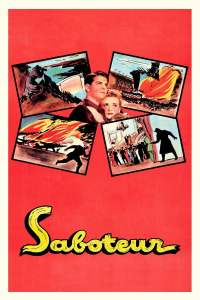 Saboteur is one of Hitch’s early Hollywood films, and was released in the early days of America’s involvement in World War II. An aircraft factory is destroyed in a fire, and a man dies in the blaze. The man’s friend, Barry, is suspect number one, but Barry knows he is innocent, and he has a single clue to follow to attempt to prove his innocence before the cops can catch him. As the mystery unravels, he finds a plot to undermine the country, with further sabotages planned. Of course there’s a girl that Barry gets tangled up with too. This is pure Hitchcock through and through, so if you are a fan, you’ll love it, and if not, you’ll think the plot is a little too much like the more popular North by Northwest that would come later.

 Jons Movie Takes