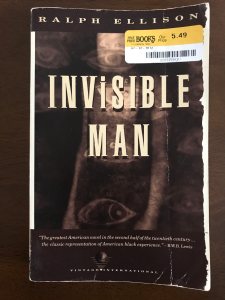
Ralph Ellison’s book Invisible Man is one of those reads where I know I’m reading a ground-breaking, beloved novel that was important to a whole lot of people, but I just couldn’t get into it myself. I didn’t think it was very well written, with the lead character far too one-dimensional for my tastes (especially for a so-called transcendent novel). Having said all that though, I can still appreciate the historical significance of it.
The narrator of the book (never named) is a young black man from the south who has high hopes for his future. He goes to a respected all-black college and does well in class. However, when he is asked to chauffeur Mr Norton, a white donor, the trajectory of his life changes. He ends up taking the rich man to the former slave buildings, now homes to the poor, where they come upon a man named Trueblood. Trueblood used to work at the school but scandalously impregnated both his wife and daughter. Mr Norton is aghast, and when he feels ill, the duo stop at a rough-and-tumble bar, where Mr Norton is further shaken by mental patients (from the local hospital) and prostitutes. Upon returning to the school, our narrator is expelled for his poor decisions. To earn money with hopes of returning to school in a year, he moves to New York.
In New York, our young man, through a series of events, ends up in a Communist group known as the Brotherhood. The Brotherhood tells him they have great plans to uplift the black men of the city and improve their lives, and realizing the potential in our main character, they make him a spokesman for the Harlem area. He is able to give thoughtful and rousing speeches, but when he is accused by a spiteful member of being out for personal attention (putting “me” before “the group” is anathema to the Brotherhood), our speaker is removed from Harlem and sent to work on women’s causes in a different area. When he returns to Harlem later, he finds that the area has been neglected in his absence, and the black people living there have not seen any improvements.
These events, along with the death of a close friend (whose death is politicized by the Brotherhood but otherwise ignored), make the narrator realize that they really don’t care for the lives of the black men in New York or anywhere else; they are just being used to further the cause of the group. The narrator abandons the group and goes to live in seclusion, in an underground room, where he is located at the beginning of the novel. He laments about his social invisibility and asks the reader to be aware of his own life lest he become invisible too.
My problems with the book are many. I had a hard time connecting to our narrator. He calls for action, but why should I believe him now when he only took up with the Brotherhood because he was a good speaker (he admitted at the start that he didn’t necessarily agree with their credo). He never really seems to have any ideas of his own, only feeding off what others tell him. He is too quick to anger, and for a supposed learned man, doesn’t think things through very well. He is too easily manipulated, which gave me a lot of frustration as the reader. And the book was far too long-winded. Long speeches that could be summed in half the time, tangents that don’t get explored, wordy dialogue that sometimes is on point, but more often than not seems juvenile or thoughtless. I can appreciate that if I were a young minority reading this, I could be moved to make sure I have a voice, but as a novel, as a piece of fiction, I don’t think it is very good.

 Jons Movie Takes
One thought on “Ellison’s Invisible Man fails to materialize”