I don’t think I’ve seen a lot of German films in my life, and what better way to catch up a bit than with one its countries most famous directors, Rainer Werner Fassbinder. Fassbinder was to the New German Cinema movement what Godard was to the French New Wave, and though he died young at the age of 37 in 1982, in his short life he directed over 40 films. Today I’ll look at some of his first big successes.
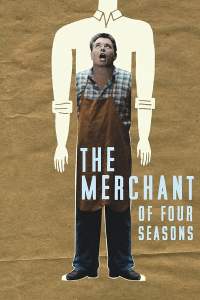 The Merchant of Four Seasons came out in 1971. It is about Hans, a man for whom life hasn’t given any breaks. He is a fruit vendor, a job for which his mother despises him (though as we see in flashbacks, she did so long before his career path was chosen). He is married to a woman, Irmgard, who is his polar opposite, a fact driven home even by their statures, with Hans being short and stocky and the slim, tall Irmgard towering over him. Though life itself doesn’t seem to like Hans, the viewer does, because he is portrayed as a likeable “everyman.” When he has a heart attack though, and the family needs to hire someone to push the fruit cart around town, even the veneer of happiness Hans tries to eke out at home is ruptured. At times throughout this film, I found myself thinking it wasn’t very entertaining as a picture, because events just sort of happened without any sort of meaning, almost like I was watching a modern day reality show following the everyday life of an average man. But as the film drew towards its conclusion, I realized the brilliance of this movie. Fassbinder does an amazing job of fleshing out Hans, and the viewer knows him through and through by the end, warts and all. By the end, I ached for the way Hans’ life turned out. Loved the movie.
 The Bitter Tears of Petra von Kant was Fassbinder’s big breakout in 1972. Petra is a wealthy clothing designer, but her money hasn’t bought her happiness. She lives alone with only a maid, Marlene, whom von Kant bosses around in a degrading manner. One evening, Petra meets Karin, a young and shallow beauty, and Petra instantly falls in love. Petra showers Karin with everything she wants, but 6 months later, Karin admits she was only using Petra for the lifestyle and does not love her. She moves out, leading to a severe depression in Petra, which is only abated by help from her family. For much of this movie, I was wondering where all the praise for this film comes from. It didn’t seem to be getting anywhere fast, and whole conversations go nowhere (Karin and Petra spend what seems like 15-20 minutes discussing trivialities like their favorite subjects in school), but then the ending came. Absolutely stunning, and from that, the whole film is painted in a new picture. A fantastic character study in both sadism and masochism, love and hurt, and ultimately, what can bring happiness. Going to have to watch this one again.
 25 years before The Matrix depicted people living out their lives unknowingly inside a computer program, Fassbinder brought us the same in World on a Wire. Fred Stiller is the technical director of a computer program called The Simulacrum. Devised as a way to predict human needs in the future, the Simulacrum is full of programs who think they are human, going about their lives in a virtual space. Stiller’s predecessor was a man named Vollmer, who died suddenly. Stiller isn’t on the job for long when he notices the head of security, Lause, has also disappeared suddenly, but more peculiarly, no one in the company remembers him. While investigating Lause’s disappearance, it isn’t long before Stiller begins to question his own existence. Part neo-noir and part science fiction, World on a Wire is a great mystery that opens up questions about the meaning of life. It’s a bit long at 3 ½ hours (it was originally a 2 part miniseries), but it is well worth the trip, and far ahead of its time in 1973, at a time when computers don’t even resemble what they’re capable of now.
 By the time I got to Ali: Fear Eats the Soul, I was really warming up to this director. This one does not start slow, but gets you right into the meat of the film. This film is about race relations, and on a larger scale, how the general public can turn on minority groups. In it, a widowed older lady, Emmi, falls in love with a young black man from Morocco, Ali. At this time in Germany, Arabs were looked down by society in much the way that black people were in America, and both Ali and Emmi are very lonely, Ali because of his race, and Emmi because of her dead husband and grown, absent children. They find love in each other, but over time, Emmi’s attitude towards Ali harshens to be more like her friends’ attitudes towards him, leading to strife in their relationship. A good film to open your eyes to problems that existed in the 60’s and 70’s and still exist today. Chuck full of tidbits that really stand out, like Emmi’s neighbors gossiping that she isn’t a “real” German because of her Polish last name from her first husband, and how she is alienated from her coworkers when her relationship with Ali starts, but gets back in their graces when the company hires an immigrant from Yugoslavia, someone new they can ostracize. The film (and much of Fassbinder’s output in this era) was inspired by the work of director Douglas Sirk, and this film in particular by All That Heaven Allows.
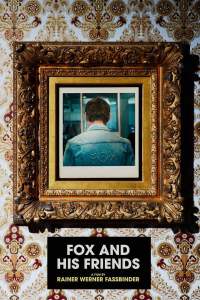 Fox and His Friends isn’t as “deep” as the four previous films I watched, and is a much more direct film. Franz (nicknamed Fox and played by Fassbinder himself) is a working class gay man who wins it big through the lottery, winning 500,000 German marks. He never cared much for money and it doesn’t seem like his cash flow is going to change him, until he gets swept off his feet by a swindler, Eugen. Eugen sees an easy target, and after telling his boyfriend they need to take a break for awhile, he woos Franz and starts milking him for all of his fortune. They buy a modern apartment, furnish it extravagantly, and pump money into Eugen’s family’s failing business. Franz doesn’t realize what is going on until he is broke and dumped, going back to his sister’s apartment with nothing left. Franz’s true friends, whom he dumped when he was running in high society with Eugen, are still hanging at the local bar. I liked Fassbinder’s other films more, but this one still features a very well written story and excellent direction.

 Jons Movie Takes
Not seen Merchant or Wire, but the rest are all good. Thanks for reviewing!
LikeLike