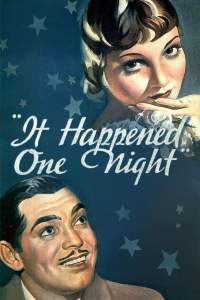
 It Happened One Night, considered one of the greatest romantic comedies of all time, came out in 1934. Starring a young Clark Gable and the arresting Claudette Colbert, it is about a young rich girl, Ellie, who has recently eloped with a pilot only interested in her for her money. Ellen’s father wants the marriage annulled and is keeping her captive on his yacht, but she escapes and attempts to flee to her husband in New York. On the bus ride there, she crosses paths with a down-on-his-luck reporter named Peter. Peter sees an opportunity to write a story about Ellie’s road adventures to New York and agrees to get her there, but of course fate has the two fall in love along the way. Delightful and funny, this film has it all. One of the last pre-code films, it has some great lines that would disappear from Hollywood for a couple decades, such as, “Remember me? I’m the fellow you slept on last night,” as well as salacious scenes of Gable and Colbert undressing in the same room (albeit with a screen separating the unmarried couple). This film was the first (and one of only 3 to date) to sweep the “Big 5” Oscars: picture, director, screenplay, actress, and actor, Gable’s only best actor win despite his illustrious career.
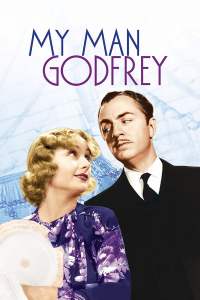 My Man Godfrey is a comedy featuring an ensemble cast including William Powell as the eponymous Godfrey. He is homeless and living in the dump by the river when he is scooped up by a rich family and brought home to be their butler. Here, we see the rich socialites are bananas, and Godfrey is submitted to a crazy household where the characters act unbelievably crazy and no one calls them out on it due to their wealth. It isn’t long before the youngest daughter falls in love with him, and we learn that Godfrey is keeping a secret about his past. The film is laugh-out-loud funny and serves as a biting criticism on the gap between the wealth classes in 1936 (and today). The acting and dialogue are better than the film as a whole, but still very enjoyable.
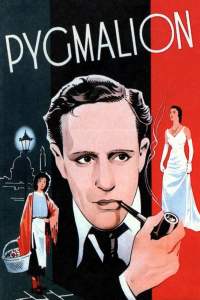 “The rain in Spain stays mainly in the plain.” Yes, that’s a famous line from the musical My Fair Lady, but it originates from the film Pygmalion, itself based on a play by George Bernard Shaw. Released in 1938, it stars Leslie Howard (a year before his famous turn as Ashley Wilkes in Gone With the Wind) as a speech instructor who takes a common girl (Wendy Hiller) under his wing, betting his friend that he can turn her into a lady in time to fool the dignitaries at an embassy ball in 6 months. Howard is perfect as the smart but uncaring gentlemen (he received his second Oscar nomination for the role) and Hiller (also nominated) is equal to him on screen; together they are fantastic. Extremely entertaining and funny movie. Howard also co-directed (along with the great Anthony Asquith) and the film was edited by future master director David Lean.
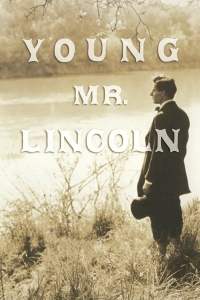 Young Mr Lincoln, directed by John Ford in 1939, stars Henry Fonda as honest Abe. Directed by one of the great directors about a great American portrayed by a great actor, I was ready for a tremendous film and was not let down. (Very) loosely based on a trial in Springfield, IL, two young men are accused of murder and Lincoln is their lawyer, arguing in their defense. Lincoln combines his “aw shucks” personality with a smart, almost manipulative guile to get what he wants through the trial and life. In the film, his political adversary, Stephen Douglas, hints that Lincoln keeps his cards close to his chest, and that most definitely seems true. Still, there is no outward showing of Abe being anything more than honest, forthcoming, and caring to his fellow man. The film is fantastic. Ford’s scenes play out powerfully with seemingly no movement or pause in speech not carefully considered, and Fonda’s portrayal of a man on a course with destiny is sublime. Fonda’s Lincoln oozes charisma and commands the room when he walks in, and it is easy to think this was much the way Lincoln moved and spoke.
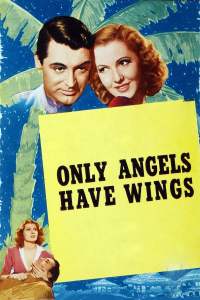 Only Angels Have Wings is a fantastic old film directed by Howard Hawks. It is about a group of pilots working for a mail service in South America and the perils they face flying through the mountains in harsh conditions. Their leader is Jeff Carter (the dashing Cary Grant), who never asks his men to make flights when the conditions are at their worst, instead taking those risks himself. Bonnie (Jean Arthur) arrives and instantly is smitten by Jeff, but he can’t get attached to women due to a bad past relationship. The other pilots on the team are Jeff’s friends, including his best friend “Kid” Dabb (Thomas Mitchell, famous as Gerald O’Hara in Gone With the Wind and Uncle Billy in It’s a Wonderful Life). Kid is a great, but aging pilot who seems to like everyone except one man, a pilot who once bailed out of plane in harsh weather leaving his copilot to due, the copilot being Kid’s little brother. When that cowardly pilot shows up in Jeff’s team, with Jeff’s former girl on his arm no less (Rita Hayworth in her breakout role), everyone has to put their animosity aside to get the job done. A very emotional film that has it all: love, heartache, and triumph. The camera work of the little 2 seater planes flying through the mountains is harrowing today, much less in 1939 when the film came out.

 Jons Movie Takes
One thought on “Quick takes on 5 classic films of the ’30s”