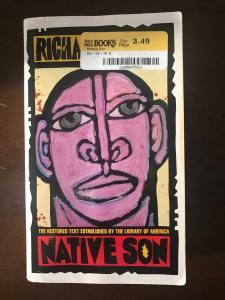
Richard Wright’s Native Son is a book, published in 1940, dealing with the lack of power of African-Americans in our country, even over their own lives. Bigger Thomas is a young man who has no control over his life or his circumstances. He and his 2 siblings (younger brother and sister) and their mom all live in a single room apartment on the south side of Chicago, the area where most of the black people are allowed to live. With blocks full of crumbling, dilapidated apartment buildings, not in much better condition than the empty condemned ones they sit next to, the residents live off the scraps that the wealthy white class give them. Bigger is given an opportunity for change when he is hired as a chauffeur for the Dalton family, a family who has given millions in support of programs to help black people in the city. However, Bigger doesn’t like this situation any better than his previous one.
Whereas Mr Dalton thinks he is helping Bigger, and his daughter Mary and her boyfriend Jan (a communist who advocates for labor changes and the advancement of all races) seem to treat Bigger more equally than he is used to from other whites, he still despises them all, for a reason that he himself cannot put a finger on. On his second day of work, he brings a drunk Mary home, carries her up to her bedroom, and when her blind mother pokes her head in the room, Bigger suffocates Mary to keep her silent, for fear of being caught in the room with her. When the mother leaves, he carries Mary down to the furnace, cuts her head off to get her to fit, and shoves her in. Bigger hatches a plan to blame her disappearance on Jan, knowing the city’s distrust of communists, and later even pulls his girlfriend Bessie into a scheme to send a kidnapping note for ransom. However, when the bones turn up in the furnace, Bigger runs. When a fearful Bessie pushes back, Bigger kills her too, bludgeoning her with a brick after raping her. He is shortly thereafter captured, and goes to face trial with the mountain of evidence against him for both murders.
A hand reaches out to help in the form of Max, a Jewish lawyer and communist. Max argues that Bigger only did what society made him do, that a man with no hope of ever achieving anything in life is left with the need to control some aspect of his life, and for Bigger, this was hate towards white people. Max even argues that families like the Daltons, while seeming to help black people, really still enjoy the distinct lines that keep the colors separated. Max pleads for leniency, for life in prison rather than the death penalty, but the judge ultimately sides with the angry mob and sentences Bigger to death. The last scene has Max and Bigger talking, and Bigger, for the first time in the book, is able to put into words what he has been feeling throughout. Max was on the right path, but didn’t go far enough. Whereas Max was hoping to show the world that there is hope and possible redemption for people like Bigger for whom white society has wronged, Bigger is finally able to explain that he is beyond hope, beyond saving, and he is damaged beyond help.
At various points in this book, I loved it and despised it. I never could get behind seeing Bigger as a tragic hero. In my book, anyone who kills, except in defense, is deserving of justice, and I’m all for the death penalty for brutal crimes like Bigger’s. I think what Write was trying to get across is that Bigger’s murders were in defense, a defense against a white society that he was too small to fight against, so he fought it the only way he could. But I don’t buy it. Granted, I’m coming at this from the background of a privileged white person who grew up 50 years after this book’s writing, and I hope things have changed a lot. I do not argue that it is eye opening to get into a person’s eyes and see the world in a way much darker and more hopeless than I ever could. I’m sure there are plenty in the inner city who still feel this way, and I’m equally sure this is what drives much of the crime the same way it did Bigger. But murder is murder, and for that alone, I could never get behind Bigger or Max’s arguments. A fine read, but a flawed one for me personally.

 Jons Movie Takes
2 thoughts on “Bigger is the damaged Native Son America created”