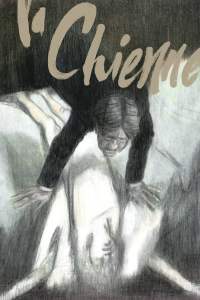
 Jean Renoir is perhaps the most renowned French director of the early sound era, and today I’ll look at five of his films from the 1930’s. La Chienne (“The Bitch”) was his second sound film (the first, On purge bébé, was more of a proof of concept to show studios he could make a sound film on time and on budget. It’s a farce and is not very good…). An opening narrator says this movie is like a lot of movies, it has a “him,” a “her,” and “the other guy.” The “him” is Legrand, a smart man to whom life has given a boring job and a shrewish wife. The “her” is Lulu, a prostitute in love with her pimp, “the other guy,” Dede. Legrand falls in love with Lulu but fails to see the obvious, that she is playing him for money which she forfeits over to Dede. This goes on for awhile, until Legrand finds a way to leave his wife (her long-thought dead first husband appears, effectively nulling Legrand’s marriage to her). He expects to now have a life with Lulu, but she laughs in his face and admits to her duplicity. In a fit of rage, he kills her, but the murder is pinned on Dede, who gets the death penalty himself. The final scene flashes forward many years, to a homeless Legrand (and the first husband!) who obviously has lost everything. Before its release, the film got the kind of publicity you can’t buy. The actors who played Lulu and Dede really were involved, and Legrand really liked her, so much of the on-camera emotions was not made up. Unfortunately Dede used money from the film to buy a car, and wrecked it with Lulu inside, killing her, before the film came out.
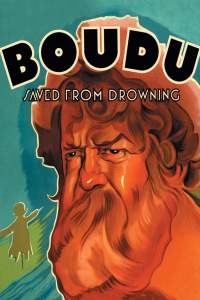 Boudu Saved From Drowning is a delightful film from 1932. It isn’t quite as polished ascetically as La Chienne, it has a much deeper element and is more thought-provoking. Boudu is a vagrant by choice, carefree and aimless. An early scene shows a family give him $5 as charity and he is bewildered, and in turn he gives it to a wealthy man because he doesn’t see a need for it. However, when Boudu loses his dog, he tries to kill himself by jumping in the river. He is rescued by a bourgeois man, Edouard Lestingois, who takes him into his family to teach him culture. Comedy ensues as Boudu tears up the house, with little regard for personal property or manners. Edouard continues to try to fit the square peg in the round hole, until Boudu finally goes to far and is kicked out of the house. Boudu takes it in stride though; he swaps his newly acquired fine suit with some rags from a scarecrow, and walks on down the road back to his preferred lifestyle. Obviously the question becomes, which drowning was Boudu most in danger from: the river, or a life society told him he needed to live? Very nice little film.
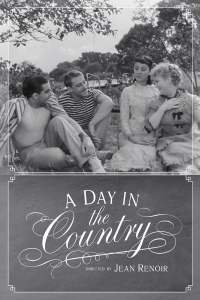 A couple years later, Renoir started a film named A Day in the Country. However, he left it unfinished when he was called away on another project, and it wasn’t until 1946 that his crew put some title cards in it to explain some missing sections, and released it. The film follows a single day when a working class family from Paris goes out to the countryside for a day of picnics and relaxation. The man of the house wants to show off his knowledge of fishing, but the women, his wife and daughter in particular, just want to relax. A local couple men take the women out boating and flirt with them, and years later, the daughter returns to the secluded grove and reminisces about “the best day of her life.” It was always meant to be a short feature, but I can’t help but feel at least some middle section of the film was left unfinished, and I felt sadness for missing out on how lovely this film could have been. The movie exudes yearning and love from every pore, showing the beautiful scenic river and young lovers languishing along its banks. Maybe I just wanted more than the 40 minutes it gave me.
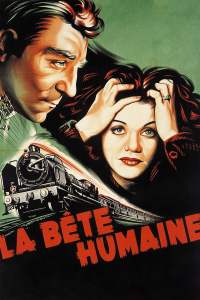 La Bête Humaine is as emotionally charged a film as you will find. It centers on a group of people living in the railroad industry. Lantier is a train engineer making daily runs between Paris and Le Havre. He’s a good enough guy, but worries that he is paying for the sins of his hard-drinking and hard-living father and grandfather, saying that that much sin in your past lives in your blood. The station manager in Le Havre is Roubaud, a man who is extremely jealous of his wife Séverine, whose beauty catches eyes wherever she goes. When Rouband finds out she’s previously been a mistress to a wealthy local man, Grandmorin, Roubaud kills him. Shortly thereafter, Lantier falls for Séverine, and in fear of her and his life, she tries to get him to kill her husband Roubaud. Lantier can’t go through with it, but when he is confronted by Séverine, the evil inside him comes out and he does kill her. Unable to live with his deeds, he jumps from the moving train the next day. The film is full of the life and the hustle-and-bustle of a busy train station, and moves at a frenetic pace. A very intense film with fine acting by Jean Gabin as Lantier (who had recently become famous for his role in Renoir’s first big hit, The Grand Illusion). This film was based on a book by Émile Zola’s book of the same name, which was also the muse for Fritz Lang’s ’50’s film Human Desire, though with a lot of changes to satisfy Hollywood sensors.
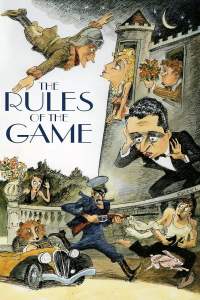 Renoir followed up in 1939 with The Rules of the Game, arguably his most famous picture today, though it was a colossal flop at the time. It features an ensemble cast trying to find love in 1930’s France. There are love triangles and quadrangles, full of couples where one person is deeply in love (or at least jealously possessive of) one person, while their lover is in love with someone else. Most of the action takes place during a week of hunting at a bourgeois estate, where couples are secreting off to kiss, and constantly ducking from husbands/wives/significant others. The films plays out as a comedy (such as the moment when one spurned husband is chasing his wife’s lover with a gun around the home, and the rich guests think it is part of the entertainment), but ultimately feels like a tragedy where no one ends up happy in the end. This dichotomy may be a reason why the film so spectacularly flamed out upon its release in France, or possibly also because it so blatantly pokes fun at a bourgeois society that made up the chunk of paying customers at the theater at the time. Looking back though, I think it clearly shows a time of uncertainty, a feeling of something lost, and a fear of what the future may bring, which fits perfectly in 1939 France. Most deserving of its hailing as one of the best films ever made. This was Renoir’s last film before leaving France for Hollywood, just before the country was invaded by Germany.

 Jons Movie Takes
One thought on “Quick takes on 5 Renoir films”