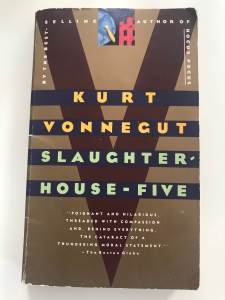
Kurt Vonnegut’s Slaughterhouse-Five is a hard book to summarize. I can give you the loose plot elements, but the meaning of the book is so much more than the plot itself. There’s a lot going on here in its meager 200 pages.
The book follows Billy Pilgrim, sort of a nobody, below-average person. Not physically imposing nor handsome, not bright nor athletic, he’s not even an every-man. The book reads in a non-linear fashion, because Billy’s life has been non-linear. At some point as an adult, Billy is kidnapped by aliens (Tralfamadorians) and he becomes “unstuck” in time. The Tralfamadorians see 4 dimensions, the fourth being time, and somehow this rubs off on Billy. One moment he’ll be fighting in World War II, and when he blinks his eyes, he’ll be a child again. The overall plot deals with these large moments in Billy’s life: his alien abduction, his capture by Germans at the Battle of the Bulge, his handling by them at labor camps, and his survival in a cellar at Dresden during that city’s famous bombing. Throughout the book, Billy seems only a witness to all of these events; though he is an participant, it seems things are going to happen regardless if he is there or not. That leads to (I think) the overall argument of the book: the balance of fate vs free will.
There’s a poignant time during Billy’s time with the aliens. He tells them about the atrocities on his planet Earth, that he thinks over time, they can create weapons that will not only endanger themselves, but that they’d take these weapons in space to endanger all civilizations on other planets. The Tralfamadorians laugh, saying that isn’t how the universe ends. Because they see all of time the same way a human looks at a mountain range from the distance, they know that one day, one of their own will be working on a new space engine when something goes wrong, and it will wipe out all of existence. Billy asks, if they know this will happen, why don’t they stop it. They are confused, maybe even make a little laugh, and reply that, it all ready happened, it will happen, it is all the same. In the same way, when he asks why they chose him to take, they answer back, why him, why them, why anything? This greatly affects Billy’s outlook on life, knowing that events are going to happen no matter what he or anyone has to say about it. This is in start contrast with everything Billy thought he knew as a younger person, raised a Christian, and he tries to reconcile his previous thoughts of free will vs the Tralfamadorian’s view of “fate.”
For a book that seems so deep, it also has a lot of humor. Because death is practically meaningless to Tralfamadorians (because they exist before and after death at the same time), when someone dies, they simply replay “so it goes,” meaning, it’s just another moment in their life. So anytime anyone dies in the book, whether gruesomely in front of Billy during the war, or quietly at home, Billy doesn’t get upset, it is simply, “So it goes.” His sort of deadpan outlook on life is funny from page to page and never gets old. I enjoyed this one a lot more than the previous book I’d read (Cat’s Cradle) and it may get me to read some more Vonnegut in the future.

 Jons Movie Takes
One thought on “Vonnegut questions intrinsic beliefs in Slaughterhouse-Five”