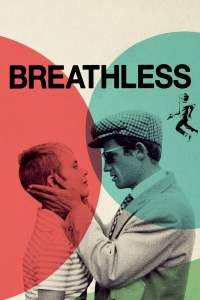
 Not the first of the French New Wave (Truffault and Resnais, among others, beat him to the punch), but without a doubt it was Breathless that brought the movement to the world’s consciousness. Paradoxically an uptempo film with long shots, showcasing the gritty feeling of a Paris culture infused with American cinema style, and a jazzy soundtrack that sometimes seems at odds with what is happening onscreen (but which you later realize is inherently intertwined), Breathless is a masterpiece. It is about a ne’er-do-well who, in the first few minutes of the film, steals a car, abandons a girl, and kills a cop. However, he does have one thing keeping him from getting away with it all, and that is the love of an American girl. He doesn’t even want to admit to himself that he loves her, but it is apparent when he has chances to head out of town but keeps coming back to her. The real focal point of the movie though, as a New Waver will tell you, is the movie itself, and the story is almost secondary. Jean-Luc Godard put his stamp on the world with this, his first, film.
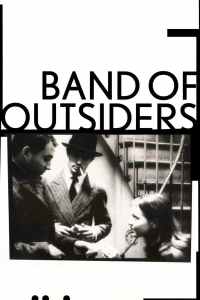 Band of Outsiders is what happens when a classic American heist film hits the French New Wave. It follows a trio of young people, Franz, Arthur, and Odile (the charming Anna Karina), as they rob Odile’s wealthy aunt. Franz and Arthur are your typical Godard men with a rebel streak, and they think Odile is a dumb girl, but really she is just young and naive. The movie is funny and engaging from its opening moments, and is often considered one of Godard’s most optimistic films, though it definitely had a dark undercurrent running through it too. There’s also a famous dance scene in the movie that you’ll recognize as having influenced several movies and shows you’ve seen. Certainly the most accessible of any of these Godard films I’m watching today.
 I have really liked most of the Godard films I have seen, but unfortunately was not able to find that joy in 2 or 3 Things I Know About Her. The Her in this case is Paris, and Godard presents the film almost as a pseudo-documentary about the middle- and lower-middle class women who have to work as prostitutes to provide food for their families. There is a loose story as we follow a single woman with other smaller tales interspersed throughout, and there are moments I enjoyed, in particular, the voice-over narrator (voiced by Godard himself), who chats with the audience, often along with his actors who break the fourth wall, either as the character or sometimes as the actor themselves. But without a traditional story to follow, I felt like I was just watching Godard’s pessimistic views on the contemporary world and the ill effects of capitalism on society. A bit of a bummer for me, who has liked most of the other French New Wave films Godard produced.
 I liked Weekend, from 1967, a whole lot more than I anticipated. I had heard it was very political, and it is that, but hell if it isn’t a marvelously made film too. Godard’s attack on the west and capitalism is ramped up here. It is about a married couple who leave Paris to visit the wife’s mother and dying father, not to see him before his death, but to make sure they get their share of the inheritance. If that not-so-subtle hint of lost humanity for the sake of the almighty dollar isn’t enough for you, Godard rams it down your throat for the next 90 minutes. As the couple make their way through the French countryside, they are confronted time and again with the breakdown of society, until they end up with cannibals and anarchists at the end. The film is famous for its long, scrolling camera shots, the most famous being an 8 minute continuous take of a traffic jam on a country road. The camera continues to move steadily past a row of stopped cars, as we see the drivers and passersby engaging in traditional western activities, oblivious and/or uncaring to the death and hurt of the people in the accident at the front of the jam. Almost all of the movie is filmed from a distance, both to show the destruction going on around our couple, but also I think to dehumanize them. This could be any two middle class people, they could even be ourselves, if we become too wrapped up in our own world to notice what is going on around us. Really great film.
 After a decade away from making traditional films, in which Godard made movies with more political themes, he returned in 1980 with Every Man for Himself. At first I didn’t know what to think about this one. Godard’s character’s frequently have a rebel, devil may care attitude, but everyone in this movie seems to be a narcissistic asshat and/or terrible person. There is a father who sexualizes his daughter, the daughter and mother (ex wife) who only care for money and presents, and a prostitute who, when her very young sister asks for money, tells her she can earn it herself on the street instead. I think that’s actually the point of the film though. The characters are all emotionally detached from any kind of humanity, most notably in a scene where the prostitute is serving a couple men and all involved are just following directions by “the boss.” Like many of his films, music is closely intertwined throughout, to the point that some scenes are slowed down in order to let the music play out. Not one of my favorite Godard films, but not bad. And it does star the incredible Isabelle Huppert.

 Jons Movie Takes
4 thoughts on “Quick takes on 5 Godard films”