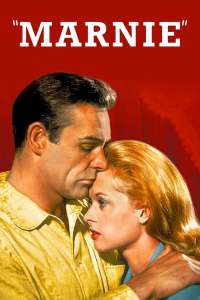
 Today I’m going to look at the last 5 films Alfred Hitchcock made. There are some good ones here, but generally they aren’t as well known as those that came before. We’ll start with Marnie, which came out in 1964, a year after The Birds. This one stars Tippi Hedren (also from The Birds) and a young Sean Connery, who at this point had only been James Bond for 2 films so far. Marnie is a kleptomaniac who bounces from company to company, staying only long enough to learn how to get into the safe and rob them blind, and in turn send the money to her secretive and hidden mother. She is finally caught by Connery’s character, Mark Rutland, but rather than turn her in, he decides to try to reform her, because he has fallen in love with her. The movie plays out as a psychological thriller, due in part to Marnie’s irrational fear of thunderstorms and the color red. Mark digs into Marnie’s past to try to find what drove her to be what she is, to a great conclusion. The ending makes the movie here; there are good scenes building to it but overall a fairly average film until then. There were moments when I rolled my eyes for the density of Mark and the one-sidedness of Marnie, but I did enjoy it at the end.
 Hitchcock followed with Torn Curtain, starring Paul Newman and Julie Andrews. Newman had obviously made plenty of films, but this was just Andrews’ 4th film, including her two big hits, Mary Poppins and Sound of Music. The eponymous curtain refers to the iron curtain, to which Sarah finds her fiance Michael is headed after receiving a mysterious message. She follows, and finds that he is renouncing his American citizenship to join East Germany, purportedly because the US government had shut down his research as a rocket scientist. Really he is there to find out what a German scientist (and by extension the USSR) knows about anti-missile systems, important info in the Cold War environment. What ensues is fantastic Hitchcock-ian paranoia, in a high stakes espionage setting. This film got some rough reviews upon its release in 1966, calling it tired and typical Hitchcock, but I enjoyed it. Though Alfred’s movies were probably feeling a bit old fashioned by 1966, with the French New Wave in storm and New Hollywood also getting ready to unleash, that doesn’t make it a bad film.
 Topaz came next, and kept with the Cold War setting, and based on the real-life Martel affair in 1962. Here, a man and his family defect from Russia to the USA. As a former high ranking member of the KGB, the man is grilled by our government for information about Russia’s involvement with Cuba. This info leads to a big brouhaha between the embassies and countries of USA, Russia, Cuba, and France. Sounds interesting, but unfortunately Topaz may be the dullest Hitchcock film I’ve ever seen. The humorous banter is flat – almost as flat as the acting – and the film crawls through scenes that never seem to reach a satisfactory conclusion. Worse, the plot shifts a couple times, leaving you feeling like it is just meandering along without cohesion. There are moments of tensity, such as when we see conversations taking place but we can’t hear what is being said, thus not knowing if there is a double-cross or some other secret being exchanged, but these don’t lead to any thrilling moments, and other moments that are meant to create tension fail to do so.
 After years in Hollywood, Hitchcock returned to England, and to the serial killer theme, with Frenzy in 1972. London is at the mercy of the neck-tie killer, who is raping women and then strangling them with a necktie. Blaney is an average man who is struggling with finances and bouncing from job to job, when his ex-wife becomes one of the necktie killer’s victims, and Blaney becomes suspect number one. No one believes his side of the story except his girlfriend Babs. We learn the identity of the real killer before too long, but have to watch him continue his misdeeds for awhile longer, to the detriment of Blaney. Hitchcock terror in a new age, since he can push the bar a little further in the 70’s than he could in previous films, including the first shots of nudity in any of his films. And we get some classic macabre humor in a scene or two as well. I liked it as a whole, though once we knew where it was headed, the ending dig drag on a little long for my taste.
 Hitch’s last film was Family Plot in 1976. It centers around two couples. Arthur and Fran are a pair of high-game robbers, fresh off a kidnapping/ransom that has yielded a huge diamond. Blanch and George are running a con involving Blanche pretending to be a psychic. Blanche has been approached by a wealthy older woman to find a long-lost nephew, the sole living family member who stands to inherit a fortune, and this quest presents a great mystery for the first 45 minutes of the film. Once the identity is found, the movie morphs into more of a suspense. In fact, a great scene with Blanche and George hurtling down a curvy road with his brakes out is as tense as it gets, and I held my breath throughout. How our 4 main characters are connected becomes apparent before too long, and the rest is a fun ride. It’s a good send-off for Hitchcock. His health was failing, and while he was working on a new script right up to the end, he died of kidney failure in 1980.

 Jons Movie Takes