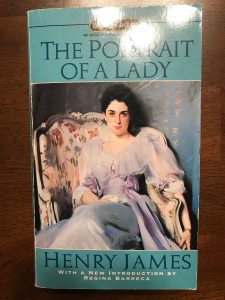
My third and final Henry James book is The Portrait of a Lady. This one is more like to The Bostonians (a wordy book that was good, but a bit tough to read) than The Wings of the Dove (still eloquent, but more accessible). Like the other two, this one again showcases James as a true master of the English language; he weaves together words as easily as I tie my shoes. This creates a very verbose narrative, but for those with the patience to get through it, it also foretells an enchanting and rewarding experience.
The eponymous lady is Isabel, a vibrant young woman from America who comes to Europe after the death of her parents, brought by her previously unknown aunt, Mrs. Touchett. Isabel is refined and well educated, but comes from no money, and Touchett and her dying husband have plenty. In England Isabel meets her cousin Ralph, a sickly man who enjoys every day knowing he doesn’t have many in front of him. She also meets a neighbor, Lord Warburton, a true English lord, who almost immediately falls in love with her. However, Isabel is obsessed with living life to the fullest, and is determined to not be tied down too early in her life. She declines Warburton’s offer of marriage, as she did a previous suitor in America as well, Caspar Goodwood. When Mr. Touchett dies, he leaves Isabel a small fortune (from Ralph’s insistence, who wants to see what Isabel, a beautiful young woman with unlimited prospects, can do with money behind her). Now wealthy, Isabel heads to Florence with her aunt.
In Florence, Isabel meets Gilbert Osmond, an older bachelor who seems to have class and charm, but no money. Madame Merle, another American who seems to be everything that Isabel hopes to be herself (elegant and full of life, and not caring what others think of her), subtly nudges Isabel into seeing something in Osmond. After traveling all over Europe over the course of a year or two, Isabel tells Ralph and his mother Mrs Touchett that she will marry Osmond. Both react with amazement, and pretty much tell her she is making a mistake, to which Isabel shows only resentment, thinking they don’t know him like she does.
Here the book jumps ahead 2 years. The Osmonds are established in high society thanks to Isabel’s money, and Gilbert’s daughter (from his first marriage) is a beautiful young woman attracting attention from eligible men. Everything seems fine on the surface, but over the next few chapters, we find that Isabel is miserable in her marriage. Everything she was attracted to in Gilbert turned out to be, well, not a lie, but not exactly what she presumed. His class and taste for the finer things was in fact due to his supreme egotism. Gilbert has always placed himself above all others, and only wanted a pretty young wife (with money) to give him all of the things to which he thought he was due. Even worse, whereas Isabel never previously cared what others thought, Gilbert cares very much that people think him to be the best of humanity, and makes Isabel throw weekly parties for society to come and fawn over him. And Isabel only blames herself for her predicament, since she didn’t recognize Gilbert for what he was in the beginning.
The family receives news that Ralph is finally dying, having returned to his father’s house in England. Gilbert, who covets Isabel as a he would a belonging, forbids her to go to, but Isabel finally stands up for herself, exposes Gilbert for the craven abuser that he is, and leaves. In England she is reunited with Warburton, who has finally given up his chase for her, and Goodwood, who has not. Goodwood tries to convince Isabel to leave Gilbert, but the ending is abrupt, and we do not know her final decision. It is implied that the strong-willed Isabel has finally given in to societal norms and will not leave her husband, but at the same time, perhaps she did, and James just didn’t want to write it as it would be taboo for the time he lived in. Completely up to interpretation.
Really I didn’t know what I wanted for Isabel in the end. She had one man (Goodwood) who obsessed over her to the extreme, to the point of being a stalker, and another (Warburton) who could have given her everything she needed, though obviously need and want are two completely different things. I found her just a person who couldn’t make up her mind; she felt like she wanted freedom but ended up roped into an impossible situation from where there was none. I think most people wanted to see her with Warburton, a true gentleman who would treat her well, but ultimately I think she ended up with what she deserved.

 Jons Movie Takes
One thought on “Inner turmoil for a modern woman in Portrait of a Lady”