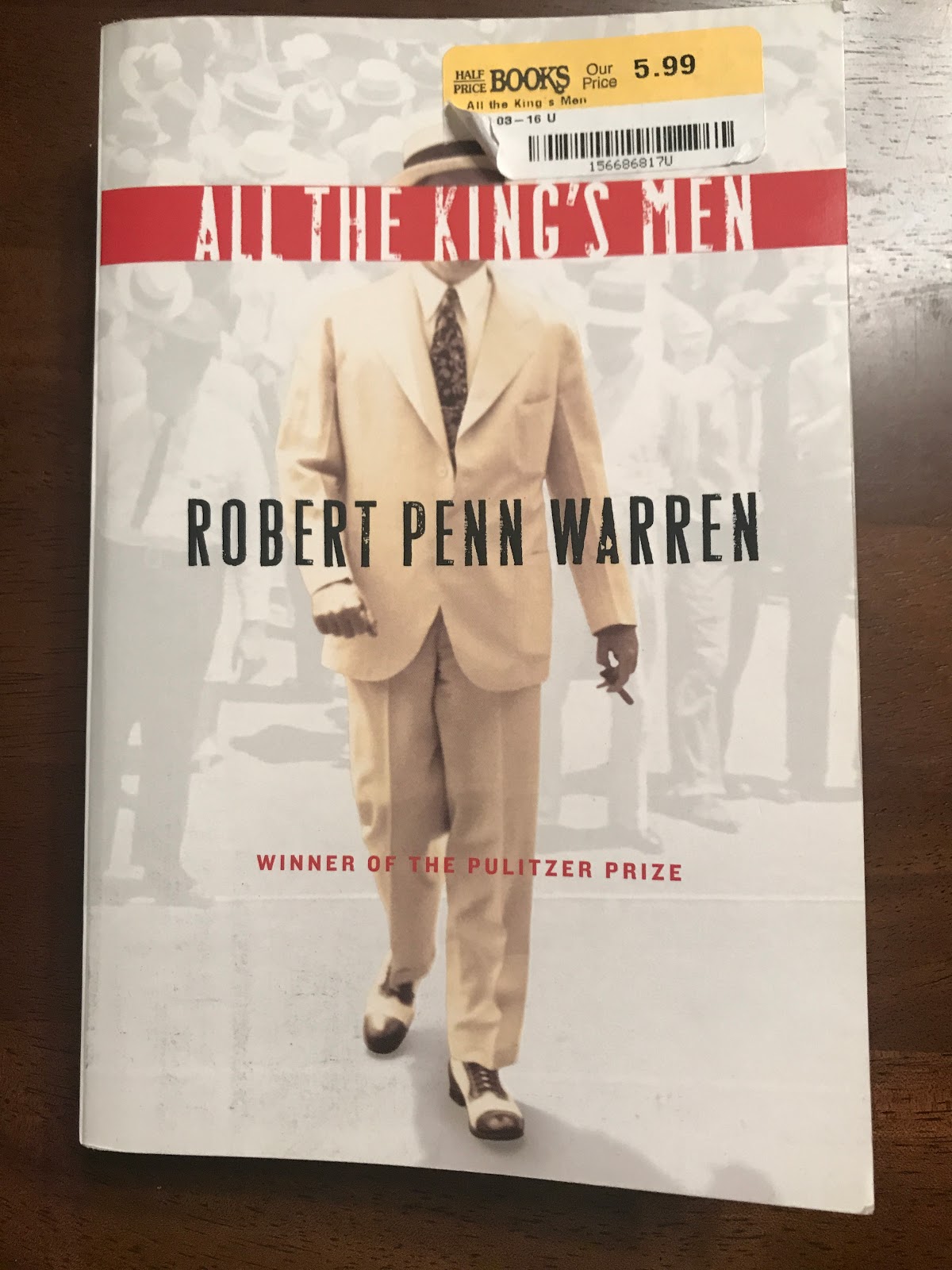
In storytelling, one of the oldest tricks in the book is to not give you much information up front, but to let details flow out slowly, over time. If done poorly, you lose interest and move on, but when done well, this gets you more invested than you might otherwise have been. This technique is done to perfection in Robert Penn Warren’s All the Kings Men. For much of the first part of this book, the reader knows very little. For awhile, we don’t even know much about the main characters, other than their names. We don’t know their motives, their backgrounds, their causes. But the little breadcrumbs that are dropped (almost miserly) are enough to keep us going, and by the time the real story gets going, nearly 200 pages in, we are hooked.
This book follows Jack Burden, a college dropout but an intelligent man, who works for the governor of the state, whom he refers to as “the boss,” Willie Stark. We learn more about Stark than Jack at first. Stark is a self-made man, coming from a humble farm. As governor, Stark excels in bullying his opponents and getting what he wants. He prefers not to bribe people, but to “bust” them, completely tearing them down. Because of his background, his cause is that of the common man, which makes him popular among the general population but doesn’t earn him any friends in the affluent and political circles. Even so, he pushes his agenda, which, for must of the book, is building a grand hospital that will cater to the poor, offering free services by top-notch doctors.
Whereas Stark is full of drive, Jack Burden seems to have none. He’s going through life fairly aimlessly, and follows Stark’s instructions to the T, no matter what they are. He is basically Stark’s go-to guy, whenever he needs to “get something done.” His devotion to Stark is driven home when Stark asks Burden to dig up dirt on Judge Irwin, a local celebrity with an impeccable record, but who happens to be opposing an upcoming vote Stark needs. Irwin practically raised Jack when his own father abandoned the family. While Burden does hope to find no “dirt,” he still does the job to the best of his ability. The betrayals don’t stop there, as Burden’s childhood friends, Adam and Anne Stanton, are also targeted by Stark in the course of the book.
This investigation by Jack is the driving force for much of the book, and tangents into his college days, his first love (Anne), and his failed marriage to another woman, provide incite as to what makes him tick. We also slowly learn more about Stark, including his marriage and constant infidelities. Everything comes to a head when Jack confronts Irwin with proof of a past bribe. Though it is ancient history and the only thing that would be hurt would be Irwin’s reputation, Irwin cannot accept even that, and kills himself. This finally shakes Jack, and even more so when he learns afterward from his mother than Irwin was really his father, and thus the reason that his mother’s husband left them when Jack was a child. The waves keep crashing down, as Burden finds out Anne has been sleeping with Stark, and Stark asks Jack to approach Adam to lead the new hospital. Even then, Jack still follows Stark.
If it sounds convoluted, it really isn’t. The book is well written, and while it does jump around quite a bit between past and present, it is easy to follow. The final, explosive conclusion is stunning, and comes completely out of left field. This book won the Pulitzer for the author in 1947 (he would win 2 more for poetry later on, the only person to have ever won Pulitzers for both fiction and poetry). The writing style is a bit different and it took me awhile to really get comfortable in the flow of words, but once in, I sped through the final half of the novel quickly. Willie Stark and Jack Burden are those kind of people that you really want to hate, for some of the despicable things they do, but I found myself continuing to root for both of them.

 Jons Movie Takes
One thought on “Corruption and salvation found in All the King’s Men”