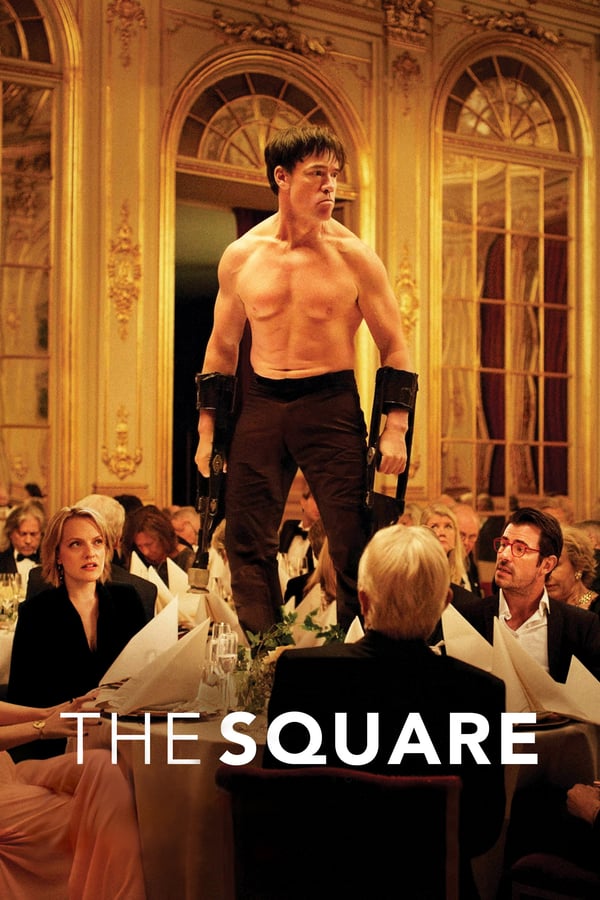
The Square is a quirky drama by director Ruben Ostlund, in the same way as his Force Majeure from a couple years ago. I just finished it, and I’m not sure if I like it or not. It is about Christian, a curator of a contemporary museum in Sweden. He loves his position of power and the money it brings too, which is in contrast to the local problem of homelessness shown throughout the film. Unfortunately Christian’s life is falling apart. First his phone and wallet are stolen, and when he uses “Find my phone” to pinpoint its location, he drops letters in every door in the building accusing them all of the theft. This obviously turns against him. At the same time, the advertising group promoting a new exhibit at his museum puts up a highly controversial video that goes viral, the fallback of which goes to Christian as the curator. In the midst of all this, Christian has a one night stand with a journalist, who sees that moment as much more than it is. These events and more circle Christian throughout the film, against the backdrop of the new exhibit, “the Square,” which is like a safe place people can stand in where all are equal and people help each other. The satire of course is that Christian walks by (and ignores) homeless people every day, and shows no empathy towards anyone else either. This film has a message about social equality regardless of wealth, but it doesn’t always hit on all cylinders.

Roman J Israel, Esq, is a rare miss for Denzel Washington. Denzel is the rare actor who, even when he plays a bad guy, you still root for him a little. It is hard to do that throughout this movie, even though he is a “good guy.” Israel is a hard-working lawyer who fights against social injustices, and has been his entire life, going back to the civil rights days. When his partner dies unexpectedly, Israel is hired on by a large firm, a group that Israel sees as nothing more than greedy vultures, but he stays because he needs the money. At that firm and among other people in his life, Israel inspires to do good deeds because of his ideals. But when Israel breaks with his ethics for a big pay day, he becomes the kind of person he’s always hated. He ceases to be a person to root for, and the film isn’t able to get back on track afterwards. A decent legal thriller, it has moments of intrigue, but lacks depth.

I generally liked Walking Out. You can tell it is low budget, but it is shot well, and is engaging. It is the story of a man in the wilds of Montana who is teaching his son all he knows about hunting. At first the young teenager misses his phone and technology, but he wants to get to know his dad, and is still at that age where pleasing Dad brings him joy. They set out at the end of hunting season for their first big game together, but things go very bad when they come across a couple wounded bear cubs and their protective mama bear. The movie seems to have been made by people who know what they are talking about, as the dad imparts good, true advice on the trek, but some of the dialogue isn’t very polished. It is well acted by the father/son duo though. A good film for outdoors-ey lovers.

Wonder is a beautiful film about a boy struggling to fit in due to facial deformities from a birth defect, but more than that, it is about acceptance. Auggie is going in to fifth grade, starting middle school, and since all kids will be starting a new school then, his parents, who have home schooled him to this point, decide to finally send him to school so he’ll have a chance to fit in more with the other new kids. Obviously there is no such thing as “fitting in” when you have something plain on your face that sticks out, and he is immediately targeted by bullies, and has a hard time making friends. The film looks at this, but also how Auggie’s life has affected those around him. His mother put off getting her masters to home school him. His sister has often gone forgotten and unnoticed by their parents, not for lack of love, just because they are always so wrapped up with Auggie’s needs. Though it is written at a level that young kids could (and should) watch for important life lessons, it doesn’t shy away from hard questions. At times heart breaking but ultimately uplifting, it is a supremely wonderful story.

BPM (120 Beats Per Minutes in France) is a fictional movie about the real-life ACT UP (AIDS Coalition to Unleach Power) group in Paris in the early 90’s, a group who was trying to get the word out about AIDS, and also trying to get the French government to do more for prevention. At the time, the general consensus was it was “the gay disease,” and while most of the people in ACT UP were homosexual, they also spoke up for heterosexuals, drug addicts, prostitutes, and prisoners, trying to make sure people had the facts on how to avoid becoming infected with HIV. The film follows quite a few people, people both “poz” and “neg” for HIV, and the director does a fantastic job of making it feel as read as gets. During demonstrations and peaceful protests, the camera stays on individuals for their actions and reactions. In between the action scenes, there are long stretches of just normal dialogue, the kind we all have in our everyday lives, which may or may not deal with the overall story of the movie. This lets us as the viewers really get to know the characters, which makes it even harder when they inevitably get sick or die. These activists fought for the rights of people with a terrible disease, many of them knowing it was too late for themselves, but hoping to make it better for those that came after.

 Jons Movie Takes
One thought on “Quick takes on 5 films”