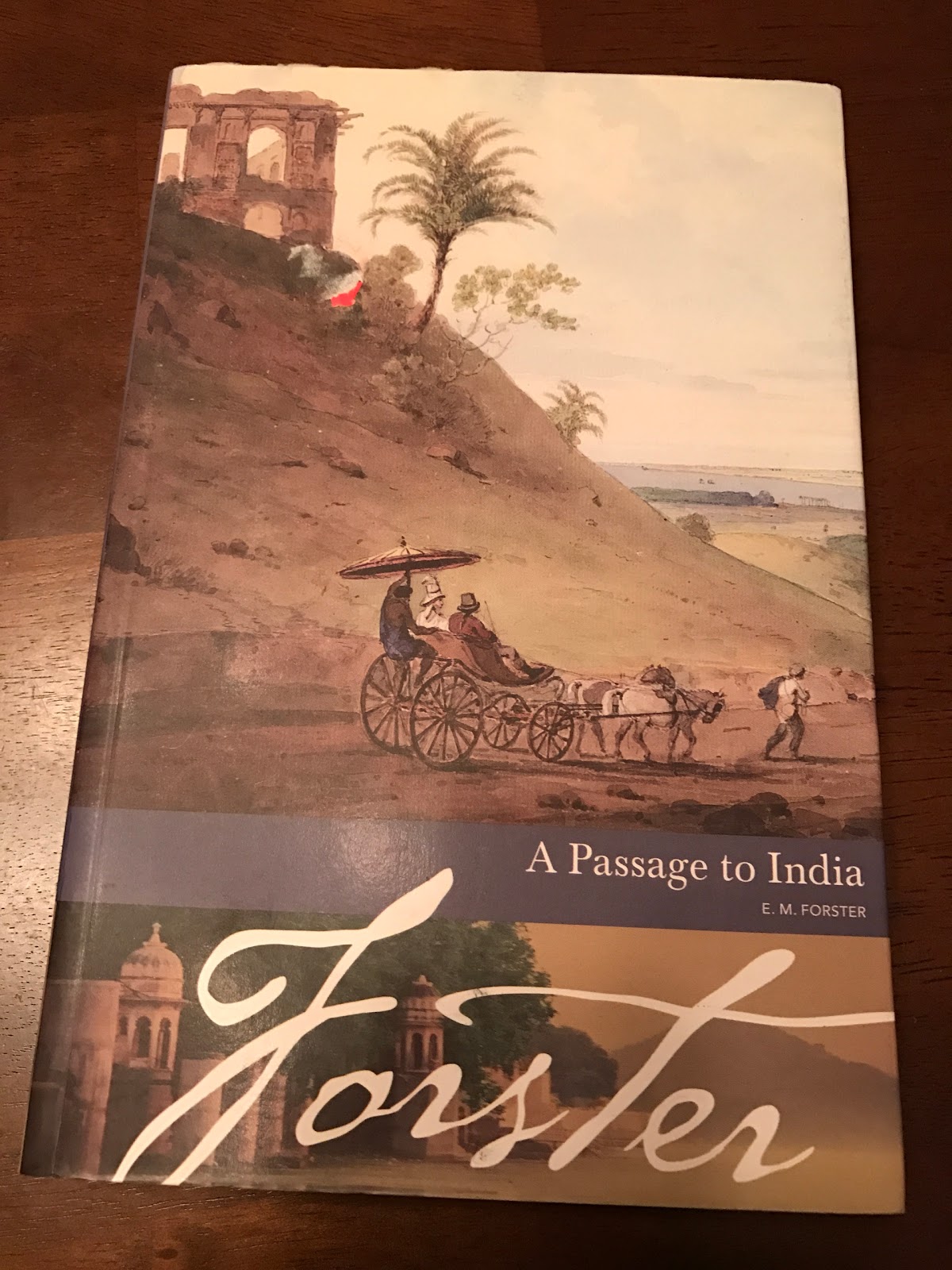
I enjoyed this E.M. Forster book more than the last. A Passage to India is engaging and thoughtful, even though it became a slightly different novel in the end than what I was expecting. Taking place during the British Raj in southern India, it is about the preconceived ideas England has of the Indian people, and likewise the notions India has for the English.
Aziz is a local doctor, popular among his people and good at his practice, but always kept at arms length by the “superior” English residents, even though he is a better doctor than their own. He runs into Mrs Moore, who is visiting her son Ronny, the local magistrate. Like most English, Ronny despises the Indians and thinks they are all crafty and trying to pull one over on everyone else. Mrs Moore doesn’t like India much either and can’t wait to get back to England, but she made the visit with Adela Quested, in hopes that Adela would marry Ronny. Aziz hits it off with Mrs Moore, and later Adela too, and promises to show them the real India that they can’t see when surrounded by the English. Aziz also soon befriends Mr Fielding, a professor at the local university who is the rare Englishmen who likes India and its people.
Aziz leads the ladies on a tour of the local caves, where Adela has a panic attack and claims to all that she was molested. Aziz, though innocent, is arrested and charged, and all of the underlying racial tensions in the area are brought to the forefront. Aziz hopes to use Mrs Moore as a character witness in his favor, but showing her true colors, she heads back to England, only to die in transit. At the trial, Adela admits she had startled in the cave and made the whole thing up, and Aziz is acquitted. He threatens to sue Adela for defamation, but Fielding convinces him not to. Both Adela and Fielding then take off back to England, and Aziz convinces himself that Fielding only held back Aziz so that he (Fielding) could still marry Adela for her money.
A few years go by. Aziz has washed his hands of the whole situation and moved to a new town. Fielding and his wife come to visit, and Aziz finds that Fielding did not marry Adela after all, but instead one of Ronny’s sisters. By the end, Aziz and Fielding laugh it off, and admit that they could be great friends, if only Britain did not govern India. They realize the racial strains on them will always cloud their thoughts of each other.
Published nearly 20 years after Where Angels Fear to Tread, you can see the changes in writing and style in A Passage to India. The former, while still well written, is choppy in spots, and Passage is much more descriptive and charming. Both took slightly different courses than I was expecting as the reader, which isn’t necessarily a bad thing, as both came off well in the end. The ultimate question of this novel, can two people of different backgrounds ever set aside stereotypical thoughts and become true friends, does get answered by the author, though I would hope we have come a’ways since 1924.

 Jons Movie Takes
2 thoughts on “Friendships examined in EM Forsters’s A Passage to India”