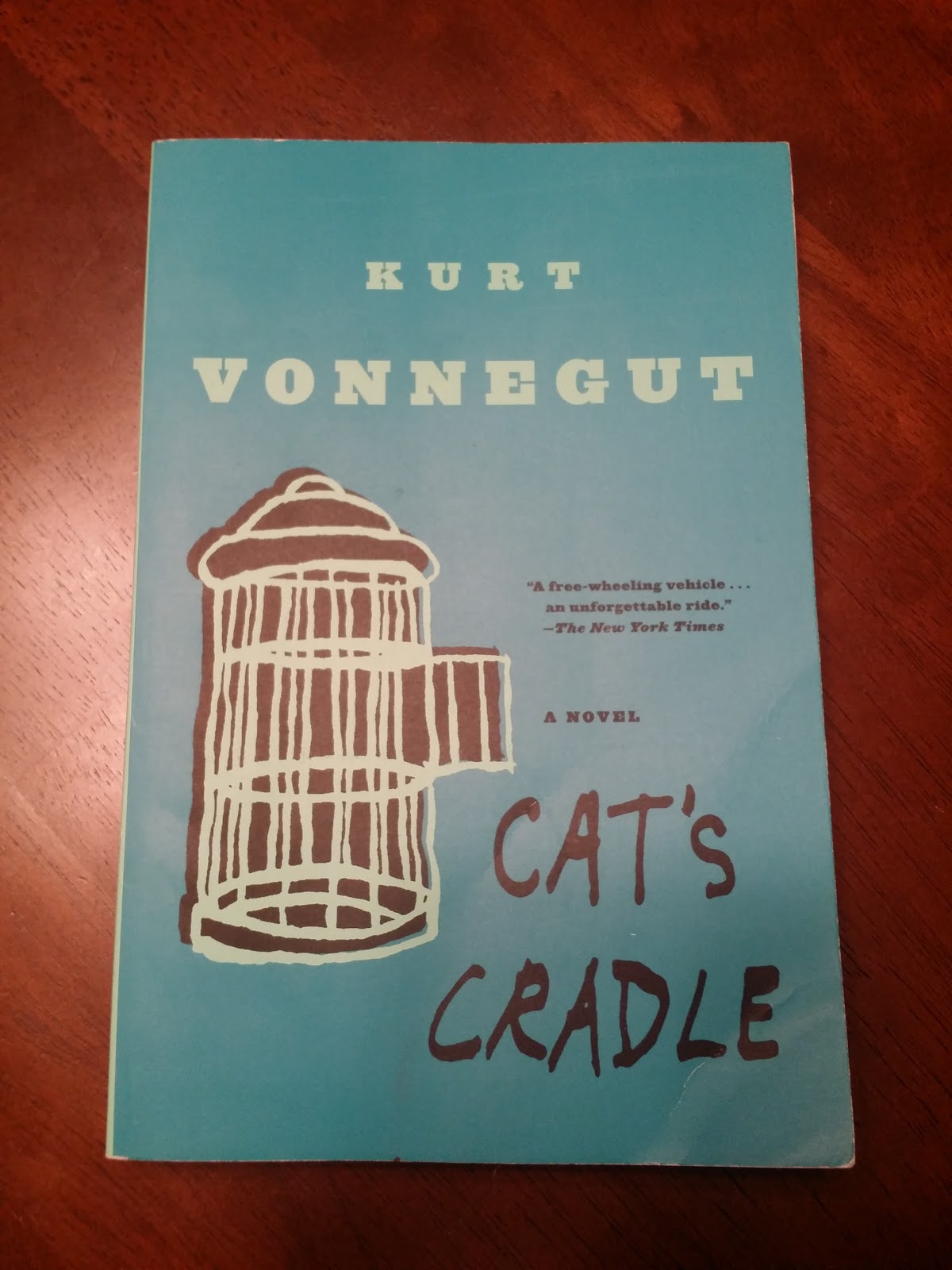
Cat’s Cradle was my first foray into the hugely popular Kurt Vonnegut. It is about what I expected, which is to say, not quite my kind of style, but I can see the appeal. It did however leave a strong impression on me.
The book is written in first person, with the narrator telling the story of when he set out to write his own book. He wanted to write about what Americans were doing on the day Hiroshima was bombed in World War II. For research, he sets out to find the family of one of the fathers of the bomb, Felix Hoenikker. Felix had died years before, and left three very peculiar children who are now very peculiar adults. Felix also supposedly left another more deadly invention called ice-9, a substance that turned any water it touched instantly to ice. A funny trick when using only a bowl of water in front of you, it would be deadly if it ever touched a river or ocean, as it would instantly spread to all other places that body of water touched (i.e. the whole planet). However, Felix’s living colleagues all agree ice-9 was just a myth.
When the narrator tracks down Felix’s oldest son Frank, who has set himself up as a military leader in the small fictitious Caribbean nation of San Lorenzo, he heads there and also runs into the rest of the family. We see just how crazy the kids are, as well as how outlandish the island nation is, in conversations in the second half of the book. There is more detail than I care to get into here, but suffice it to say, there is a weird religion that everyone follows, yet no one admits to. Before the end, the kids admit they do in fact each carry a piece of ice-9, which does indeed up getting out and basically destroying the world, leaving only a handful of survivors. The narrator contemplates mankind’s future on this desolate planet, and what got them here, as the book ends.
The manner of writing is very quirky and downright silly at times (think Wes Anderson, though obviously Vonnegut came long before). Having said that, there is depth and meaning in this book. Written at a time when the Cuban missile crisis very nearly wiped us all out, Vonnegut obviously looked at what could have happened if cooler heads hadn’t prevailed. I’ve read that in other books, Vonnegut focuses strongly on the idea of free will, and that certainly is strong here too, with Felix’s kids destroying the world basically because they did whatever they wanted to do in life, with little thought to the consequences. The book feels like it is going nowhere fast, for a huge portion, but when it shifts in the final 50 pages, it turns fast, and leaves you with a lasting impression and something to think about.

 Jons Movie Takes
One thought on “A light read with a dire warning in Cat’s Cradle”