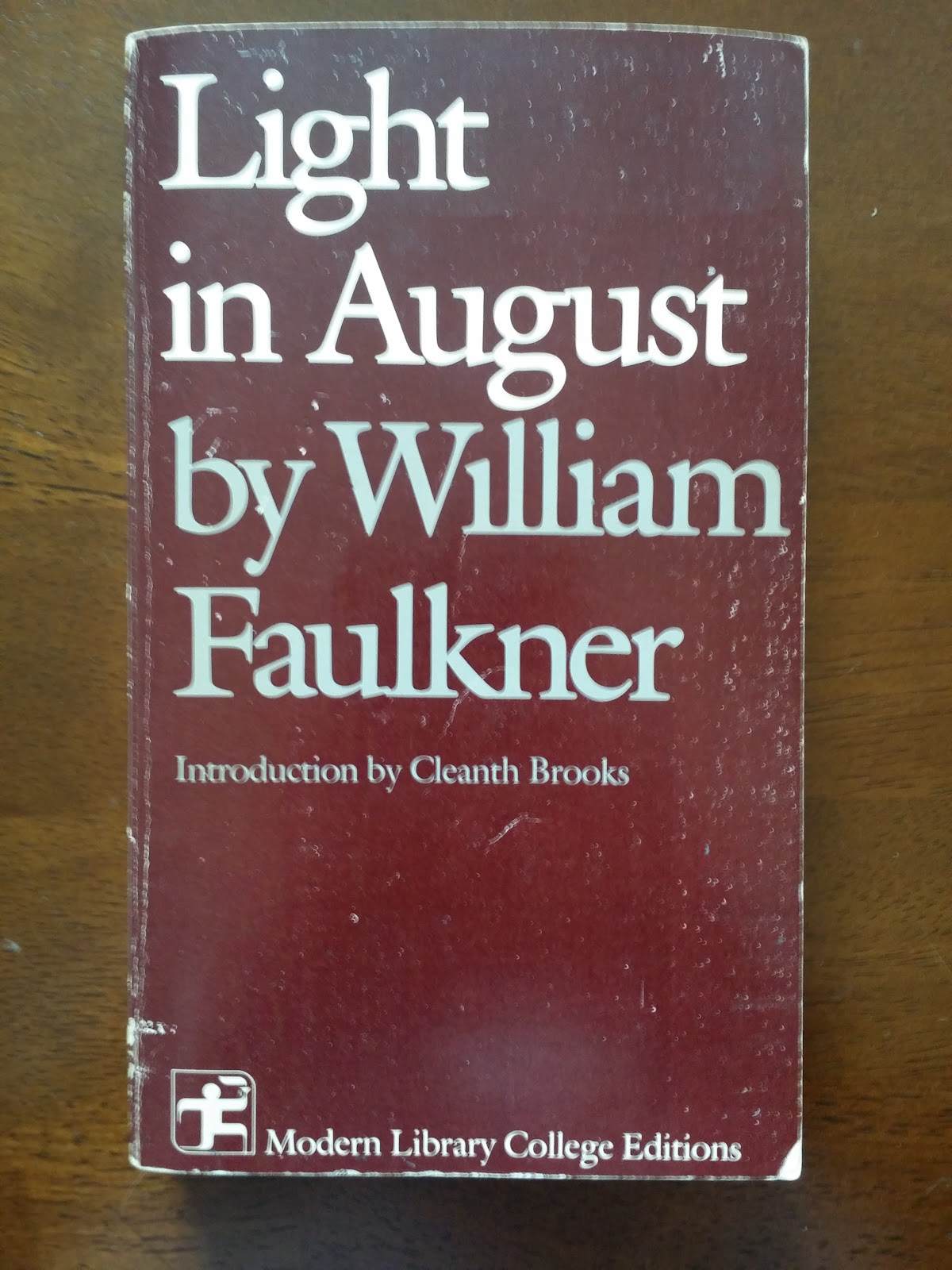
I’m going to chalk William Faulkner’s Light in August as a great book that I just don’t want to have to spend the time deciphering. There’s a lot going on, some of which Faulkner opts to share with us, other things he leaves for us to figure out, but all of it is told in a rather obtuse way.
It has basically 3 over-arching story lines, taking place in the south in the 1930’s. Lena is a young woman who has become pregnant by a southern rascal, Lucas Burch, who heads out of town upon hearing the news. She convinces herself that he is just coming up with money to marry her and build a family, and when he doesn’t show up as the baby’s date approaches, she sets out to find him. We also learn about Joe Christmas, an orphan who struggles with his heritage. Though he looks white, he believes he had a black father, which leaves him angry towards both races at different points in his life. He spents his first 25 or 30 years as a pretty awful person; picking fights, destroying lives, and not owning up to his sins. The third story is that of Hightower, a disgraced minister in the town of Jefferson, Mississippi. Through an unfaithful wife and a mental meltdown, he is a preacher without a congregation. Jefferson is where all the stories connect, as Christmas has settled here and Burch as well, who has changed his name to Joe Brown.
Lena finally comes to town in her search, meeting Byron Bunch, who recognizes her quarry based on Lena’s description of him. She arrives just as Christmas’s white lover is murdered (by Brown or Christmas we never learn), and Bunch sets Lena into a cabin to await her lover, even as he himself falls in love with her. When word gets out of Christmas’s heritage, he becomes the de facto target of the police search. The story gets stranger from there, with Christmas’s maternal grandparents entering the scene and Hightower becoming heavily involved before the end.
The book is obviously mostly about race, and how that affects our views of people (or at least, those views in the 30’s when the book was written). We’ve come a long way in many ways, but not so far in others. My only problem is sometimes the characters’ actions don’t make much sense, from a reader’s (outsider’s) perspective, or even in context within the lines of the novel. Whereas my previous read captured my interest and made me want to ponder the interweaving plots and subplots, I mostly just wanted to move on from this book.

 Jons Movie Takes
One thought on “Muddled plots and characters in Faulkner’s Light in August”