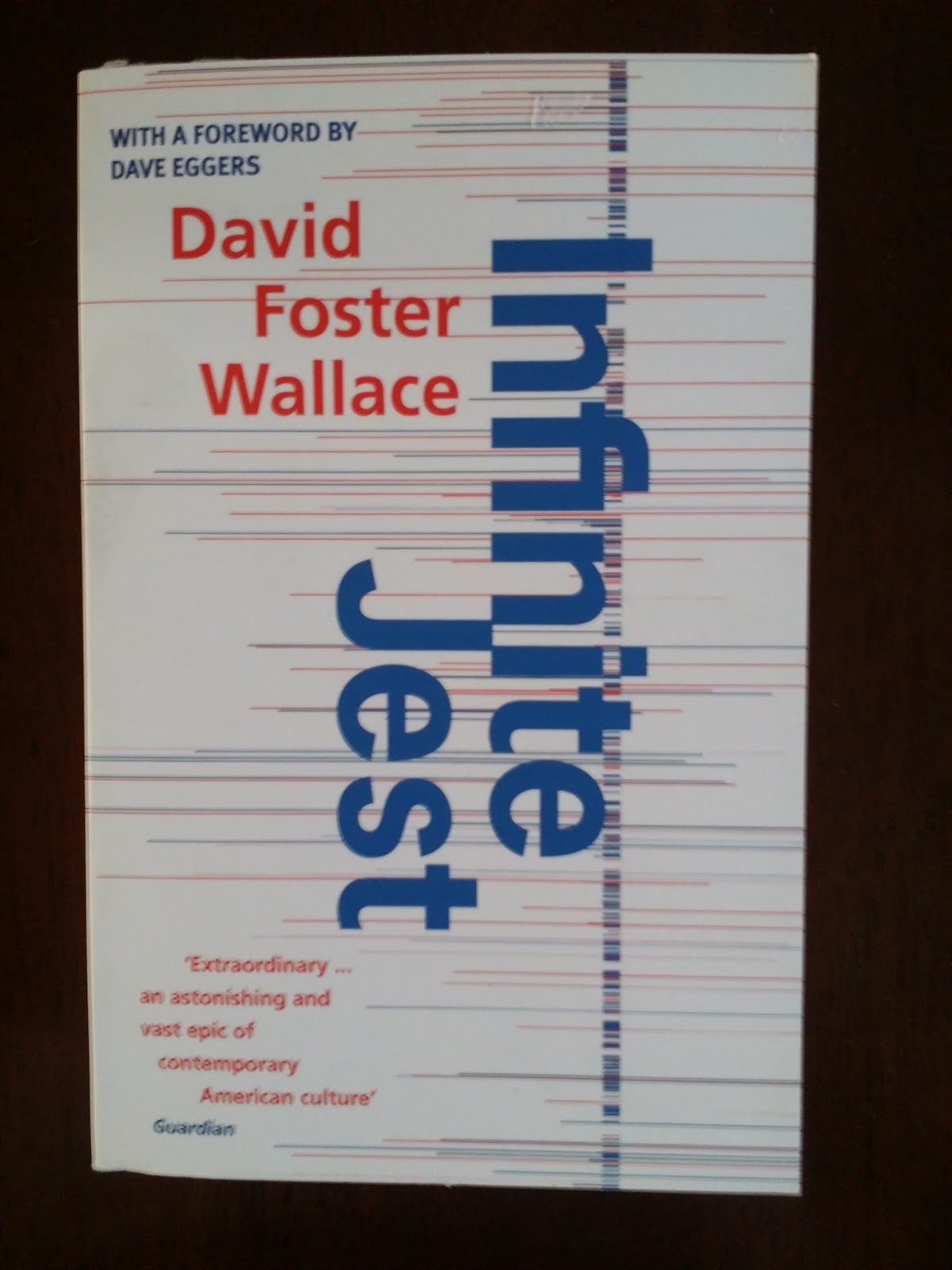
I’ve finally just finished David Foster Wallace’s Infinite Jest. Took me a solid 4 weeks to read this one, and I’m not a slow reader. Coming it at over a 1000 pages (plus endnotes, and sometimes endnotes on the endnotes!), and an often convoluted narrative, it isn’t the easiest read, but it is well worth the journey. It is an absolutely brilliant work, I think one of the truly great novels of the last half century.
This will be a very different kind of synopsis, because I won’t say anything about the book at all. Much of what makes this book exciting is a series of plot revelations. There are big shifts in the story, and sometimes plot elements you thought were maybe going nowhere, end up being vitally important to the overall story. So while I won’t be saying anything about the story, I’ll instead write a little about where (I think) it came from and its lasting appeal.
I was first turned on to this novel from a film I saw last year, The End of the Tour, which was biographical about the author’s life just after this book was published. That movie was great, and it made me very curious about this book that was being applauded so heavily at the time it came out. In fact, when I had about 100 pages left in the book, I went back and re-watched the movie, and I got a very different feeling from it after having read most of the book now. Wallace was (he committed suicide in 2008) very introverted and obviously highly intelligent. He admitted to having an addictive personality (and many forms of addiction play a heavy role in Infinite Jest), but he also (in the movie) talks about people being spoon-fed entertainment and just taking it without thought or perspective. “The Entertainment” is also key to this novel.
So what does Wallace do with his ideas about entertainment and addiction? He writes this novel that leaves much to the reader to come up with their own conclusions. If you google reviews, most negative reviews rant that the ending is too sudden and leaves too much open to interpretation. I feel that is exactly what Wallace wanted. And really, the answers are all there if read carefully and in-between the lines, though a lot of it is easily missed because parts might be buried in drug-induced ramblings or dream-like hallucinations. I tend to think that even though the book is hefty and long, there really isn’t much in there (if anything) that doesn’t deserve its place. Many times seemingly innocuous passages end up having a strong impact on the reader’s understanding of how it all fits together, even though you might not know it at the time. Which means re-reading the whole damn book again (which I will be doing some time in the next year, while it is still fresh in my mind). So that takes me to my final observation.
Wallace wants us to grow with his novel. He wants us to think for ourselves. He does give us all the keys to understand Infinite Jest, but he doesn’t just map it all out for us, and sometimes doesn’t even show us the doors that those keys open. It is up to the reader. Having read it, I googled interpretations of the ending, and there are many, and what was beautiful about the whole experience, my own was not in the majority. I think Wallace would be ok with that too.

 Jons Movie Takes
One thought on “The brilliance of a modern classic in Infinite Jest”