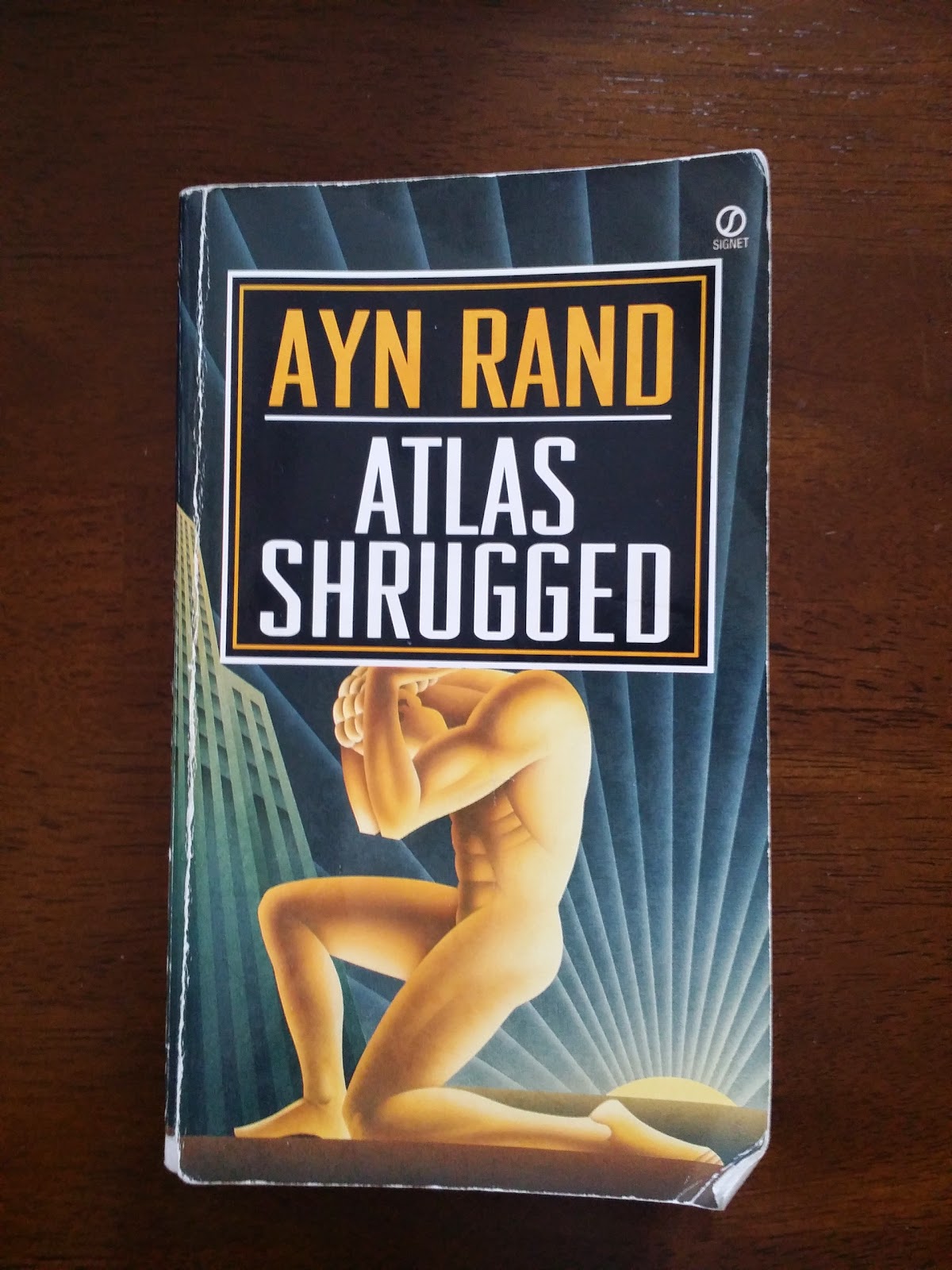
Who is John Galt? That is the opening line of Ayn Rand’s Atlas Shrugged, and the key question for most of the novel. The answer is much more than it seems.
Rand was born in Russia in the early 20th Century, and was a teenager during the revolution that overthrew the Russian Empire and set up the soviet state under Lenin. These changes had a profound impact on her, as evidenced by Atlas Shrugged. The backdrop for this novel is the advancement of “People’s States” across the world. Countries have decried wealth and knowledge. Successful businessmen are targetted as being greedy and unsocial, and told that they must share their wealth with the poor and unable (or unwilling) to work. Free thinkers and philosophers have been replaced with a new school of thought, which denounces profit-making and advanced thinking, and says that people should not think on their own, but should only do what they are told. The USA is one of the last democratic nations where people can still own their own businesses and make decisions on their own, but it too is under attack from within by these new schools of thought. People across the country are either clambering for a high paying job, yelling “I deserve it as much as the next guy!” or giving up, saying simply in a “shit happens” sort of way, “Who is John Galt?” No one seems to know what this means.
The book follows Dagny Taggart. She is the heiress of Taggart Railroads, and an old school businesswoman who only works for profits. As a woman she cannot be head of the company, so she is the operating vice president, while her brother Jim is the head. Jim is definitely of the new school of thought, wanting to give jobs to those in need, whether they are qualified or not. He sees the writing on the wall and is setting up strong political friends in Washington. Dagny’s childhood friend and one-time lover is Francisco d’Anconia, a rich playboy who seems to be only interested in frivolously squandering the millions he inherited in his family’s multi-generational copper mining business. While the railroads (and all industrial businesses) are failing due to incompetent workers replacing the more qualified, Dagny is trying to keep her company afloat. It seems she will be saved in time by Hank Reardon, a steel company owner who has invented a new type of steel that is stronger, cheaper to make, and more durable. It isn’t long before the government steps in and ruins this though, by saying it isn’t fair for Reardon Steel to corner the market on this new invention, that he must share his patent with all the other steel companies, and so he doesn’t make more profit that anyone else, all the plants must produce an equal output and sell at the same prices. At the same time, Taggart is beset by other railroad companies yelling for equal ride-time on her rails and profit sharing. In this way, all the companies across the country are failing together.
Hank and Dagny become close and eventually lovers, as they keep struggling to keep their respective companies, and their own little corners of the country, from collapsing, despite everything the politicians throw at them. Across the country, the best of the best, including successful business owners, intelligent engineers and scientists, etc, are throwing up their hands to the changing system and simply disappearing, but Hank and Dagny keep fighting. Francisco reveals his ulterior motive, that he has created the playboy image to keep the countries around the world from taking a closer look at his business management, and he has purposefully been self-sabotaging his copper business into the ground. On the morning when the Chile government is to announce they are nationalizing his copper mines in that country and taking them over, they realize the mines have all ready been emptied or exploded and buried, with workers being paid basically to look busy for years. Francisco tells Dagny he is part of a group that is speeding along the collapse of the world, so that when every country has failed, the world can be rebuilt properly from the ground up.
Dagny refuses to join Francisco’s cause, and will go down with the ship it seems. While exploring an old abandoned factory with Hank, she finds a rusting old motor, built upon technology she has never seen. It seems it can run on electricity pulled from the atmosphere around it, so it doesn’t need fuel and is completely self sustaining. Unfortunately it is incomplete, so she finds one of the world’s last remaining engineers to try to rebuild it, while at the same time going on a mission to find its creator. Going from the previous company’s owners, to managers, to employees, she is able to piece together the story of the inventor of the motor. He was a young man that completed it just before the company went “social.” When the company started paying all people equally, and awarding bonuses not to those that worked harder or achieved more, but to those who were in greater need (new baby, broken leg, whatever it is), the young man walked out and was never heard from again. His name, of course, was John Galt.
Turns out John, Francisco, and Ragnar Danneskjold (a pirate who has been harassing government ships off the coast for a decade, stealing all the gold and sinking anything that could help each country), were all college friends. They saw the way the world was headed and developed a plan to help it along its way, so that one day again value would be put on real intelligence and the advancement of technology, not just the giving out of alms to “looters.” The three have been secretly approaching businessmen and scientists, and getting them to disappear to a hidden, self-reliant city in the Rocky Mountains. Hank and Dagny are also approached, but they cannot let go quite yet, so they continue to try to prevent the inevitable. When Hank’s plant is attacked and looted because he would not cooperate with the government, he finally gives in himself and disappears. John Galt sends out a radio broadcast for all to hear, with his manifesto for the coming collapse and telling people that they brought it on themselves, but the end will only be a new beginning. Shortly after, he is captured. The government tries to force him to help the situation, while he refuses, saying there is nothing he can do in the way they want help. Society is in full de-evolution by this point, with riots in some parts of the country, states declaring secession in others. The final trans-continental railroad collapses, cutting off coast-to-coast travel and setting off a panic in New York, where the population will starve without food from the midwest. After being tortured, Galt is rescued by Francisco, Ragnar, Hank, and Dagny, who finally is ready to join their group. As their escape plane is flying over New York, the lights in the city go out as the power plant fails. One of the final scenes is a train sitting idly on abandoned tracks in Arizona, as a horse-and-buggy crew offers to take the strandoned passengers to a neaby settlement. Technology and organized government has finally completely collapsed.
This has the feel of an epic, dystopian book. Coming in at over 1000 pages, it is a long read, but a good one. Rand considered it her ultimate achievement and showed most clearly her philosophical idea of objectivism. Though she continued to write non-fiction books about her ideas, I don’t believe she ever wrote another novel after Atlas Shrugged. It isn’t for casual readers and it does get a bit bogged down by long philosophical speaches by its protogonists, but it is clevely written and is much more than just a work of fiction.

 Jons Movie Takes
One thought on “The world falls apart in Atlas Shrugged”