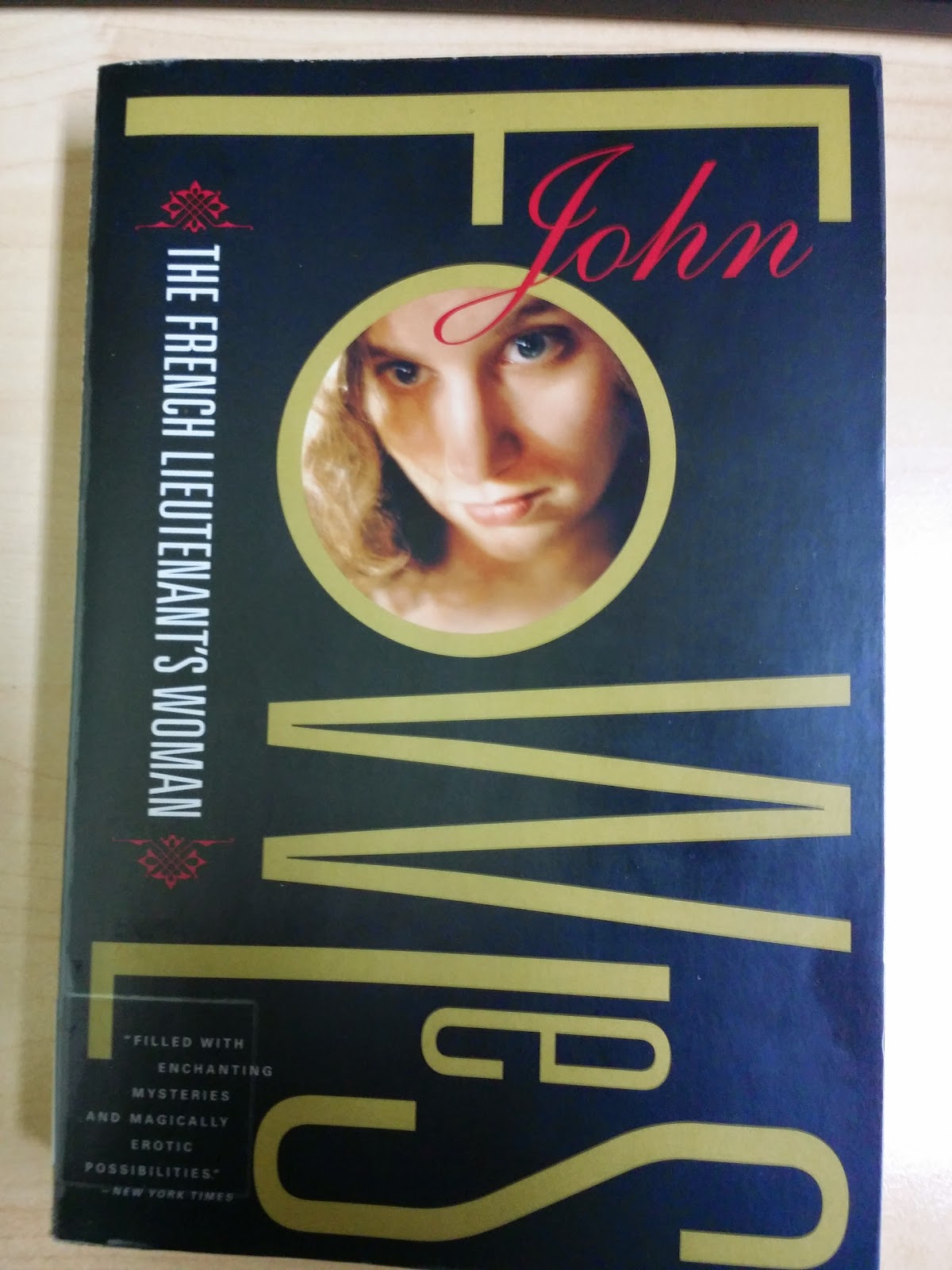
On my quest to read through this list of “100 Great Novels” I knew I’d find at least a few I didn’t much care for. I finally found one at # 8, The French Lieutenant’s Woman by John Fowles. It’s not a terrible novel and is obviously well thought of, but it isn’t my cup of tea.
As a reader, I like to immerse myself in the book I’m reading. I like to think that what I’m reading can exist in another world, that I see the characters as real beings. Even the most outlandish sci-fi can come to life in my mind and be real when I turn the pages. In Woman however, we are told early on by the writer (in first person) that it is a work of fiction and he is but telling a tale. Fowles even goes so far as to change his story here and there, where he will write a chapter or two, and then in Clue-like fashion say, “It may have happened like that, or it may have happened like this.” In this way, it is hard to truly care for characters that you can’t even envision as real. Furthermore, he treats this novel almost as a conversation he is having with the reader, or a point of debate (obviously a one sided debate as you cannot discuss with him, just hear his point of view).
The plot follows Charles, a mid-19th century entitled rich man in Victorian England society. He is wealthy to a point, but is in line to inherit much more when his heir-less rich uncle will die. Charles is engaged to Ernestina, daughter of a “new money” family who’s merchant father is looking to raise her to a higher society. They are wintering in the small town of Lyme, where Charles comes across the “French Lieutenant’s Woman,” Sarah. Sarah is a depressed for having been spurned by a marooned French soldier who she says she deeply loved. Charles is immediately moved and over the course of the novel, grows to have feelings for Sarah. After a book full of hand wringing and deep introspection, during which his uncle marries (thus leaving Charles out of his inheritance), and some minor revelations about Sarah, Charles finally decides to leave his betrothed. By this time Sarah has left too. When he finally finds her a couple years later, she seems to only wish to enjoy her misery.
This book is at times esoteric, with Fowles becoming very philosophical. He will spend whole sections of chapters discussing the meaning of thoughts and ideas, some that seem to only superficially pertain to the story at hand. He is obviously well read and a deep thinker, and while I do like a book that makes me think, sometimes I just want to be engaged in a good plot.

 Jons Movie Takes
2 thoughts on “Characters fail to come to life in The French Lieutenant’s Woman”