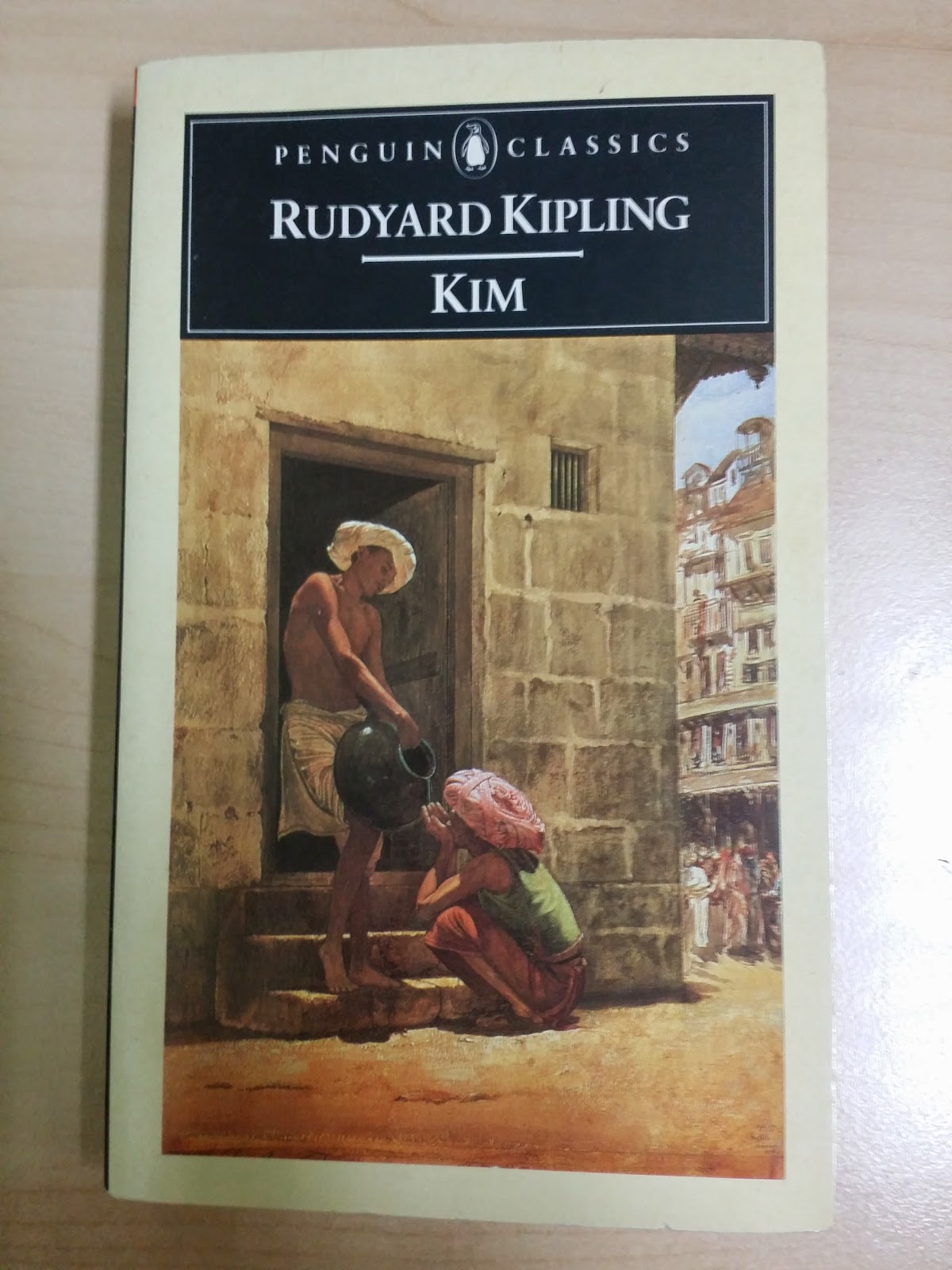
Rudyard Kipling’s Kim was published in 1901, and is titled for the main character. Kim is a young man in India, about 13 or so. His parents were Irish, but both died when he was very young, so he has raised himself on the streets and is so ingrained in the local customs that he is able to blend in seamlessly.
The book opens with him helping a Tibetan lama, or holy man. Kim begs for food for him and immediately is attracted to his cause. The lama is on a holy quest to find a sacred river with healing properties. Kim decides to join along, and is promptly given the title of chela, or disciple. On their way out of town, they are aided by Kim’s friend Mahbub Ali, a successful horse-breeder and trader. When Mahbub’s camp is raided by unknown spies, Mahbub sends Kim off with a note, a coded message, to deliver a couple towns over. Kim does so, and eavesdrops afterwards to realize the note was a warning of an impending troop deployment in the ongoing conflict between British and Russian forces, who have been opposed for decades over the land in Afghanistan and India.
Shortly after leaving the village, the duo comes upon a British regiment. Once Kim’s ancestry becomes known, they take him under their wing to raise him as a Sahib (Arabic for holder or master, but in this book really means any Euro- or Russian- caucasian). The lama is amazed Kim is actually British, but now that he knows he wants him to be educated as such, agreeing to pay the fee for a good school for Sahib children. Kim is reluctant at first, not wanting to be taught English math and writing, skills he sees as useless, but he is approached by Mahbub again, and initiated into “The Great Game.” Because Kim is fluent in the local customs across India, but has a British background, he is going to be taught how to be a spy for the British government, which Mahbub has been all along.
For the next 3 years, Kim is educated in English skills in school, but spends his holidays learning from Lurgan Sahib, a master spy. Here he trains his memory, and how to disguise his look and speech to blend in no matter what region he is in, and from fellow spy Hurree Babu, about medicines. Finally he sets off from school and rejoins the lama on his quest, who is unaware of Kim’s new career. Several rapid adventures happen in succession, culminating when the pair inadvertently come across a couple Russian spies for the other side, who Babu has been guiding while waiting for the right moment to steal their papers. A conflict sets off, which leaves the lama sick in spirit (he gave in to anger, putting him “off his path,”), and the Russians’ papers in Kim’s hands. He slowly treks the ailing lama south, growing physically weaker himself with fatigue and illness, until they finally collapse.
When he comes to a few days later, he finds Babu has caught up to him. Babu looks through the papers and finds they are very important, detailing Russian spies and movements, and future plans. He congratulates Kim on his work and agrees to meet him when he returns to town. Kim also finds the lama is restored, he has found his spiritual awakening, his “river” that he has been seeking this whole time, and promises to now impart his wisdom to Kim. The novel ends not knowing what Kim will do, if he will go to town to immerse himself as a full time spy, if he will follow the lama on a spiritual quest, or if he will continue to try to do both.
This was a fascinating book to read. It is extremely detailed, as the reader I was fully immersed in the Indian customs, lifestyles, and view of life. Kipling is so matter-of-fact about things that are so foreign to me as an American, that you really feel at ease in the culture. The caste system is on full display, showing Kim’s reactions to different people solely based on where they are from. The entire way of life is different, from how certain groups are treated, to how beggars are tolerated, to their speech, which is full of metaphors and colorful descriptions. It is a very rich and fulfilling read. While Kipling’s The Jungle Book will forever be what he is most known for, Kim is an engrossing and mesmerizing tale.

 Jons Movie Takes
2 thoughts on “The Great Game shown in a close view in Kipling’s Kim”