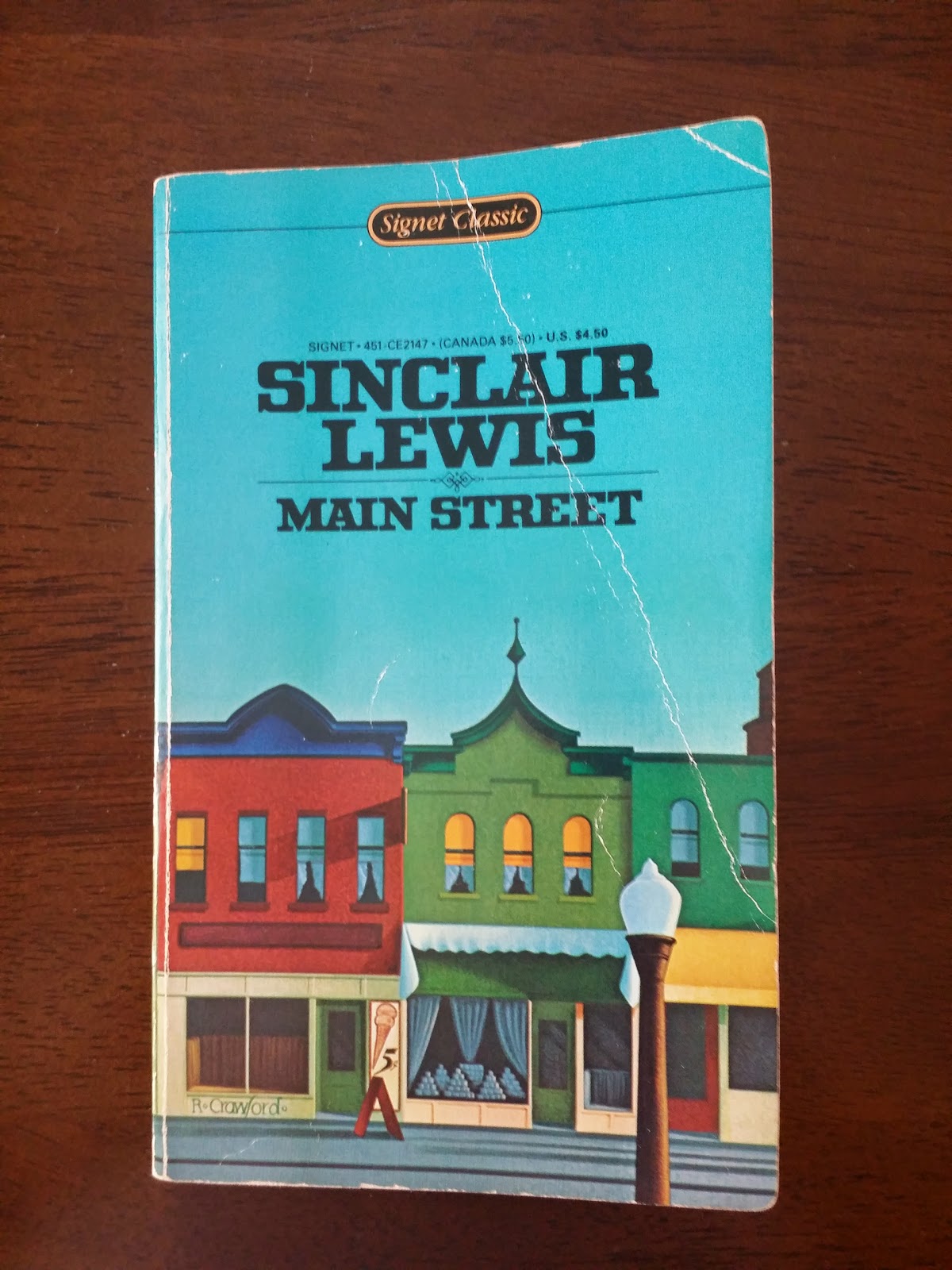
Main Street is a good old piece of Americana. Written in 1920 by Sinclair Lewis, it (with his followup Babbitt) was largely responsible for him winning the Nobel Prize in literature 1930. It is a satirical look at rural towns in America in the early 20th century. It focuses on Carol, a strong willed city-born girl with big ideas and big expectations, who marries the local doctor from Gopher Prairie, MN.
For the backdrop: in the late 19th and early 20th centuries, cities were growing at a near unsustainable pace, some doubling in size in just 10 years. In fact, the 1920 census was the first to show nearly the same number of people now living in a city as in the country, for the first time in our nation’s history. As such, there was sort of a romantic idea going around of “the simple life” away from the urban areas, the way “it used to be.” Lewis wrote Main Street to sort of shoot down those wistful ideas.
Carol is fresh out of college in 1911 or so. She falls for Will, a doctor some 10-15 years older, and marries him pretty quickly. He brings her back to Gopher Prairie, which she immediately hates. She sees the dirty small town as needing not just a facelift, but a total demolition and rebuild, and envisions a quaint Main Street where the houses are all pretty and in neat little rows, where the citizens attend plays and discuss the latest forward-thinking novelists and writers. Of course in reality, and locals just want to know who bought the latest automobile, and have you seen Sam’s new fence, and the ladies just want to gossip about who is being scandalous.
The first fully half of the book (and it is not a short book) does feel tedious at times, as Carol rams her head repeatedly against the norm, and nothing comes of it. She tries to get the ladies club to read more advanced literature and is shot down. She tries to produce a play which is an utter failure. She tries to advance her husband out of love and respect, but he stays true to his upbringing and while he wants to be the husband she desires, he can’t change who he is. Carol ends up feeling very alone and isolated. When she does find a true friend (in itself scandalous, a foreigner with a socialist-idead husband and baby), the wife and baby die suddenly of typhoid. She then latches on to person after person to liven up her dreary life, but each is taken from her in bizarre ways. Because the first half of the book was slow and dreary (like her life), when these events happen in the second half, they are all the more riveting (I actually gasped aloud while reading, when things occurred suddenly).
Finally Carol has had enough. She takes her one son and moves out from her husband to Washington DC. Here the book almost fast forwards. Before, we heard every detail of Carol’s monotonous life, and before we know it we are 2 years further down the road. Carol has become pregnant again (the book never says if she was unfaithful, or if this was due to Will’s visits to DC). Either way she is discussing her future with friends there, and decides to finally move back home. She accepts her mundane existence in Gopher Prairie, but finally has a way to change it. She latches on to her 2 children, promising herself that she will raise them to be aware of the world outside of their small town, so that when they are grown they will not be like all the others coming from Main Street.
This was the first book I’ve ever read from Sinclair Lewis, and I must say he is an extremely detailed writer. His depictions of Gopher Prairie are so precise, you can smell the oil, feel the dusty wind, hear the idle chatter. The way he wrote of Carol’s inner struggle, penning her thoughts for us to read and then following up with her actual words, keeps the reader aware constantly of the fight going on inside her. For me it was also fascinating to read a book written nearly 100 years ago. We joke about it now in society, but even then the “head of the house” was often the woman, who set forth what the family would do and the husband sort of trailed along. The local town leaders would get on their soapbox and talk about how these forward-thinking women, with their ideas about women’s suffrage, would be the downfall of our society, and then step down to see what their wife wanted them to do that evening. A very good read, though definitely not for the impatient.

 Jons Movie Takes
One thought on “Living the quiet life in rural Main Street”