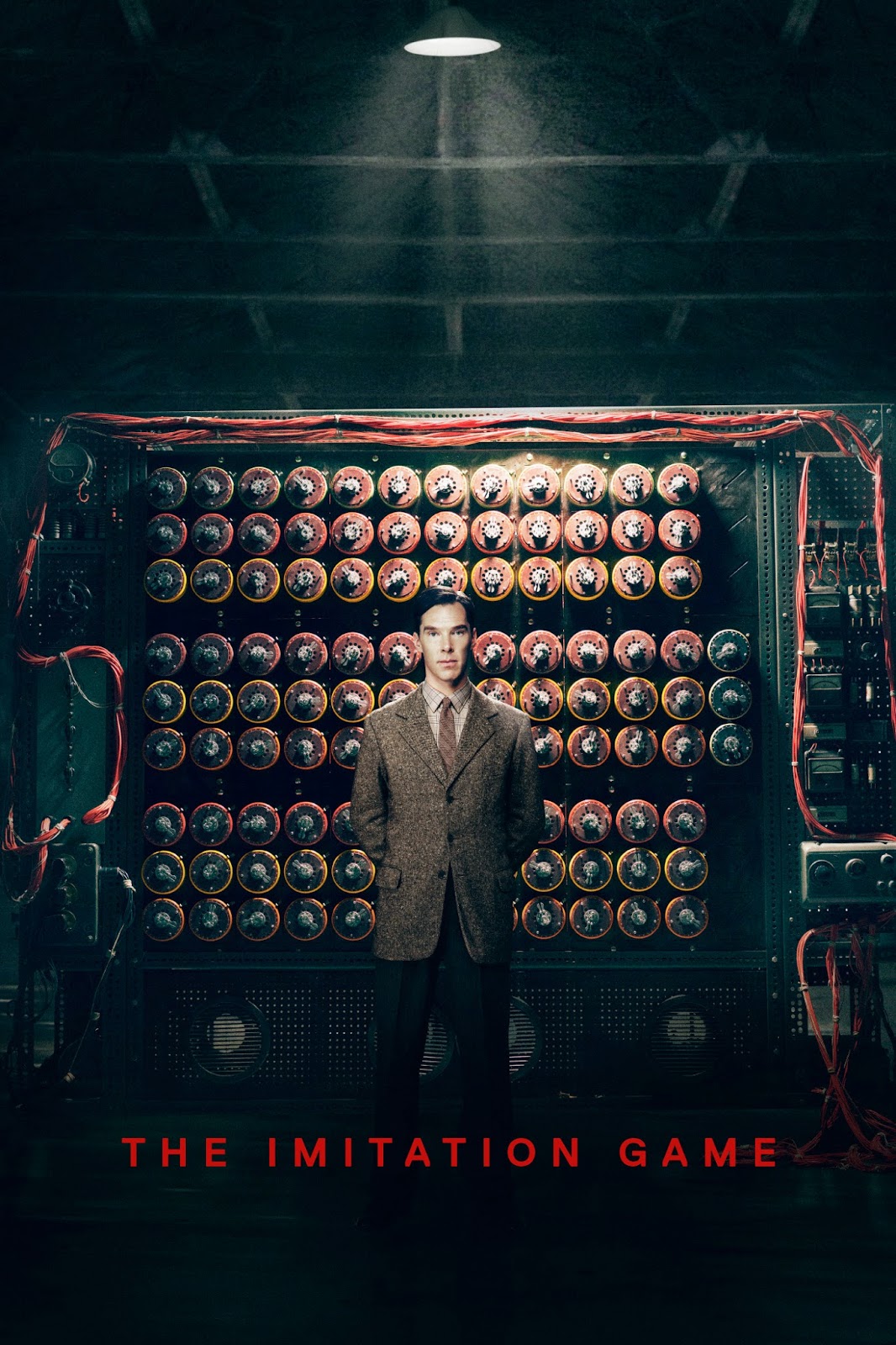
The Imitation Game is the best movie I’ve seen since Birdman, and easily a top 5 for me for the year. It is the engrossing story of Alan Turing, portrayed brilliantly by Benedict Cumberbatch. Turing is an English mathematician who, with a top secret team of geniuses, was tasked with breaking the German enigma machine during World War II. He was a man with a lot of personal and professional issues, but he went on to be one of the leading founders of computer science.
The movie takes place over three windows in time. We start with Turing in the 30’s. He is shown the German enigma, a code-making machine that no one has been able to crack, due to it being capable of 159 million million (a whole ton of zeros) configurations. And every night the Germans reset it to a new scenario. The team spends every day trying to crack just one message, but ultimately fails again and again. Turing knows it is a losing proposition, so he theorizes a machine that can calculate the algorithms faster than a human possibly could.
We also see Turing in flashbacks as a young teenager, struggling with other children due to his (undiagnosed, obviously due to the time in which he lived) Autism or Asperger’s. He doesn’t pick up on social cues and is awkward. He is having a hard time dealing with his own homosexuality, in a time with it was not only frowned upon but illegal. We also see moments after the war, in the early 50’s, when Turing has been apprehended for his lifestyle.
The film is brilliant, not only for the incredible odds Turing and his team (among them Joan Clarke, played by Keira Knightley, a woman trying to do a “man’s job”) overcame, but for the heart wrenching ordeal he had to go through in his life. And being a 2 hour movie, it could only tell so much. I’ve been reading about him the rest of the day since, and it is remarkable that his life has stayed out of the mainstream consciousness. See this movie, it will open your eyes and your heart.

 Jons Movie Takes